PSA to all you fantasy writers because I have just had a truly frustrating twenty minutes talking to someone about this: it’s okay to put mobility aids in your novel and have them just be ordinary.
Like. Super okay.
I don’t give a shit if it’s high fantasy, low fantasy or somewhere between the lovechild of Tolkein meets My Immortal. It’s okay to use mobility devices in your narrative. It’s okay to use the word “wheelchair”. You don’t have to remake the fucking wheel. It’s already been done for you.
And no, it doesn’t detract from the “realism” of your fictional universe in which you get to set the standard for realism. Please don’t try to use that as a reason for not using these things.
There is no reason to lock the disabled people in your narrative into towers because “that’s the way it was”, least of all in your novel about dragons and mermaids and other made up creatures. There is no historical realism here. You are in charge. You get to decide what that means.
Also:
“Depiction of Chinese philosopher Confucius in a wheelchair, dating to ca. 1680. The artist may have been thinking of methods of transport common in his own day.”
“The earliest records of wheeled furniture are an inscription found on a stone slate in China and a child’s bed depicted in a frieze on a Greek vase, both dating between the 6th and 5th century BCE.[2][3][4][5]The first records of wheeled seats being used for transporting disabled people date to three centuries later in China; the Chinese used early wheelbarrows to move people as well as heavy objects. A distinction between the two functions was not made for another several hundred years, around 525 CE, when images of wheeled chairs made specifically to carry people begin to occur in Chinese art.[5]”
“In 1655,Stephan Farffler, a 22 year old paraplegic watchmaker, built the world’s first self-propelling chair on a three-wheel chassis using a system of cranks and cogwheels.[6][3] However, the device had an appearance of a hand bike more than a wheelchair since the design included hand cranks mounted at the front wheel.[2]
The invalid carriage or Bath chair brought the technology into more common use from around 1760.[7]
In 1887, wheelchairs (“rolling chairs”) were introduced to Atlantic City so invalid tourists could rent them to enjoy the Boardwalk. Soon, many healthy tourists also rented the decorated “rolling chairs” and servants to push them as a show of decadence and treatment they could never experience at home.[8]
In 1933 Harry C. Jennings, Sr. and his disabled friend Herbert Everest, both mechanical engineers, invented the first lightweight, steel, folding, portable wheelchair.[9] Everest had previously broken his back in a mining accident. Everest and Jennings saw the business potential of the invention and went on to become the first mass-market manufacturers of wheelchairs. Their “X-brace” design is still in common use, albeit with updated materials and other improvements. The X-brace idea came to Harry from the men’s folding “camp chairs / stools”, rotated 90 degrees, that Harry and Herbert used in the outdoors and at the mines.[citation needed]
“But Joy, how do I describe this contraption in a fantasy setting that wont make it seem out of place?”
“It was a chair on wheels, which Prince FancyPants McElferson propelled forwards using his arms to direct the motion of the chair.”
“It was a chair on wheels, which Prince EvenFancierPants McElferson used to get about, pushed along by one of his companions or one of his many attending servants.”
“But it’s a high realm magical fantas—”
“It was a floating chair, the hum of magical energy keeping it off the ground casting a faint glow against the cobblestones as {CHARACTER} guided it round with expert ease, gliding back and forth.”
“But it’s a stempunk nov—”
“Unlike other wheelchairs he’d seen before, this one appeared to be self propelling, powered by the gasket of steam at the back, and directed by the use of a rudder like toggle in the front.”
Give. Disabled. Characters. In. Fantasy. Novels. Mobility. Aids.
If you can spend 60 pages telling me the history of your world in innate detail down to the formation of how magical rocks were formed, you can god damn write three lines in passing about a wheelchair.
Signed, your editor who doesn’t have time for this ableist fantasy realm shit.
Raise your hand if you like getting detailed critiques on the myriad flaws in a fanwork you completed over three years ago.
What.
The fuck.
Are people thinking.
I got a comment the other day asking me if I could ‘make this into a real fic, a long one i could fangirl over’. The fic was nearly 5,000 words long, and in a fandom I hadn’t been part of for nearly ten years. It was very obviously a complete work. There was nothing else to the comment. No praise, no ‘I liked this part’, no nothing.
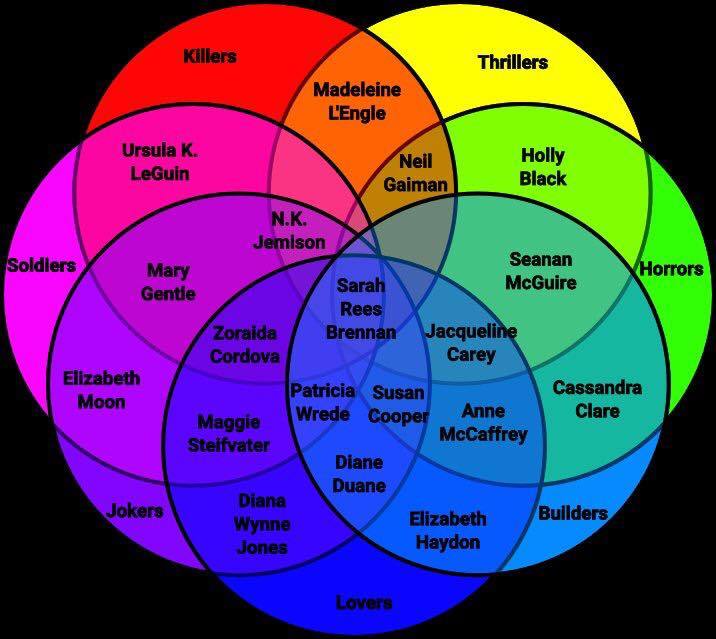
THIS IS SO AWESOME. So many names of writers I love. And me too!
I find this picture fascinating. While obviously not a comprehensive picture of every kind of writing, it is a fairly comprehensive picture of a certain flavor of fiction. And in selecting authors to fill each spot, the person who made the selections picked all women authors, except for one.
I haven’t read more than a few of these authors, but I have enjoyed the ones I have. Seeing them all laid out like this is kind of a big motivator to read more of them.
They were making a point with their selections: the original, non-ironic, totally “what I just picked the best people, why are you looking at me funny” version of this graphic was all male authors, with one woman (who had a gender-neutral name and could have been included by mistake).
Writing Advice: it doesn’t matter if an idea has been done before. It’s never been done by you. So long as you do it well, and in your own way, it’s a wonderful contribution.
*slams fists on table*
THERE WAS ONLY ONE BED
*runs into wall* THEY HAVE TO PRETEND TO BE DATING
*shakes fist at room* IT’S JUST SEX THEY SWEAR
*gasps in shock* WHAT DO YOU MEAN WE’RE BONDED?!
*internal screaming* BUT HE DOESN’T LIKE ME! WHAT DO YOU MEAN RON???!!!
*blank horror* WHY DO I HAVE TO SHARE MY ROOM WITH HIM OUT OF ALL PEOPLE?!?
*blushes* SHE’S WRITING HER FIRST NOVEL AND I SERVE HER COFFEE EVERY DAY JUST THE WAY SHE LIKES IT BUT SHE DOESN’T KNOW I EXIST…
Story time: I started a book about 23 hours ago and just finished it. Also in that time I slept for 10 hours, spent time with family, was at work, etc. Anyway, I enjoyed the book (Simon vs. the Homo Sapiens Agenda). But it felt like it flew by, so after I finished I looked up the word count because what are pages? Pages are meaningless. I only function in word counts anymore.
The estimate I found was 58,580. My immediate reaction was “oh, that’s why. That’s nothing!” But what a shitty response. Because no. That’s not nothing. That’s a whole. Damn. Book. An entire novel! And Fic authors regularly bust out 30k, 50k, 100k, 150k words. AND THEY DO IT FOR FREE. WHILE WORKING AND LIVING THEIR LIVES.
So anyway, thank your favorite fic author today because they deserve it. Because they’re amazing. They’re the MVPs.
As for “Write what you know,” I was regularly told this as a beginner. I think it’s a very good rule and have always obeyed it. I write about imaginary countries, alien societies on other planets, dragons, wizards, the Napa Valley in 22002. I know these things. I know them better than anybody else possibly could, so it’s my duty to testify about them.
OKAY I have been meaning to do this for MONTHS but hey, there’s no better time than the present so buckle up, here we go!
THESE BOOKS ARE A GODSEND.
I am ALWAYS on the lookout for writing aids that ACTUALLY HELP. If you’re like me, and occasionally venture out to buy books on, let’s say, showing vs telling – you will always get the same rehearsed speeches on what that means. -summons pretentious writer’s voice-You’ve got to shoooooow what’s happening in the scene, not teeeeeeell~~ BAH! What you NEVER get, however, is how to do it, or how do it better.
THESE BOOKS ARE THE STUFF OF DREAMS
Each of these is so freaking helpful, I can’t even convey. They all follow the same format as the pictures I’ve shown above, so you get one detailed page of descriptions followed by tons of more in-depth, thought provoking concepts.
I’ll do my best to lay out the five that I have and if you are interested, hop on over to Amazon and buy these suckers up because they are AMAZING; I have NEVER used a writing resource more than I use these.
Negative Trait Thesaurus & Positive Trait Thesaurus -gives you a definition of said negative trait -gives you similar flaws also found in the book -gives you possible causes of WHY the character might have this trait -gives you a list of other behaviors the chara might have -gives you examples of the chara’s thought process -gives associated emotions -gives positive aspects of the trait, as well as negative -gives examples of well known chara’s that have this trait -talks about how the chara might overcome it -gives traits that, when combined with this one, might cause conflict How I use this information: Chara building, or when I get stuck on what I want a character to do. Man, I just can’t decide what they WOULD do. Well, awesome, I have a little guide to help me think through the character’s possible motivations. Also, I get help building a potential backstory because I get a framework of which to think, why is the character this way?
Urban Setting Thesaurus & Rural Setting Thesaurus -gives a whole lot of examples of sights, smells, tastes, and sounds -gives examples of textures and sensations (ie at an ‘antique shop’ you may encounter chipped paint, distressed wood, etc) -gives you possible sources of conflict (ie at a ‘hotel’ you might have noisy neighbors) -gives list of people you might expect to find at said location -gives related settings -gives tips on this type of setting -gives a setting description example How I use this information: IMAGERY IMAGERY IMAGERY
Emotion Thesaurus (aka MY FAVORITE) -gives a definition of the emotion -gives physical signs and signals (ie chara may look pale, might fidget, etc) -gives internal sensations (aka, blood pounding in the ears, dry throat, adrenaline rush) -gives mental responses (ie fight or flight) -gives cues of acute or long-term impacts of the emotion -gives ‘may escalate to _______’ and directs you to other emotions -gives cues of suppression (ie cues of suppressed rage) -gives writer tips How I use this information: I love this book so hardcore, it’s so helpful with internalizing. It’s great because I get to step outside of that box of using the same five responses to a certain emotion and start really thinking about, what can a character do instead to show that they are feeling this, rather than me using adverbs or his adrenaline pumped fifty gazillion times.
These books are all co-written by Angela Ackerman and Becca Puglisi (bless their souls) and if this sounds of interest LOOK INTO IT!! I get such buyer’s regret after buying writing guides but these are legit the best ones I have found and I reference them so, so, so much.
Hope this helps anyone out there looking for something life-changing!!
The Crocodile Hunter style of writing involves chasing after cool-looking ideas that wander by and tackling them into submission.
I don’t recommend it for the long-term because it’s exhausting, but if there isn’t at least a LITTLE bit of Crocodile Hunter in your writing, I’m probably not going to read it.

 knitting in the dark