And yet fanfiction is an inherently transformative work which, by its very nature, strives to address or change some flaw that exists in canon, even if that flaw is “why isn’t there more of this thing?!” Fanfiction has addressed the lack of gay men by making straight characters gay; it’s addressed countless cultural misappropriations with wildly varying AUs; it’s addressed canon plot holes and timeline issues with fix-it fics and crossovers. Fanfic is the show your show could be like, if only you dared to dream.

But for all its transformative nature, fanfiction and fandom still suffer from a real dearth of femslash. Beyond the simple fact that very few girls exist in canon materials, the societal emphasis on the male gaze seems to have affected fanficcers’ creativity to such an extent that even in our own fantasies, we cannot give women a fair shake. Just as the answer to “Why is there so much slash?” cannot be boiled down to “ Well, straight girls are horny”, the answer to “Why isn’t there any femslash?” cannot be boiled down to “Well, straight girls don’t care.” The bias against female characters and female pleasure is an ingrained, institutionalized problem which won’t go away on its own.

Conclusion of Lady Geek Girl and Friends’s fascinating article on femslash and fandom (do give it a read if you’re interested!)

interesting

(via spiralstreesandcupsoftea)

You are 12. You’re at the library looking for some generic young adult fiction novel about a girl who falls for her best friend. Your dad makes a disgusted face. “This is about lesbians,” he says. The word falls out of his mouth as though it pains him. You check out a different book and cry when you get home, but you aren’t sure why. You learn that this is not a story about you, and if it is, you are disgusting.

You are 15. Your relatives are fawning over your cousin’s new boyfriend. “When will you have a boyfriend?” they ask. You shrug. “Maybe she’s one of those lesbians,” your grandpa says. You don’t say anything. You learn that to find love and acceptance from your family, you need a boyfriend who thinks you are worthy of love and acceptance.

You are 18. Your first boyfriend demands to know why you never want to have sex with him. He tells you that sex is normal and healthy. You learn that something is wrong with you.

You are 13. You’re at a pool party with a relative’s friend’s daughter. “There’s this lesbian in my gym class. It’s so gross,” she says. “Ugh, that’s disgusting,” another girl adds. They ask you, “do you have any lesbians at your school?” You tell them no and they say you are lucky. You learn to stay away from people.

You are 20. You have coffee with a girl and you can’t stop thinking about her for days afterwards. You learn the difference between a new friendship and new feelings for a person.

You are 13. Your mom is watching a movie. You see two girls kiss on screen. You feel butterflies and this sense that you identify with the girls on the screen. Your mom gets up and covers the screen. You learn that if you are like those girls, no one wants to see it.

You are 20. You and your friends are drunk and your ex-boyfriend dares you to make out with your friend. You both agree. You touch her face. It feels soft and warm. Her lips are small and her hands feel soft on your back. You learn the difference between being attracted to someone and recognizing that someone you care about is attractive.

You are 16. You find lesbian porn online. Their eyes look dead and their bodies are positioned in a way that you had never imagined. You learn that liking girls is acceptable if straight men can decide the terms.

You are 20. You are lying next to a beautiful girl and talking about everything. You tell her things that you don’t usually tell anyone. You learn how it feels not to want to go to sleep because you don’t want to miss out on any time with someone.

You are 15. Your parents are talking about a celebrity. Your dad has a grin on his face and says, “her girlfriend says that she’s having the best sex of her life with her!” You learn that being a lesbian is about the kind of sex you have and not how you love.

You are 18. You are in intro to women’s and gender studies. “Not all feminists are lesbians- I love my husband! Most of the feminists on our leadership team are straight! It’s just a stereotype,” the professor exclaims. You learn that lesbianism is something to separate yourself from.

You are 21 and you are kissing a beautiful girl and she’s your girlfriend and you understand why people write songs and make movies and stupid facebook statuses about this and time around you just seems to stop and you could spend forever like this and you learn that there is nothing wrong with you and you are falling in love.

You are 21. And you are okay.

a thing I wrote after arguing with an insensitive dude on facebook all day or Things Other People Taught me about Liking Girls (via squidterritory)

I will never not reblog this.

(via vanguardvivian)

Kelly Sue DeConnick Explores Gender Dynamics and Defiance on Bitch Planet

kellysue:

Paste: The way that the word “compliant” is used, and takes on these incredible sinister connotations throughout the first issue…when did you arrive on that?

DeConnick: Everyone who works in the medical field hates me for that choice, by the way. Apparently, non-compliant patients are nothing you want to cheer for. I don’t remember making that decision. This is a thing I see with my daughter. My daughter is a very spirited 4-year-old girl. And with my daughter more than with my son — when my son is, let’s say spirited, it tends to be, “Boys do that; that’s boys.” And it’s chuckled at, if not encouraged. And when my daughter has initiative or is disagreeable or has a different idea about how she wants to do things, she’s a pain in the ass. She’s a troublemaker. She needs to smile and act nice and not disrupt the system. And I want so badly to protect this[, this] thing about my daughter that I most treasure right now: Tallulah does not give a fuck if you like her. I am so proud of her for that. And I know that there are parents that that will horrify. Please understand that we have a saying in our home, that you don’t have to be nice, but you must be kind. And what we’re trying to emphasize is you don’t have to be compliant; you don’t have to just go along with the way of things.

Full interview in LINK

I haven’t read Bitch Planet or Pretty Deadly yet, but I have to say I approve of the word usage of ‘complaint’ here. Many people, many of them disabled, many of them female or queer or people of colour, have the label ‘non-compliant’ attached to their files simply because they have opinions about their own medical or psychiatric care that do not mesh with those of their primary physician. This isn’t a benign thing – people’s accounts of their symptoms are dismissed, they are forced into courses of treatment or medications that are unsuitable for them, forced into institutions or even die through improper medical or psychiatric care, all because a physician decided their patient was too uppity and didn’t have a right to independently research their condition or make informed choices about what treatment was right for them. Given that disabled people, women, queer people and POC are more likely to be subjected to these forms of social control by medical practitioners, government agencies and law enforcement, the use of the word compliant rings true to many people who have been subject to the whims of these agencies in the course of their lifetime. Just my two cents, from a disabled autistic queer girl, for whom the world has been difficult, but not as horrific as it has been for some of my fellows.

mrv3000:

There are many things I love about Phryne Fisher.  One of the biggies is how much she likes and is protective of women.

And one of my favourites:

beatrice

An autistic, academically gifted university student in an otherwise all-male student body is framed, stalked, bullied and slandered.

Phryne doesn’t lay the blame on her, fixate on her differences or say her treatment is justifiable. She imitates her behaviour to understand it, opens up her home as a safe haven, and tries to see the world from the girl’s perspective rather than deciding to coach her to pass.

Do you know of any articles related to Autism in women or people who identify as one?

talesfromthechickpea:

Academic articles? Not really, though I might be able to find some. Blog stuff and diagnostic help? Sure!

For Ladies on the Spectrum

Some people may recommend the book Aspergirls by Ruby Simone, but I cannot. I did not like the book at all and did not identify with much of what Simone said. It was also very heteronormative, which really bothered me. 

Agreed. I’m a queer autistic woman, and a friend of mine bought a copy of Aspergirls and handed to to me to look at. I admit I didn’t read it from cover to cover, but I didn’t need to. I looked up certain headers that were of interest to me, and decided that I did not want or need to read it. It was so heteronormative that I felt I had nothing to gain from reading it. It was exclusive at best and offensive at worst, and it had this weird New Age vibe to a lot of the stuff she was talking about. Basically, the book is for cishet Aspies who want a man in their life. There is nothing for queer girls, transgirls, lesbians, asexuals, bi girls, gender divergent folks or any other flavour of difference. I cannot speak for how much privilege is in it either, because it was some time ago I looked at it, but it wouldn’t surprise me if there was a bunch of that, too.

I feel like that’s the thing that’s holding back many young women writers, and many young women in general now—this idea that we don’t put our work out until we believe it’s immaculate, and there’s no such thing as perfection to begin with. Secondly, the lack of a perfected idea never stopped men from speaking out! To be successful I think you really have to shove yourself forward, and I consider myself really lucky that I’ve never held myself back in those ways. To a fault! I’m sort of a pamphleteer for my own work, standing on a street corner ringing a bell, shouting, “Look what I made! Look what I made!”

Elizabeth Gilbert (via robinwasserman)

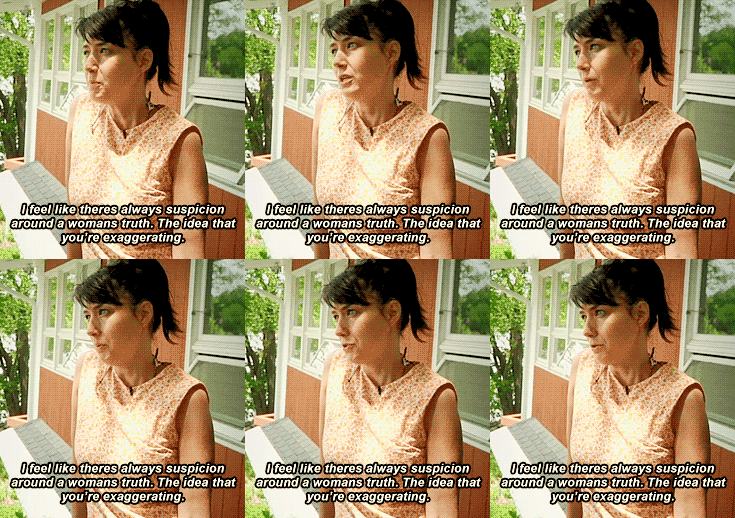
I feel that Elizabeth Gilbert is right, but I wanted to talk a little bit about bell-ringing, and why women are held back, and how much people resist women shoving themselves forward—how much they resist women doing something that might lead to success.

Compliments are two-edged swords for women: thinking well of yourself is a dangerous activity people will try to stop you engaging in.

I remember vividly being sixteen and having a friend come up to me and compliment my outfit. ‘Thank you!’ I said. ‘Wow,’ she said, and blinked. ‘Normally people say—oh hey, I like *your* thing, but no, it’s cool you just said thanks! It’s great you’re so confident!’ ‘I’m sorry,’ I said. ‘No, I really like your top. I’m sorry.’

And from then on, I remembered to compliment back rather than act like I was so great I could just take a compliment. If possible, I complimented first, just to be safe!

And there’s nothing wrong with complimenting other people. And my friend is and was a lovely person. It wasn’t her fault she said it, or my fault I took it that way. It’s that this is a system that tries to get you coming and going.

THE WORLD: Have high self-esteem generally.

LADY: I’m so cute.

THE WORLD: Uh but don’t be vain!

LADY: I’m so smart.

THE WORLD: Do not be a stuck-up bitch!

LADY: I quite like my…

THE WORLD: Gosh you think HIGHLY of yourself, don’t you?

“Girls are trained to say, ‘I wrote this, but it’s probably really stupid.’ Well, no, you wouldn’t write a novel if you thought it was really stupid. Men are much more comfortable going, ‘I wrote this book because I have a unique perspective that the world needs to hear.’ Girls are taught from the age of seven that if you get a compliment, you don’t go, ‘Thank you’, you go, ‘No, you’re insane.’ “ – Lena Dunham

It’s not that guys don’t get insecure, too. Of course they do: they are human. But it’s true that girls are *taught* insecurity, via a barrage of social pressure… pressure from everybody.

A friend of mine wrote a post a few weeks ago talking about being a woman writer online, and the things you heard from people while… being a woman writer online. Two of those things were: it didn’t sell so she’s a failure, and the other was: it did sell and I liked it but it’s rubbish.

Those two things (she does sell/she doesn’t sell) can’t be true of one writer at one time: obviously she was talking about stuff that happens, across the board, to women writers. Several people, of course, rushed to inform her that she was a bad writer (so she deserves what she gets!) and a bad person (so she deserves what she gets!). Because of course, she had to be whining about how she was treated personally, and she had to be told she deserved it.

Pretty classic method of trying to shut someone up. And never mind that a LOT of women writers, with a lot of different careers, reblogged it: probably they were bad people too, or bad writers too, or whiners, or making everything about sexism, or when they thought it applied to them they were mistaken. (So silly.)

I see this all the time, from people who are openly like ‘Yuck, feminists’ in real life, to people online who are like ‘I am one thousand per cent dedicated to feminism, and I haven’t noticed that a huge amount of my hatred is devoted to women doing it wrong and I love no lady real or fictional as much as I love Bucky Barnes/Tom Hiddleston/Joseph Fink/Derek Hale/a member of One Direction chosen by lottery.’
And it has a profound effect on women’s ability to do their jobs. As Elizabeth Gilbert says, not being a bell-ringer for your work is holding you back: but being a bell-ringer for your work is something that comes with the risk of being attacked, feeling lousy… and stopping being a bell-ringer for your work, learning it’s too risky, sacrificing a bit of yourself to preserve the rest.

This training makes women very quiet for a while, because that’s how self-doubt works: you don’t think ‘it’s the world, the world’s all messed up.’ You think: it’s me. You think, I just have to do better. You’re ashamed that you didn’t do better before you spoke up. 

But there is no way to do well enough: there is no time there won’t be pushback when you speak up, because the desire behind the pushback, conscious or unconscious, is not for you to do better. It’s for you to stop.

Emily Gould’s talked about the impact an online attack had on her professionally.

‘I felt fear doing events around publication. Not stage fright, fear for my physical safety. Instead of planning celebrations I was arranging with bookstores and my publisher for adequate security at events. I felt worried that the location of my apartment had been revealed in so many profiles. It’s not like I experienced physical trauma or was tortured but I felt under attack. This wasn’t something that “happened on the internet” or something that could have been avoided by “just unplugging.” Talking to readers, doing events, and promoting books online is my job.

I still haven’t sorted out what kind of damage was done.’

http://emilygould.tumblr.com/post/98563959520/just-want-to-say-this-to-have-said-it

And leaving aside individual examples, science has shown the barrage of nasty messages women get for just existing, let alone daring to do something.

‘The study found that female bots received on average 100 malicious private messages a day while the male bots received an average of 3.7. ’ 

http://www.concurringopinions.com/archives/2009/03/cyber_harassmen.html

So ladies, getting harassed about thirty times more than dudes? And that’s just online… think about what happens in real life, like Joanne Harris having a publisher reject her based on her ‘lack of physical appeal.’

http://joannechocolat.tumblr.com/post/97879457176/are-you-too-fat-to-get-published

One cannot help but think ‘Gosh, if I was receiving thirty times less crap, I might have a better opinion of myself and I might get more done!’

And it’s not just online, and it’s not just publishing, sometimes it’s also your nearest and dearest who have an interest in shutting you up: the people you love and should be able to trust.

Zelda Fitzgerald had her work stolen from her by her husband F. Scott Fitzgerald, who frankly said he was just typing out her diaries sometimes, and she was depressed (who can blame her!) because stories written solely by her got more money when F. Scott Fitzgerald was listed as co-author… or when he was listed as the only author!

http://online.wsj.com/news/articles/SB10001424127887323393304578362314070442492

It’s very reminiscent of the way Walter Keane pretended that he was the one painting his wife Margaret Keane’s paintings, which were a phenomenon in the 1960s. 

(She won the court case by having a paint-off.

MARGARET: I painted the paintings. Hey, I’ll paint one right now! In court. Let’s both paint one! Right now. In court.

WALTER: I… uh… brought this note from home to say I’m delicate, so…)

And yet, *would* the paintings have sold like they did if everyone had known they were painted by a lady from the start? I don’t know, but I’d guess probably not.

Which doesn’t make it right. Women deserve credit for their work, and they deserve a fair valuation of their work, and often they do not get either.

http://www.nytimes.com/1999/05/23/magazine/style-an-eye-for-an-eye.html

(THE WORLD: You want the CREDIT?

LADY: Well, I made it…

THE WORLD: But maybe you didn’t! Maybe your husband did it! Maybe your brother Branwell did it!

LADY: And also, work takes time, and I need to eat.

THE WORLD: And now you want to get PAID? Where’s your pride in your work, you money-grubbing ho?

LADY: Oh, *now* I’m meant to be all about the art?)

It is not just one’s husbands who snake women’s work: writing novels at all used to be sneered at as a lady thing, and then suddenly men started doing it and there was serious important literature, and women should stop doing that thing they invented! On a smaller scale but in the same vein, a woman called Victoria Lambert created Doctor Who, but no women have been allowed to write Doctor Who episodes for six years and counting.

It is not, of course, writing but all work done by women that is devalued in various ways: Female scientists’ contributions are overlooked and forgotten, teaching changed from a male-dominated job to a female-dominated job in the 1800s when people realised a) oh no all kids need teaching! and b) oh wait thank god we can just pay the ladies half as much… and it is still a female-dominated and thus underpaid job today, the games industry chases women away savagely (http://elizabethsampat.com/the-truth-about-zoe-quinn/), actresses are not given their own movies to lead (51% of the population, 10.8% of the lead roles in big movies!), women directors are just not given jobs (6% of 2013’s big movies had women directors), women take jobs as film editors instead of directors and then are not given credit for their contribution to films (e.g. Thelma Schoonmaker, who has edited all Martin Scorsese’s movies since 1980), women have 5% of Fortune 100 CEO positions, Taylor Swift gets it in the neck for writing songs about her own love life while Adam Duritz of Counting Crows, to name but one dude, can do the same thing for a decade and nobody cares.

It’s not easy to love yourself or what you do or what you have created. It’s not easy to promote yourself or praise yourself. The whole situation is fixed to make it difficult. 

Bell-ringing is so complicated. A writer friend of mine asked for several promotions she knew male authors who sold less well than she had received: she got turned down. So she literally invented a new kind of promotion. They gave it to her in sheer puzzlement.

(It worked, and since then many people have been given that kind of promotion. Mostly dudes. The writer friend who invented it has been criticised a lot for not being a true artiste, and being arrogant. The dudes who got the promotion she invented have almost without exception gone on to win prizes women seldom win, be reviewed in many major publications that feature very few women, and talk about their own genius and get others to talk about it too.)

Dorothy L. Sayers, a badass writer who knew what she was talking about, said it was surprising anyone going through the wringer of sexism ‘retained any rag of sanity or self-respect.’

That’s why bell-ringing is such a complicated thing. It’s why shoving yourself forward is so difficult. ‘Well, just do it anyway’ is good advice, the only advice possible, but it’s also important to acknowledge what gets in the way of doing what we want to do. So that for every time we get pushback or feel ashamed, we remember to celebrate rather than be ashamed.
Despite the pressures of the world, so many women have done and made so many things! Just concentrating on writing, they: invented the novel. Popularised science fiction. Now, they’ve popularised young adult fiction and invented new adult fiction. 

So, if you manage to get by and think you’re not so bad most days, that’s a triumph. If you manage to create something despite the voices inside and outside your head telling you not to, that’s amazing. If you make a mistake, own up to it, but know it’s probably not as bad a mistake as everyone is rushing to tell you it was. If you feel shamefaced about something you have done or made, that’s an injustice the world has put in your way—it’s not because you did or made something to be ashamed of. If you can create something, and believe in it and yourself enough to talk about it and think about how to get it out in the world… you have accomplished a series of amazing deeds. You have triumphed against a series of adversities.

That’s something worth bell-ringing about.

(via sarahreesbrennan)

Posts like this are why Sarah is one of my favorite humans and you should read both the whole thing and all the links.

(via seananmcguire)

silentauroriamthereal:

nofreedomlove:

image

image

image

imageimage

image

image

image

Source

“Image Credit: Carol Rossetti

When Brazilian graphic designer Carol Rossetti began posting colorful illustrations of women and their stories to Facebook, she had no idea how popular they would become. 

Thousands of shares throughout the world later, the appeal of Rosetti’s work is clear. Much like the street art phenomenon Stop Telling Women To Smile, Rossetti’s empowering images are the kind you want to post on every street corner, as both a reminder and affirmation of women’s bodily autonomy. 

"It has always bothered me, the world’s attempts to control women’s bodies, behavior and identities,” Rossetti told Mic via email. “It’s a kind of oppression so deeply entangled in our culture that most people don’t even see it’s there, and how cruel it can be.”

Rossetti’s illustrations touch upon an impressive range of intersectional topics, including LGBTQ identity, body image, ageism, racism, sexism and ableism. Some characters are based on the experiences of friends or her own life, while others draw inspiration from the stories many women have shared across the Internet. 

“I see those situations I portray every day,” she wrote. “I lived some of them myself.”

Despite quickly garnering thousands of enthusiastic comments and shares on Facebook, the project started as something personal — so personal, in fact, that Rossetti is still figuring out what to call it. For now, the images reside in albums simply titled “WOMEN in english!“ or ”Mujeres en español!“ which is fitting: Rossetti’s illustrations encompass a vast set of experiences that together create a powerful picture of both women’s identity and oppression.

One of the most interesting aspects of the project is the way it has struck such a global chord. Rossetti originally wrote the text of the illustrations in Portuguese, and then worked with an Australian woman to translate them to English. A group of Israeli feminists also took it upon themselves to create versions of the illustrations in Hebrew. Now, more people have reached out to Rossetti through Facebook and offered to translate her work into even more languages. Next on the docket? Spanish, Russian, German and Lithuanian.

It’s an inspiring show of global solidarity, but the message of Rossetti’s art is clear in any language. Above all, her images celebrate being true to oneself, respecting others and questioning what society tells us is acceptable or beautiful.

"I can’t change the world by myself,” Rossetti said. “But I’d love to know that my work made people review their privileges and be more open to understanding and respecting one another.”

From the site: All images courtesy Carol Rossetti and used with permission. You can find more illustrations, as well as more languages, on her Facebook page.

Oooh. I reblogged a partial version of this recently but I didn’t know how many more there were! I LOVE these!