“Despite all of that, I don’t “look” disabled… there are no visual cues that I am plagued by chronic pain and fainting spells.
…I can’t help but mull over my experiences with non-disabled people doubting me as I’m en route to meet the photographer for this shoot. Will Sean be able to grasp the nuances of my disability? More importantly, will he care?”
Since I don’t see this all that often, but part-time wheelchair usage is a thing and these are things I learned as someone who uses a wheelchair part time. (Please add to it if you think of things!)
*Not as many people as you think are watching you get out of your car to walk to where your wheelchair is to get in it.
*Chances are you have only a manual one- this can be hard on your arms. It’s okay to ask for help from someone to push. But it’s just as okay to yell and make a big deal when they push without asking (Then asking them 4 minutes later to push you. Wheelchairs can be emotional things- it’s okay to be emotional.)
*It’s okay to get up from your chair occasional. You don’t have to “pretend” that you can’t get up from your wheelchair. Everyone is different. You don’t owe ANYONE an explanation.
*Don’t be embarrassed about telling family members or friends you need the wheelchair. Chances are they WILL forget. They won’t mean to- but this is new for them and even more part-time for them. It IS okay to insist on bringing the wheelchair. Even on short trips.
* This is an important one I had to learn. IF ITS HARD FOR SOMEONE TO PUSH YOU. Say a hill, or something. DON”T JUST SAY “I feel bad” AND GET UP AND WALK IT. IF ITS HARD FOR THEM TO PUSH YOU. THAT MEANS IT’LL BE JUST AS HARD TO WALK IT. You are in that wheelchair for a reason, don’t feel guilty.
*You are NOT faking. Part-Time wheelchair usage is OKAY to do. You are not exaggerating your symptoms, you are not pretending you are worse than you are. Everyone’s story is different. You do not owe anyone an explanation.
PSA to all you fantasy writers because I have just had a truly frustrating twenty minutes talking to someone about this: it’s okay to put mobility aids in your novel and have them just be ordinary.
Like. Super okay.
I don’t give a shit if it’s high fantasy, low fantasy or somewhere between the lovechild of Tolkein meets My Immortal. It’s okay to use mobility devices in your narrative. It’s okay to use the word “wheelchair”. You don’t have to remake the fucking wheel. It’s already been done for you.
And no, it doesn’t detract from the “realism” of your fictional universe in which you get to set the standard for realism. Please don’t try to use that as a reason for not using these things.
There is no reason to lock the disabled people in your narrative into towers because “that’s the way it was”, least of all in your novel about dragons and mermaids and other made up creatures. There is no historical realism here. You are in charge. You get to decide what that means.
Also:
“Depiction of Chinese philosopher Confucius in a wheelchair, dating to ca. 1680. The artist may have been thinking of methods of transport common in his own day.”
“The earliest records of wheeled furniture are an inscription found on a stone slate in China and a child’s bed depicted in a frieze on a Greek vase, both dating between the 6th and 5th century BCE.[2][3][4][5]The first records of wheeled seats being used for transporting disabled people date to three centuries later in China; the Chinese used early wheelbarrows to move people as well as heavy objects. A distinction between the two functions was not made for another several hundred years, around 525 CE, when images of wheeled chairs made specifically to carry people begin to occur in Chinese art.[5]”
“In 1655,Stephan Farffler, a 22 year old paraplegic watchmaker, built the world’s first self-propelling chair on a three-wheel chassis using a system of cranks and cogwheels.[6][3] However, the device had an appearance of a hand bike more than a wheelchair since the design included hand cranks mounted at the front wheel.[2]
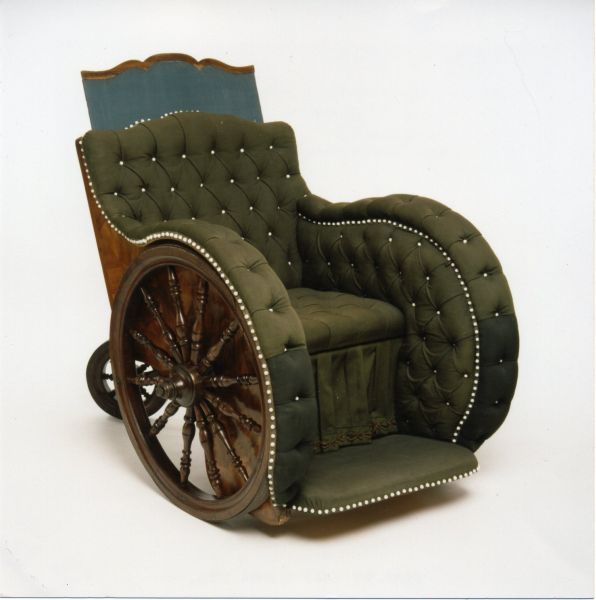
The invalid carriage or Bath chair brought the technology into more common use from around 1760.[7]
In 1887, wheelchairs (“rolling chairs”) were introduced to Atlantic City so invalid tourists could rent them to enjoy the Boardwalk. Soon, many healthy tourists also rented the decorated “rolling chairs” and servants to push them as a show of decadence and treatment they could never experience at home.[8]
In 1933 Harry C. Jennings, Sr. and his disabled friend Herbert Everest, both mechanical engineers, invented the first lightweight, steel, folding, portable wheelchair.[9] Everest had previously broken his back in a mining accident. Everest and Jennings saw the business potential of the invention and went on to become the first mass-market manufacturers of wheelchairs. Their “X-brace” design is still in common use, albeit with updated materials and other improvements. The X-brace idea came to Harry from the men’s folding “camp chairs / stools”, rotated 90 degrees, that Harry and Herbert used in the outdoors and at the mines.[citation needed]
“But Joy, how do I describe this contraption in a fantasy setting that wont make it seem out of place?”
“It was a chair on wheels, which Prince FancyPants McElferson propelled forwards using his arms to direct the motion of the chair.”
“It was a chair on wheels, which Prince EvenFancierPants McElferson used to get about, pushed along by one of his companions or one of his many attending servants.”
“But it’s a high realm magical fantas—”
“It was a floating chair, the hum of magical energy keeping it off the ground casting a faint glow against the cobblestones as {CHARACTER} guided it round with expert ease, gliding back and forth.”
“But it’s a stempunk nov—”
“Unlike other wheelchairs he’d seen before, this one appeared to be self propelling, powered by the gasket of steam at the back, and directed by the use of a rudder like toggle in the front.”
Give. Disabled. Characters. In. Fantasy. Novels. Mobility. Aids.
If you can spend 60 pages telling me the history of your world in innate detail down to the formation of how magical rocks were formed, you can god damn write three lines in passing about a wheelchair.
Signed, your editor who doesn’t have time for this ableist fantasy realm shit.



 knitting in the dark