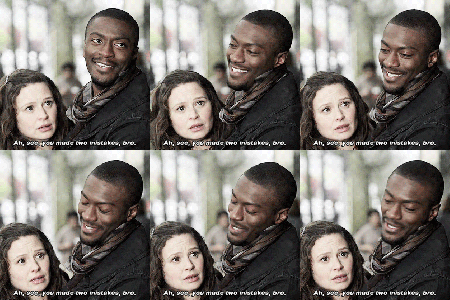
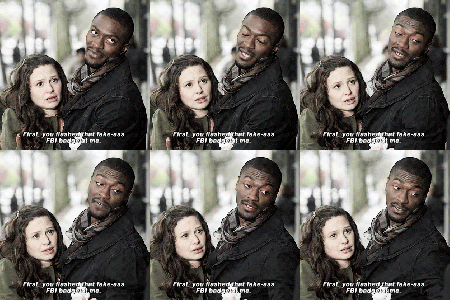
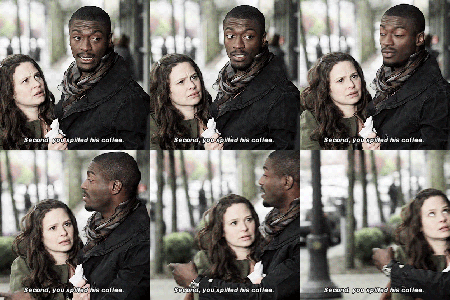
What I like best about this is that we know Eliot doesn’t commit hair-trigger violence over minor things – if someone bumps into him and spills his coffee he’s likely to be annoyed, but he’s not going to automatically break their arms.
Which means that what’s happening here is Hardison, in bringing up the coffee, is giving Eliot explicit permission to break arms, and Eliot is playing into it. And the only real reason for playing into the coffee schtick is that it will amuse Hardison.
My grandfather was a generally peaceful man. He was a gardener, an EMT, a town selectman, and an all around fantastic person. He would give a friend – or a stranger – the shirt off his back if someone needed it. He also taught me some of the most important lessons I ever learned about violence, and why it needs to exist.
When I was five, my grandfather and grandmother discovered that my rear end and lower back were covered in purple striped bruises and wheals. They asked me why, and I told them that Tom, who was at that time my stepfather, had punished me. I don’t remember what he was punishing me for, but I remember the looks on their faces.
When my mother and stepfather arrived, my grandmother took my mother into the other room. Then my grandfather took my stepfather into the hallway. He was out of my eye line, but I saw through the crack in the door on the hinge side. He slammed my stepfather against the wall so hard that the sheet rock buckled, and told him in low terms that if he ever touched me again they would never find his body.
I absolutely believed that he would kill my stepfather, and I also believed that someone in the world thought my safety was worth killing for.
In the next few years, he gave me a few important tips and pointers for dealing with abusers and bullies. He taught me that if someone is bringing violence to you, give it back to them as harshly as you can so they know that the only response they get is pain. He taught me that guns are used as scare tactics, and if you aren’t willing to accept responsibility for mortally wounding someone, you should never own one. He told me that if I ever had a gun aimed at me, I should accept the possibility of being shot and rush the person, or run away in a zig-zag so they couldn’t pick me off. He taught me how to break someone’s knee, how to hold a knife, and how to tell if someone is holding a gun with intent to kill. He was absolutely right, and he was one of the most peaceful people I’ve ever met. He was never, to my knowledge, violent with anyone who didn’t threaten him or his family. Even those who had, he gave chances to, like my first stepfather.
When I was fourteen, a friend of mine was stalked by a mutual acquaintance. I was by far younger than anyone else in the social crowd; he was in his mid twenties, and the object of his “affection” was as well. Years before we had a term for “Nice Guy” bullshit, he did it all. He showed up at her house, he noted her comings and goings, he observed who she spent time with, and claimed that her niceness toward him was a sign that they were actually in a relationship.
This came to a head at a LARP event at the old NERO Ware site. He had been following her around, and felt that I was responsible for increased pressure from our mutual friends to leave her alone. He confronted me, her, and a handful of other friends in a private room and demanded that we stop saying nasty things about him. Two of our mutual friends countered and demanded that he leave the woman he was stalking alone.
Stalker-man threw a punch. Now, he said in the aftermath that he was aiming for the man who had confronted him, but he was looking at me when he did it. He had identified me as the agent of his problems and the person who had “turned everyone against him.” His eyes were on mine when the punch landed. He hit me hard enough to knock me clean off my feet and I slammed my head into a steel bedpost on the way down.
When I shook off the stunned confusion, I saw that two of our friends had tackled him. I learned that one had immediately grabbed him, and the other had rabbit-punched him in the face. I had a black eye around one eyebrow and inner socket, and he was bleeding from his lip.
At that time in my life, unbeknownst to anyone in the room, I was struggling with the fact that I had been molested repeatedly by someone who my mother had recently broken up with. He was gone, but I felt conflicted and worthless and in pain. I was still struggling, but I knew in that moment that I had a friend in the world who rabbit-punched a man for hitting me, and I felt a little more whole.
Later that year, I was bullied by a girl in my school. She took special joy in tormenting me during class, in attacking me in the hallways, in spreading lies and asserting things about me that were made up. She began following me to my locker, and while I watched the clock tick down, she would wait for me to open it and try to slam my hand in it. She succeeded a few times. I attempted to talk to counselors and teachers. No one did anything. Talking to them made it worse, since they turned and talked to her and she called me a “tattle” for doing it. I followed the system, and it didn’t work.
I remembered my friend socking someone in the face when he hit me. I recalled what my grandfather had taught me, and decided that the next time she tried, I would make sure it was the last. I slammed the door into her face, then shut her head in the base of my locker, warping the aluminum so badly that my locker no longer worked. She never bothered me again.
Violence is always a potential answer to a problem. I believe it should be a last answer – everything my grandfather taught me before his death last year had focused on that. He hadn’t built a bully or taught me to seek out violence; he taught me how to respond to it.
I’ve heard a lot of people talk recently about how, after the recent Nazi-punching incident, we are in more danger because they will escalate. That we will now see more violence and be under more threat because of it. I reject that. We are already under threat. We are already being attacked. We are being stripped of our rights, we are seeing our loved ones and our family reduced to “barely human” or equated with monsters because they are different.
To say that we are at more risk now than we were before a Nazi got punched in the face is to claim that abusers only hurt you if you fight back. Nazis didn’t need a reason to want to hurt people whom they have already called inhuman, base, monsters, thugs, retards, worthless, damaging to the gene pool, and worthy only of being removed from the world. They were already on board. The only difference that comes from fighting back is the intimate knowledge that we will not put up with their shit.
– “Many compared you to Quentin Tarantino because of the violence in your movies, but I prefer comparing you to Stanley Kubrick, because you always tackle issues of modernity, present and future times, and you explore the themes of domination by the rich and violence of the poor. – Your remark is very interesting. On the set of Stoker in the United States, Nicole Kidman made a similar comment. She said that I was often compared to Hitchcock, but that she would see more resemblance between me and Stanley Kubrick.”
In the year 1905 my paternal great-grandmother, a Jewess from Austria-Hungary, left her homeland–although perhaps “fled” would be a better word–with nothing but a suitcase, the clothes on her back, and the potential promise of finding work with a distant cousin who had been living in the slums of Victorian Glasgow in Scotland since the 1890s.
During that time she married my great-grandfather, an Irish Catholic immigrant who lived in the notorious “Rat Pits”–so called because the Irish (and therefore inherently Catholic) residents “bred like rats”–and worked as a boat smuggler (meaning he smuggled people and other commodities into Scotland from Ireland on a boat, he was not in fact a smuggler of boats), a shoe maker, a wood carver and general jack of all trades master of none, with a stereotypical love of drink and a violent temper to go with it. But he provided for her and didn’t force her into sex work like so many girls her age were, so she forgave a great many things that would no longer be forgiven and had lots of children, many of whom died.
Dad tells me he remembers her “singing” their names and lighting candles at specific times, but only when his grandfather was “out” (smuggling, or visiting another woman, he never elaborated on this) because she sang her prayers in Yiddish and they’d spent many years trying to hide her Jewishness.
Being a Catholic in the turbulent streets of Glasgow where Protestant faith is still practiced militantly in some areas, was troublesome, but it was infinitely less trouble than being Jewish during the years that would lead up to two world wars. So she hid behind his Catholicism and his large family, and watched as the world turned against her and her people once more. And despite her pale skin and bright eyes and her passing status as an equal among the Irish matriarchs of the slums, they still woke to blood smeared over their front door more than once, or were spat on in the streets. She told my father, jokingly, it was her nose, though to look at photos you’d never notice she was different from anyone else. That was the joke.
After her husband died she became unapologetic about her Jewishness. She spoke Yiddish at home and made sure my father, who had been living with her from the age of seven, knew some words too. He was fourteen years old when he heard her “sing” his mother’s name and
watched her tear the clothes she was wearing, having now outlived all of
her children. She outlived many of her grandchildren too. And when no one was left to make the meal of condolence, my mother–a gentile girl from the neighboring street–found out, she tried her best to make one.
Dad tells me it was largely inedible, not least of all because it wasn’t kosher, but for his Maw (Scots slang for mother) it was one of her first memories of someone not of the faith acknowledging her Jewishness with kindness. She was sixty years old and had been living in Glasgow for forty five years.
And she spent the majority of that time forced to move from slum to slum by her faith, until eventually in post World War Two Glasgow, the local authorities either had to dig mass graves or deal with the conditions of the poor and chose to be merciful and built better housing instead. She was eventually moved to a housing estate where she could look out and see a garden rather than squalor and degradation and no one charged her extra rent because everyone knows people like her have secret stashes of money and will pay anything not have their windows broken or pigs blood slashed over the door. The history books never tell you that sort of thing. They only tell you about the selective moments in history when tyrants had the audacity to threaten other tyrants, and only then does mass discrimination, abject poverty and genocide through the former become an unpalatable evil that needs to be stopped.
Nothing much has changed.
She lived long enough to hear about Holocaust deniers and my father tells me, spat
their names with all the vitriol of an ancient curse held dormant in the fires of the earth. And when she was buried, the man who cut her tombstone informed my father it probably wasn’t a good idea to put a Star of David on the stone, because those were the stones that were the most often attacked, the graves desecrated and the grass salted so nothing would grow.
And this is no ancient history. This was in the UK, in 1979. This was less than forty years ago. And still whenever my father visits he will find some form of vandalism enacted on her tombstone. It’s her name you see, even in death it doesn’t sound right.
Margarethe Ingrid Fehrenbach Patton. Or “Maggie Patton” as she was known for most of her life, never hearing her own name save for the few times she went back to the degradation of the Gorbals, usually when someone had died and there were traditions to be kept. And forty years on some dull and depraved bastard still feels the need to paint a swastika on her grave in neon paint or tip it over and smash the urn of flowers, because not even death is free of persecution.
And this is not just my family history, it is many family histories told over and over again, and I get to recount it from the safety of 2015, with my gentile name and baptized gentile faith.
So yes, it matters that we are seeing a new wave of antisemitism, online and in the physical world. It matters that there are blogs being set up for the purpose of sending images of dead bodies and gore to Jewish people and their friends. It matters that those people are losing friends because it’s the only way to not also be harassed and retain their own freedom of communication the way theylike it. It matters that people feel the need to ask what is wrong with Nazism in the same way one might ask what is wrong with a little rain. It matters that Jewish characters in popular media are stripped of their ethnicity and faith and made not only into Neo-Nazi sympathizers, but volunteers to a Neo-Nazi regime (if you can’t work out why this is horrifying, here). It matters that a family in Houston Texas found the mezuzah of their door violated with the symbol of a Nazi swastika. It matters so much because this is not the past, nor is it some distant land you can pretend you can neither see nor hear. We live in the age of constant communication, we are no longer blind, except to things we do not wish to see.
We cannot pretend that horrific acts of violence are not enacted against others on a daily basis, because if we do so then we are enabling these acts. You cannot stand silent against hatred, otherwise you enable things like this:
It’s happening in the way in which people insist on calling the black people being murdered by police “thugs” while white protesters are cited the rules of Baseball (three strikes and you’re benched with a fine or jail time, not murdered), it’s happening every time someone says “well maybe they shouldn’t name their children ghetto names" as a means to dehumanize another human being, it’s happening whenever someone cites free speech in the protection of hate crimes. It happens every time you think “well it’s not happening to me so it can’t be that bad” and close your eyes and make the horror of it all into a mere inconvenience interrupting your enjoyable browsing time between mainlining netflix and cat gifs.
It’s happening. And we don’t have the excuse of ignorance to hide behind, it’s there.
And I don’t know what the fuck to do. I can block and report all the live long day, but it doesn’t solve the issue of tumblr and other social media platforms being like “just ignore it, dont feed the trolls”, like sticking a band aid over a gaping sore in need of urgent surgery in the hope that it will somehow go away. You might think someone receiving gory images and threats is not the same as an act of physical violence, but it is undoubtedly violence. It’s people painting pigs blood over my Great Grandmas door and telling her she doesn’t belong in the country that she thought was safe and being told snidely to be thankful it wasn’t worse.
To you it might be petty and mildly distressing, but to another person it’s salted earth and the promise that not even death is safe.
And you are either complicit in this, or you are against it.
Decide.
I’d say sorry for reblogging this again, but I just had to read Nazi apologism with my own two eyeballs in the year 2017 and I’m this close to hauling off with an axe.
I reiterate my previous statement from two years ago: you are either against these atrocities, or you are complicit in them. Decide.
[edited to fix the use of language in original post, if you reblogged this earlier, please delete and reblog without the unintentional use of a slur word used to describe sex workers.]
“All her life she has wanted to run and run and run, but only now does
she have the body to do it.”
Peggy Au where she gets the serum and having another Super Soldier along changes things. Explicit, Peggy/Steve and Peggy/Steve/Bucky
1st is Steve, Bucky and Peggy during the war and the 2nd is the three of them in Avengers timeline before the battle of New York. Coulson had some input in the costumes. Buck is not happy AT ALL.
I have been waiting for this one to go live for a while. I adore the fic and want so much more in this universe. Shadow very patiently waited for me to finish these artworks before posting. I have more I want to do but health and other deadlines are getting in the way so when I do get around to them they’ll be added to the series on AO3 and posted here.
My not-a-bang fic is live! I’ve been working on this one since January, and kath_ballantyne made me gorgeous art to go with it! If you like super soldier Peggy punching Hydra in the face and banging Steve like a barn door, this is the fic for you!



 knitting in the dark