cybertronian:

giandujakiss:

jamesfactscalvin:

officialnatasharomanoff:

project-blackbird:

reservoir-of-blood:

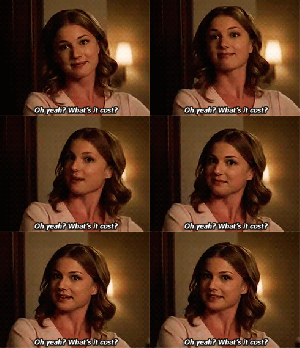
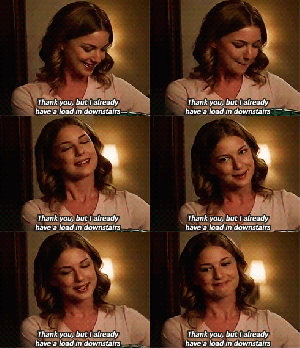
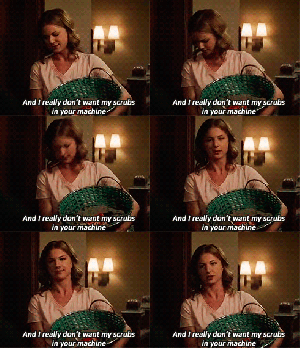
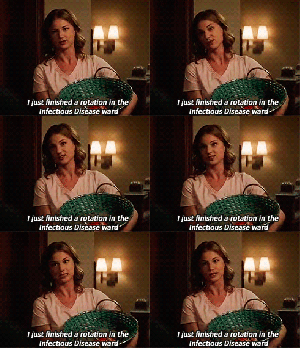
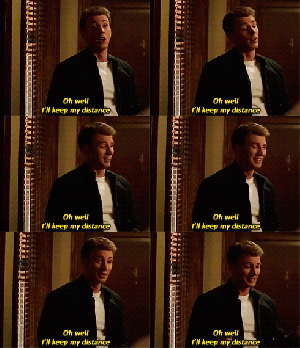
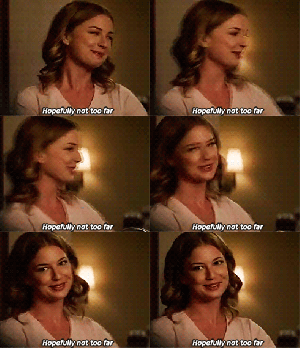
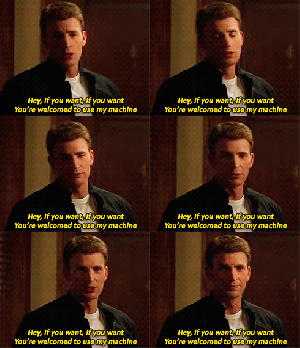
Emily Vancamp as Sharon Carter in “Captain America: The Winter Soldier”

Here’s an example of what we call a “soft no”. Sharon turns down Steve’s offer in a way that’s meant not to insult him but never actually uses the word “no”.

Steve clearly gets the message, though, and importantly offers to leave her alone. Sharon’s comment afterwards gives him an opportunity to try again later, but he doesn’t press and respects her rejection of his company even though it’s probably hurt his feelings a bit.

Just in case you ever wonder “What would Captain America do?”; there you go.

never do something steve rogers wouldn’t do.

Unless it’s jumping out of a plane without a parachute, you probably shouldn’t do that

I just have to add – I’ve seen interviews with Marvel people where they say that this scene demonstrates that Cap’s awkward with women and doesn’t know how to ask women out on a date.  And it drives me crazy, because – as the OP says – Steve behaved perfectly here.  It was a very charming, nonthreatening offer, and he accepted her rejection with good grace.  You can’t help but feel that to Hollywood, the fact that she said no means he asked badly – which is exactly how I’d expect Hollywood to think, namely, the idea that men should keep pressing and pushing women until they say yes

Read this, then read it again.

badumshhh:

the real reason dumbledore ain’t gonna be gay in the newest film is because jude law took one look at johnny depp and refused to even pretend to have affection for that bleached little not-colin-farell

The thing is, Jude Law is about the Straightest Guy in the world (RDJ actually described him as Disappointingly Heterosexual in an interview) but he is utterly secure in his masculinity, so he’s happily played Bosie in Wilde with sex scenes and full frontal nudity, and shut down interviewers who tried to ‘no homo’ his description of the Sherlock Holmes film as a romance without turning a hair. If there was ever going to be a straight man playing Dumbledore as gay he would be TOTALLY comfortable doing it, so even though it’s without question studio straightwashing, I love the idea of Jude looking at Depp and declaring, with a perfect lip-curl, that there are things he just won’t do on camera because they’d make him less of a man.

Way back on the seventies, even before the first Star Wars movie came out, Laura Mulvey, feminist film theorist published her work “Visual Pleasure and Narrative Cinema”. In it, she explained, according to Freudian theory, the two pleasures from cinema come from 1) identifying yourself in the story to forget about life for a while, and 2) enjoy looking at visually appealing images and people. Because the industry was entirely controlled by straight white men, though, they inherently filled the first niche with people like them and the second one with objectified and sexualized women, especially there solely for the enjoyment of the male gaze.

Left without lead characters to identify with, minorities —what an ugly and deceiving word when they amount for the majority of people in the world— had to desperately search for themselves in background characters. A big part of the fandom consists of women, people of color, queer or with disabilities, latching on to the few characters they could find representation in. They get attached to this characters, love them like part of their own family and friends, because they provide something that is so rare to them in mass media: a voice.

One can only imagine what it is like to be a straight white male. To go to the movies, enjoy the story fully, and then leave without the necessity to form any kind of emotional attachment to the characters. Why would they? They will find themselves perfectly represented all over again in the next movie they decide to watch, whichever it might be, and the next one, and the next one. Representation to them is not a luxury, it’s a given right.

Seeing this, it’s no wonder how confused and scared straight white males are, now that they can’t find themselves leading the charge of the new Star Wars franchise. Two movies in a row they’ve had to sit on that theater and face the minority’s reality, facing a situation that is so unlike anything their psyche is used to they react like wounded animals, with a primal fear of being erased from a narrative they are sure to own.

The best part is, for the first time, they are so desperate to find themselves that, like lost children in the dark, they have latched themselves to the one character that has given them a chance at representation: Kylo Ren. They have projected on him their airs of grandeur, blind expectative of an easy redemption and even the misguided self-assurance that, in the end, he will be the ‘true hero’ —instead of the women and people of color who are actually fighting evil in the story. Inadvertently, though, they have willingly chosen to self identify with the most annoying, manipulative, mediocre, unbelievably self-righteous and unbearably whinny fuck-boy this franchise has ever created.

Though, looking at their reactions and comments online, they might not be too far off on that one.

On Star Wars, Representation and Straight White Males (via princessamericachavez)

Violence, Abusers, and Protest

rook-seidhr:

deadcatwithaflamethrower:

fabulousworkinprogress:

My grandfather was a generally peaceful man. He was a gardener, an EMT, a town selectman, and an all around fantastic person. He would give a friend – or a stranger – the shirt off his back if someone needed it. He also taught me some of the most important lessons I ever learned about violence, and why it needs to exist.


When I was five, my grandfather and grandmother discovered that my rear end and lower back were covered in purple striped bruises and wheals. They asked me why, and I told them that Tom, who was at that time my stepfather, had punished me. I don’t remember what he was punishing me for, but I remember the looks on their faces. 

When my mother and stepfather arrived, my grandmother took my mother into the other room. Then my grandfather took my stepfather into the hallway. He was out of my eye line, but I saw through the crack in the door on the hinge side. He slammed my stepfather against the wall so hard that the sheet rock buckled, and told him in low terms that if he ever touched me again they would never find his body. 

I absolutely believed that he would kill my stepfather, and I also believed that someone in the world thought my safety was worth killing for. 

In the next few years, he gave me a few important tips and pointers for dealing with abusers and bullies. He taught me that if someone is bringing violence to you, give it back to them as harshly as you can so they know that the only response they get is pain. He taught me that guns are used as scare tactics, and if you aren’t willing to accept responsibility for mortally wounding someone, you should never own one. He told me that if I ever had a gun aimed at me, I should accept the possibility of being shot and rush the person, or run away in a zig-zag so they couldn’t pick me off. He taught me how to break someone’s knee, how to hold a knife, and how to tell if someone is holding a gun with intent to kill. He was absolutely right, and he was one of the most peaceful people I’ve ever met. He was never, to my knowledge, violent with anyone who didn’t threaten him or his family. Even those who had, he gave chances to, like my first stepfather. 

When I was fourteen, a friend of mine was stalked by a mutual acquaintance. I was by far younger than anyone else in the social crowd; he was in his mid twenties, and the object of his “affection” was as well. Years before we had a term for “Nice Guy” bullshit, he did it all. He showed up at her house, he noted her comings and goings, he observed who she spent time with, and claimed that her niceness toward him was a sign that they were actually in a relationship.

This came to a head at a LARP event at the old NERO Ware site. He had been following her around, and felt that I was responsible for increased pressure from our mutual friends to leave her alone. He confronted me, her, and a handful of other friends in a private room and demanded that we stop saying nasty things about him. Two of our mutual friends countered and demanded that he leave the woman he was stalking alone. 

Stalker-man threw a punch. Now, he said in the aftermath that he was aiming for the man who had confronted him, but he was looking at me when he did it. He had identified me as the agent of his problems and the person who had “turned everyone against him.” His eyes were on mine when the punch landed. He hit me hard enough to knock me clean off my feet and I slammed my head into a steel bedpost on the way down.

When I shook off the stunned confusion, I saw that two of our friends had tackled him. I learned that one had immediately grabbed him, and the other had rabbit-punched him in the face. I had a black eye around one eyebrow and inner socket, and he was bleeding from his lip. 

At that time in my life, unbeknownst to anyone in the room, I was struggling with the fact that I had been molested repeatedly by someone who my mother had recently broken up with. He was gone, but I felt conflicted and worthless and in pain. I was still struggling, but I knew in that moment that I had a friend in the world who rabbit-punched a man for hitting me, and I felt a little more whole.

Later that year, I was bullied by a girl in my school. She took special joy in tormenting me during class, in attacking me in the hallways, in spreading lies and asserting things about me that were made up. She began following me to my locker, and while I watched the clock tick down, she would wait for me to open it and try to slam my hand in it. She succeeded a few times. I attempted to talk to counselors and teachers. No one did anything. Talking to them made it worse, since they turned and talked to her and she called me a “tattle” for doing it. I followed the system, and it didn’t work. 

I remembered my friend socking someone in the face when he hit me. I recalled what my grandfather had taught me, and decided that the next time she tried, I would make sure it was the last. I slammed the door into her face, then shut her head in the base of my locker, warping the aluminum so badly that my locker no longer worked. She never bothered me again. 

Violence is always a potential answer to a problem. I believe it should be a last answer – everything my grandfather taught me before his death last year had focused on that. He hadn’t built a bully or taught me to seek out violence; he taught me how to respond to it.

I’ve heard a lot of people talk recently about how, after the recent Nazi-punching incident, we are in more danger because they will escalate. That we will now see more violence and be under more threat because of it. I reject that. We are already under threat. We are already being attacked. We are being stripped of our rights, we are seeing our loved ones and our family reduced to “barely human” or equated with monsters because they are different. 

To say that we are at more risk now than we were before a Nazi got punched in the face is to claim that abusers only hurt you if you fight back. Nazis didn’t need a reason to want to hurt people whom they have already called inhuman, base, monsters, thugs, retards, worthless, damaging to the gene pool, and worthy only of being removed from the world. They were already on board. The only difference that comes from fighting back is the intimate knowledge that we will not put up with their shit.

And I’m just fine with that.

Hallelujuah, so may it be.
#violence is the last resort of the gentle #it is not the answer#but sometimes it’s the question and the answer is yes (x)

cricketcat9:

queenstravelingdarling:

colachampagnedad:

tkdontslay:

this-is-life-actually:

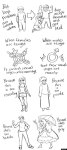
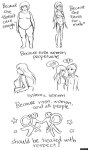
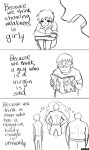
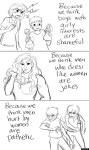
this is so great. fuck toxic masculinity. we need something like this stateside (x) | follow @this-is-life-actually

i love this so much

for all my quiet & reserved men going thru it i love u all

This!!!! Spread this message around. Crying is good!!!!

Crying is not female thing, crying is a human thing, and an animal thing, and, I dunno, maybe an alien thing too. Have a cry if you feel like it, dudes!

Review: Episodes by Blaze Ginsberg

I really wanted to like this book. I liked Raising Blaze, his mother’s parental account. It’s a personal account by an autist, which I always want more of. I even liked the idea of the format, which I know from reviews here put some readers off. But this book’s unique style and presentation soured for me very quickly for one reason – the continual misogyny and male entitlement.

Blaze’s attitude to girls his own or near his own age is disturbing. If they’re a friend, he flies into rages if he so much as sees them talking to another guy. If they’re a new acquaintance, he immediately scouts them as a potential girlfriend and demands their number or email address, then flies into a fury again if they never reply/answer. (Spoiler: None of them ever do.) This jealousy and rage even extends to girls he’s never met or seen – if he meets someone new and finds out they have a sister, then discovers the sister has a boyfriend, he immediately ‘hates’ them. That’s right – hates. And not just in a passing annoyed way – he hates them enough for it to ruin his entire day or a song he liked at the time.

For those who might say ‘he’s a teenager’ or ‘he’s autistic, he can’t do regular relationships’, stop right now. This has nothing to do with age or autism, and everything to do with toxic masculinity. Blaze is the result of a society that tells men, especially quirky men, that they’re ‘entitled’ to whatever girl they like. That if they push hard enough the woman they want will say yes and become a reflection of their desires. Blaze’s incessant girlfriend hunt isn’t born of a desire for romance, intimacy or companionship. The book seems to make it quite clear – he wants a girlfriend because it’s the next achievement marker in life. That’s why he demands the numbers of every girl he meets. The individual woman doesn’t matter, because she’s just an object to be gained; a proof of his masculinity.

The book was written some time ago, so I hope that in the intervening years, Blaze has learned more about what it means to be a receptive, not aggressive partner. Because if he hasn’t… well, women deserve better.