This post may be triggering. I’m about to talk about being fat, and my eating disorder, and an exchange I had with a new therapist at my treatment center. It’s an assumption that has become so common place it hardly phases me anymore. But it should. It needs to. Because it’s an example that even within a treatment facility with a weight set point mind set and a health at every size governing philosophy, when the staff see me, and see my body, and my size, there’s an assumption that I either have binge eating disorder or compulsive eating disorder.
I’ll share the interaction, and then why it’s so important. I sat down to an orientation for a new group I’m joining. The therapist and I have met in passing, but have had no direct interaction before this. She asked how my recovery was going. I told her I’ve had a lot of set backs over the last six months, but I’m four weeks in to eating AND sleeping, which is a huge accomplishment. I’m really starting to feel true hunger and my dietitian is thrilled that I’m actually eating. And the therapist said, “Oh, so, you mean feeling hunger and eating in a good way?”
And I just stared at her for a moment. I’ve gone for so long not knowing what actual hunger felt like, doing anything and everything to busy myself the moment my body twinged in that direction, suddenly becoming desperately busy and oh look, it’s too late now, I’ll just eat at the next meal, or perhaps the next…
When I first entered treatment, I was nauseated all the time. The amount of food on my meal plan felt impossible. Every meal was a nearly unbearable experience. My meal plan’s been raised multiple times since then. Now, I wake up hungry and cranky until I feed my body. It’s still hard to eat. But I’m doing it. Every day. So many things have changed.
But not that I’m fat.
Every now and then, I get to forgot that I’m fat for a little while. It’s usually not long before I’m reminded, before an assumption, or a seemingly innocuous question brings it back to the forefront. Right. I exist in a large body. There are a lot of assumptions that go along with that.
And my answer was a laugh, and a clear explanation, because I’ve had to do it so many times before, ticking off each thing on my fingers. “Oh! I have a restrictive eating disorder. My behaviors are restricting, purging, starvation, diet cycling, and using exercise as a way to punish my body. My meal plan is a minimum I have to eat each day, going over that is great but I can’t go below. And I have restrictions on water, because I have a history of water loading.”
"Oh!“ was her reply.
I followed immediately with the example I always use, preempting the inevitable bingeing question. “When I started here, I thought I binged. I was like, ‘I totally binge. I’ll eat an ENTIRE cheeseburger!’ And the staff was like ’…That’s not a binge.’”
And she stepped in and finished the sentence with, “…right, that’s a portion.”
And suddenly we were back on the same page. She had adjusted her internal diagnostic criteria of me, and what I struggle with, and the rest of the orientation went great. I’m excited about the group, and I think she’ll be a great facilitator. I do feel a bit heartsick though that she didn’t take a moment to look at my file, or speak to my current treatment team before our orientation. It would have saved me from that moment, where I have to explain, again, that while yes, I’m fat, the disorder that I’ve been struggling with for over 30 years is restrictive, based in control, anxiety, and trauma, as well as genetics and a solid dose of disordered modeling. The reactive eating I’ve done, what feels like bingeing to me, falls squarely in the realm of a portion, or at its most extreme, a large meal.
Now there’s some great stuff over at www.youreatopia.com and @bigfatscience & @everythingeatingdisordered if you’d like to understand how you can not lose weight, and even gain weight, while being in a restrictive state. This is especially true while diet cycling, which has been my path in between ED behaviors for the past 15-ish years. To quote @heavyweightheart “It turns out human bodies are a little more complicated than lawn mowers.” We’re not just fuel-in, energy-out robots. There are all kinds of processes that occur making us very different than, say, a car’s engine. And each of us has unique needs.
And here’s where we veer into the why: Why these underlying assumptions matter so very much, why they must be examined and challenged, and why there needs to be more open and honest dialogue around the reality of eating disorders occurring in individuals of all body sizes.
I went to my neurologist recently to discuss the increase in my migraines in both frequency and severity. I told him in clear and blunt language that I’m in the early stages of eating disorder treatment for a restrictive eating disorder and on exercise restriction. He asked why. Not kindly, or with compassion. But very bluntly. “Why?” And I explained.
He then went on to bring up weight loss three times and walking an hour a day four times in the remaining time of the appointment. Did he say these things over and over because he thought this was what was best for my overall health, taking into consideration the serious damage I’ve done to multiple organ systems with my decades of starvation and purging? No. He said these things because of the theoretical damage that could occur based on correlation between these issues and obesity. My blood pressure, pulse, blood sugar, and other metabolic measures of health look pretty damn good for someone with as many health issues as I have, none of which are weight related, but many of which are ED related.
It’s so ingrained.
You’re fat. Get healthy. Lose weight. Exercise. My psychiatrist put it really well. She said, “If you had gone in for a well check, checking in and making sure you’re eating a variety of food and getting some exercise makes sense when discussing migraines. But it’s like you went in and said, ‘I’ve been through hell. And I’m still there.’ And his response was, ‘Let’s get some walks in!’ He didn’t actually listen to you, or hear you.”
I was asked recently whether I thought there was any point when inpatient treatment would have been appropriate. And I said yes. When I was 19, and passing out daily in class, and my movement teacher told me I couldn’t return until I’d seen the doctor. They diagnosed me as hypoglycemic. I was at a “normal” BMI, the smallest I’d ever been, but still not underweight. I had never missed a period, and the fact that I worked out 2-8 hours a day showed how really dedicated I was to my health. I used the diagnosis as an excuse to become a vegetarian and cut even more food out of my diet, and learned how to eat just enough to not pass out in class. 19 years after that, I finally sought treatment.
We say it over and over and over. Eating disorders impact all manner of people. Eating disorders are mental health disorders first, and cause a myriad of health issues, further psychological issues, and relationship and social issues. And not everyone who has them is underweight. Yes, the pictures of skeletal women are the most shocking, attention grabbing, and likely to get people to raise both money and awareness, which ED treatment desperately needs. But the cost is that the rest of us, those in average size bodies, and yes, those of us in fat bodies, are receiving extremely dangerous messages, repeatedly, about our bodies, and our health.
I’m not referring to our theoretical some day health, that health that my neurologist is so focused on. I’m talking about our health right now.
My biggest wake up call in treatment was when my dietitian sat me down, looked at me seriously, and said, “We need to talk about your weight.” I flinched, sure that she was going to say that I’d gained a huge amount of weight adding in more food, that I was messing up my meal plan, that I was failing at recovery.
Instead, she said, “You’re losing weight alarmingly fast. You have to start eating again. Everyday. Your full meal plan. All that long term damage you thought you wouldn’t have to worry about?” She pulled out some charts and showed me some very scary things. “You’ve been doing this for 30 years. It’s now. The long term damage is happening now.” I was shocked. Wasn’t I supposed to lose weight? Wasn’t I supposed to shrink away into nothingness? Or at the very least, into a “normal” BMI?
My restriction, dieting, and exercise addiction were supported and even recommended to me by my doctors. And what’s so scary is that when I tell doctors outside my treatment team I’m in recovery, and on exercise restriction, it’s still being recommended. My dietitian was horrified. My therapist was furious. My psychiatrist gently but firmly suggested I find a different neurologist.
It’s hard enough to confront that what you’re doing is hurting yourself. It’s excruciating to confront that your eating disorder also hurts the people you love, and who love you. There’s no break from recovery. There’s no day off. And when you’re fat, you also deal with a daily onslaught from every direction suggesting, prodding, lecturing, even screaming at you that you are invalid in your body. That you are not worthy as a human being until you reach a certain weight. And that your well being is dependent on you losing weight.
We live in a culture where being thin is so closely aligned with being healthy, that that goal is worth anything. It’s worth a doctor telling me to actively do things that will harm me. He’s not the first. He’s just the most recent this month. Not this year. Not this season. This month. It causes assumptions so deeply ingrained that even amazing, supportive therapists at the front line of this work still catch themselves making a judgment based on the size of the body of the person sitting in front of them.
I’m having to unlearn a lifetime of information while it’s still being forcefully given to me by doctors, friends, biological family, the media, random strangers on social media, random strangers on the street, and every single packaged food loudly proclaiming it has less fat, less calories, and more all natural ingredients!!! I have had to narrow my focus. I listen to my treatment team. I do my own research. I trust the chosen few who are supporting me with everything they have.
I’m fat, and I have a restrictive eating disorder. These things can, and do, exist in the same body, at the same time. If you take anything away from reading this, know that I am not the only person who exists in a large body who has a serious eating disorder. And it may not be the kind you think.
This is so important
Thank you for sharing your experience, it will help so many people, including me.
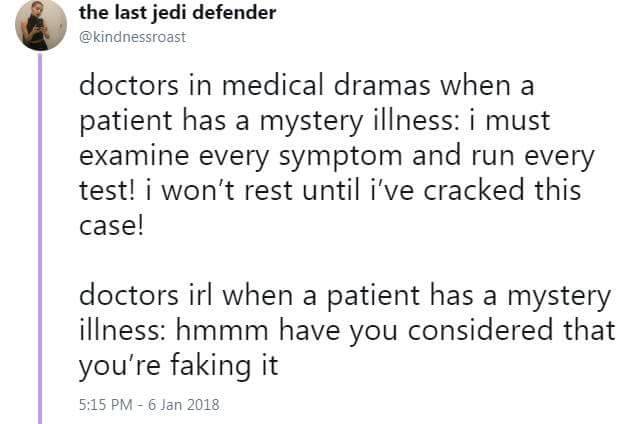
Or you should lose weight and we’ll run tests again.
I get that doctors can be assholes sometimes, but y’all making fun of people from a stance where you know jack shit about medicine compared to them
Like did a doctor say this to your face? Say that you were faking? Or were you assuming because you misinterpreted something you don’t understand?
If a doctor asks “are you SURE about xyz” it’s not because they think you’re faking, it’s because many times a patient will hold back information without realizing it and, as you ask the question again, they may remember something that they didn’t the first time.
Like idk about the specific events around the OP, and in no way am I saying that there aren’t manipulative and abusive doctors out there, but people tend to misunderstand things that they don’t know very well.
Yeah, patients do frequently get told that it’s psychological, psychosomatic, due to stress*, etc. Like, that is a really common experience people with chronic illness have, or people with “weird” illnesses like chronic fatigue, Lyme, EDS, etc.
And alas, people with weird mystery illnesses or chronic illnesses *do* often know more about their illnesses than the average GP. GPs are trained to identify and diagnose horses. They aren’t prepared for unicorns, and some think they don’t even exist.
It’s not even manipulation or abuse, it’s just being lazy, or not having the right training and not wanting to GET the right training. An ignorant doctor can do just as much damage as a malicious one.
* “Due to stress” is VALID, stress can make you very very sick, but when a doctor wants to just leave it there instead of treating it, well, that’s shitty.
I put this in tags before, but fuck it. Never mind being accused of faking it, I have had a doctor straight-up tell me, about my cardiac and neurological symptoms that have made it impossible for me to work or leave the house alone, “Huh. That’s weird. Unfortunately, we can’t do anything about that…”
No tests were run. No blood tests, no drug tests, no scans, not even a tilt-table test or the knock-off “sit down for a few minutes and then stand up while we take your blood pressure and heartrate” version of a tilt-table test that would have very quickly indicated that something is very wrong. They didn’t even suggest a referral to a specialist, the bare minimum you could do if you don’t know what the fuck you’re looking at. I’ve been suffering from a chronic, disabling condition since I was seventeen, and only now, twelve years later, have I begun to find someone who will listen and acknowledge that yeah, that’s actually a thing you’re dealing with and a problem.
Yeah, some doctors are good at their jobs. Some doctors give a shit. Some of them literally don’t listen to anything you say, and wave you off like your life-ruining symptoms are nothing, and just want you out of their office as soon as possible. All the medical training in the world doesn’t help when the person with that training fails at empathy, at listening to the people in front of them and hearing what they’re saying and acknowledging that this is a fucking human who is suffering and fixing that is literally their entire job.
“You’re probably not actually sick” or “that’s weird but I can’t fix it” is never an acceptable response, and fuck you for suggesting that chronically ill people don’t understand they’re being dismissed when almost all of us have dealt with it for literal years before we even begin to understand what’s wrong with us.
#look my stepmom is a doctor #i have a very dear friend who is in med school and I’m sure she’ll be great #but oh my god I hate doctors at large #and I have developed this hatred over years of being ignored and abused #‘maybe you misunderstood what they were saying…’ #BITE ME
I am lucky enough that my chronic illnesses are really easy to diagnose and understand for GPs: psoriasis and psoriatic arthritis. Also depression, but thankfully when you go in saying “I have depression, I have tried these prescriptions, please try me on this other prescription” most GPs will kind of go “eh, okay.” I have visible signs of psoriasis, and arthritis is pretty easy to get doctors to pay attention to, even when you’re only 25 years old.
On the other hand, we have my wife, @taibhsearachd, who explained her position above. She’s had some SERIOUS BULLSHIT going on since she was 17 years old, I have been personally privy to it, and I have accompanied her to 99% of her doctor’s appointments, and despite BOTH our best efforts at getting doctors to listen – seriously, ME FROM THE OUTSIDE explaining shit that I could VISIBLY OBSERVE – we still got shit like, and I reiterate that this is literally what we were told, “Huh, that’s weird, too bad we can’t do anything about it”. Without ANYTHING BEING TESTED AT ALL.
And like, even for shit that should be easier to deal with, like “i’ve been diagnosed with clinical depression and my antidepressants don’t work anymore and I need a new one”, I’ve LITERALLY WITNESSED a goddamn doctor dismiss her request for a prescription with the statement “You’re too pretty to be depressed”
Some doctors are good. But unfortunately MANY OF THEM are fucking shit at their jobs. They, like the girl in the cubicle behind me plans on doing, became doctors for the money or prestige, or just don’t give a shit about things they’re not interested in, or WHAT THE FUCK EVER, and they are BAD AT THEIR JOBS and they ACTIVELY AVOID HELPING PEOPLE WHO DESPERATELY NEED THEIR HELP.
And that is a goddamn FACT.
Your daily reminder that dismissal of women’s reported symptoms in health situations straight up kills them.
Also, your regular reminder that if a marginalised person who has experienced discrimination says, “You’re hurting me”, your response should never be, “No, I’m not.” It should be, “Oh shit, I should listen to your words and not do that again.” Otherwise, you’re deliberately making the choice to perpetuate the harm against a vulnerable person, and that makes you an abuser. If your response is, “maybe you imagined it/misinterpreted the situation/exaggerated it”, you’re gaslighting them, and are an abuser. If you use the vulnerable person’s physical health/mental health/disability/race/class/religion/gender/sexuality as an excuse for how they’re treated differently, then you’re an abuser and a bigot and possibly a eugenicist. And if you use your status to do this to people on a regular basis because you think that status makes you better than them, then you’re a classist tool abusing those without the status to fight back.
@i-ran-over-the-easter-bunny should read what I just wrote and read what they wrote again and have a good hard think about why they’re so eager to jump in and defend people in a position of power over vulnerable sick people. Why they’re so willing to dismiss the testimony of victims of systemic violence and abuse (neglect IS violence), and accept that medical professionals THEY DON’T EVEN KNOW are morally and professionally pure and never inclined to ignore, dismiss or gaslight the people in their care because it’s easier than actually doing their damn job. People with complex and/or undiagnosed health conditions often have to become experts in their own health because doctors often don’t have enough specialised knowledge to treat them without making the choice to educate themselves further, which many are just not bothered to do. It’s just so much easier to write ‘anxiety’ or ‘obesity’ or ‘drug seeking’ on a file and forget about them.
For an example, the average dignosic window between symptoms reported and diagnosis for Ehlers Danlos Syndrome is ten years. It took my partner thirty years and probably over twenty health professionals to get a diagnosis, and only then because we did our homework and asked for referrals for a specialist who could diagnose that specific condition. Even now, with a diagnosis, we are running into doctor after doctor who are convinced it’s another specialist’s problem, including a cardiologist who acknowledged, only when pushed for clarification, that she had an electrical problem with her heart, potentially serious, but that he ‘wasn’t going to do anything about it’. In those words. Tell me who’s faking it, who knows jack shit, who misunderstood something about a cardiologist who can’t be bothered to treat a potentially serious heart condition, when it’s LITERALLY HIS JOB.
Inexplicably annoyed by men writing about knitting!
???????
The tags on this are extraordinary:
girlfriend: *does a completely harmless craft that she enjoys, creating something while she watches tv*
boyfriend: “what is this anti-feminist spinster shit, i’m so alienated”
this is literally why I feel like I have to apologize for sewing
“sweetly oblivious old ladies” Hon I 100% guarantee to you that those old ladies are aware of you, your bloodline, your daily habits and your breakfast order and gossip about how rude you are as soon as you leave.
“If you want to eavesdrop on someone, knit or sew or some sort of womanly craft. Men will act as though you are deaf and blind even when shown evidence otherwise.” – Tricksters’ Choice.
I sourced this one a while back and I was really glad I did. It’s from the book Knitting Yarns: Writers on Knitting, an anthology in which “twenty-seven writers tell stories about how knitting healed, challenged, or helped them to grow.” The passage in question, from a story by Andre Dubus III, describes the writer’s state of mind after going through some problems with his family and having a fight with his girlfriend. Part of his difficulty is that their class disparity has recently come to the fore (his family is working-class, she was born into wealth; the “busywork” line seems a little more pointed), but mostly it’s that he feels disconnected from his roots and craves the easy connection to the past that his girlfriend’s art represents. Look at the way that even this out-of-context passage is written: his apparent contempt barely disguises his envy of her ease and skill, “her fingers working the needles and yarn without having to peek.” The entire arc is about how, finding himself compelled by her craft despite himself, he asks her to teach him to knit so that he can make a Christmas present for his aunt, and, in the process, comes to realize that there is more to knitting than the shallow ideas he read into it before he really understood it.
It’s sad that a man who wrote honestly about the impact that a “womanly art” had on his life got skewered (no pun intended) on the Internet because of this contextually necessary lead-up passage in which he outlines the negative stereotypes that stood in his way and pokes fun at his own immaturity.
My partner and I used to do a biannual local craft market, selling our own handknitted and handmade goods. One of the elderly ladies who ran the trash and treasure side of the market was talking to us about it, about how her own mother? grandmother? I can’t remember, was never without something to do with her hands. She said that she talked to her about it, and she said, “Well, Bea, sometimes a lady needs to sit down.” Bea clarified that she was talking euphemistically about pregnancy. She was also talking about male expectations of female productivity. That if your man came home at the end of the day, and said, “well, what have YOU done all day?” that you could then trot out a list of mending, knitting and handcraft (in addition to the staples of cooking and cleaning) to justify your upkeep. So, yeah, if a dude has a problem with a girl doing handcraft in her spare time, he should know that it’s his damn fault women are conditioned to be busy and productive even in her leisure, and maybe question exactly what benefit he brings the family unit by playing video games.
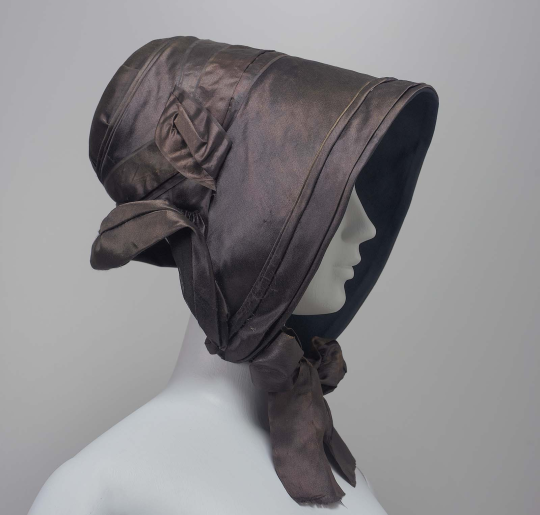
I CAN EXPLAIN THIS so basically there’s this type of bonnet called a ‘poke bonnet’ and they look like this:
and in the regency there was this trend of the front part getting longer and longer until you couldn’t really see the wearer’s face… and people have been mean for all history and love to really deride and rip into the fashion trends of young women, so satirical cartoons like the one above popped up that were basically trying to say ‘hurr dburr stupid poke bonnets soon we won’t even be able to talk to women unless we stick our damn FACES INSIDE THEIR HATS!’
and yeah so that’s why we have a drawing of what looks like women sucking men’s heads off floating around tumblr
let’s bring back poke bonnets so ppl will have to leave me alone
I think the most compelling part of this comic is the two women in the background who are having a conversation without their bonnets even touching but all the men feel they have the right to invade the women’s spaces as much as possible
i know right? the woman in pink is clearly not having a good time
Satirical Regency Artist: Women, if these hats get any bigger, it’s going to be very difficult for men to mash our faces right up against yours!
Regency Hatter: *maintains eye-contact as she sews a massive goddamn brim onto a new hat* Imagine that.




 knitting in the dark