Lord of the Rings/Hobbit Art by Megatruh
I cant believe someone beat me to do a master-post of my own art e_e
but I appreciate the credit though~
Tag: the hobbit
this isn’t a fucking competition, bard.
I…I recognize the joke, but these are totally different kinds of bows, each with its own benefits and suited to its user.
Bard’s using a longbow.
- Longbows are awesome and take a fuckton of regular practice to use, because the muscle strain required to be a longbowman(/woman) actually deforms the arms and back of the user.
- “Bard the Bowman” is still known by that sobriquet even though he’s low status, his family’s life and profession changed when the dragon attacked. Why would he be called that, if not that he’s still in regular practice and people see him using the thing over and over and over?
- Longbows are less-damaged by damp than composites, being made of once single piece of wood rather than layers of material, which is handy if one lives in the middle of a freaking lake.
- The longbow changed the face of warfare in real life, esp. for England. They’re effective killing machines over long distance, even against armored enemies.
- Conclusion: Bard’s a tank-muscled distance shot used to fighting with good sightlines.
Legolas and Tauriel use recurve bows, albeit in different styles.
- Legolas’ looks like a Turkish bow, though I don’t recall seeing him use a thumb draw (which is not mandatory if you’ve got super strong elf-fingers, I guess).
- Tauriel’s looks to be a Scythian composite bow by the shape.
- Composite recurve bows are much easier to use in confined spaces and at odd angles.
- They have been historically used by folks who specialize in archer tricks like multiple arrow shots (a thing we have seen Legolas do).
- Because of the curves, composites pack heavy draw weight (the factor that determines with what force, i.e. how fast and far, the arrow will travel) into limited space.
- Short draw (the distance you have to pull back the arrow to shoot it) means a quicker release time and quicker time to get your next arrow on the string.
- Legolas and Tauriel fight in a forest, not know for long sight lines or easy travel, nor for enemies who can be seen coming. They need weapons that won’t be getting caught on a bush at an inopportune time. Likewise, you see fewer spears and longswords among the elves of the Greenwood.
- Conclusion: Legolas and Tauriel are guerrilla fighters from a heavily-forested territory and their weapons reflect that.
Kili also uses a composite recurve bow.
- For practical purposes, note that Kili has significantly shorter arms than any of the other archers here mentioned. Long draws, like on Bard’s longbow, are not feasible and that means he’s not going to get the power he is capable of producing.
- Dwarves are fucking strong, all right? That wee little bow looks very like the Mongolian horse-bow in size and shape that my friend used with a draw weight of 55 lbs. (I’m not a weakling and I can draw 35 for a decent length of time when in practice). Kili’s could easily be upwards of 75-100 lbs.
- Kili’s a hunter. Likely, his main concern with a bow (when not following his uncle on an inadvisable quest) is the procurement of dinner for his family. To do that with a bow you need to be very quiet or very quick on the draw. Dwarves are not known for being super-quiet, though I believe I remember something about Fili and Kili being better at that than is typical.
- Anything that can kill a deer can probably kill a person (or an orc). That little horse-bow can easily kill or maim.
- Conclusion: Kili is a hunter. He uses a bow that allows for the production of a lot of power at short notice and is suited to his size and strength.
Bigger is not always most effective. Your medieval weaponry rant has concluded for the day, unless someone wants to talk to me about swords.
LotR + Blades
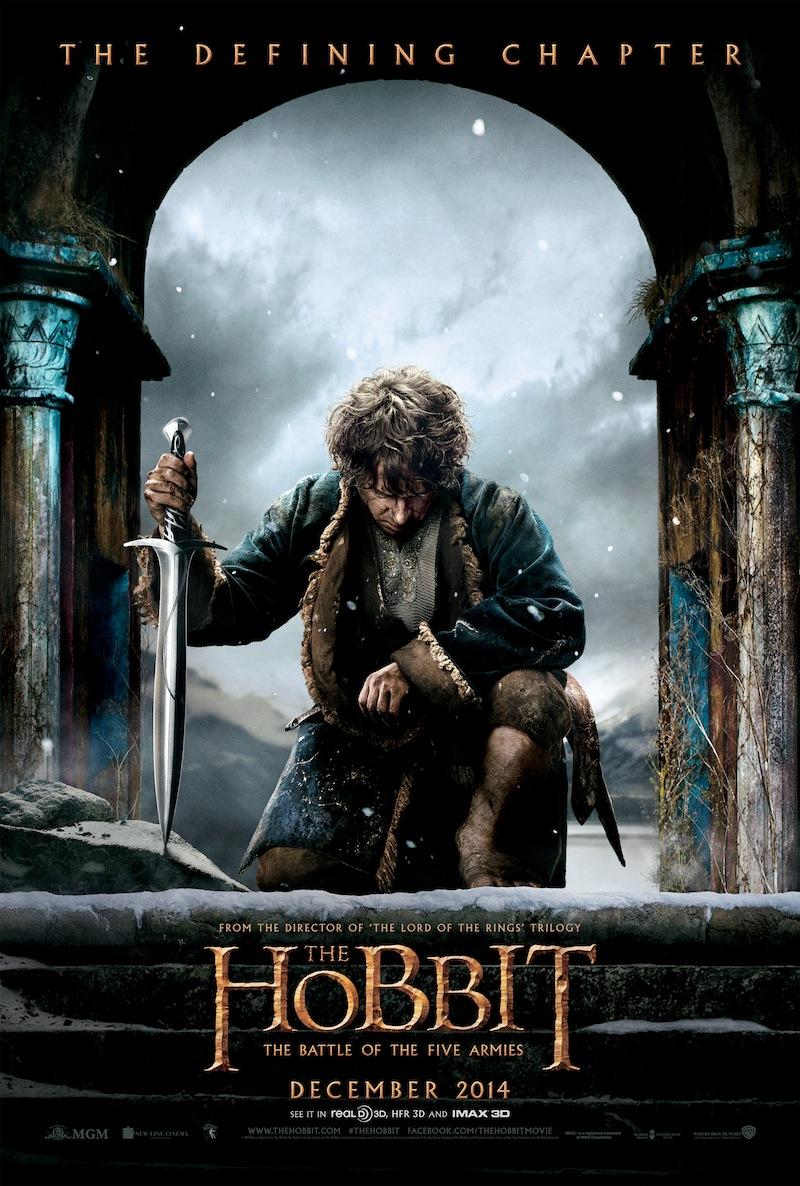
The crouching cover is in this year…
I fully expect to see Bilbo on the cover of DoS in this pose.
Edit: FUCKIN CALLED IT
oh my god

What were your inspirations, especially since [Tauriel] is a completely created character; what brought you to bring that power because there were a lot of ways you could have played that role that would have been along the lines of what we usually see for a girl in an action movie where she’s not in the adventure, she’s the prize…?
Reblogging not just because special effects are cool but because body doubles, stunt doubles, acting doubles, talent doubles — all the people whose faces we’re not supposed to see but whose bodies make movies and tv shows possible — these people need and deserve more recognition. We see their bodies onscreen, delight in the shape and motion of those bodies, but even as we pick apart everything else that goes on both on and behind the screen, I just don’t see the people who are those bodies getting the love and recognition they deserve.
We’re coming to love and recognize actors who work in full-body makeup/costumes, such as Andy Serkis, or actors whose entire performances, or large chunks thereof, are motion captured or digitized (lately sometimes also Andy Serkis!). But people like Leander Deeny play an enormous part in making characters such as Steve Rogers come to life, too. Body language is a huge part of a performance and of characterization. For characters/series with a lot of action, a stunt person can have a huge influence on how we read and interpret a character, such as the influence Heidi Moneymaker has had on the style and choreography of Black Widow’s signature fighting style. Talent doubles breathe believability and discipline-specific nuance into demanding storylines.
Actors are creative people themselves, and incredibly important in building the characters we see onscreen. But if we agree that they’re more than dancing monkeys who just do whatever the directors/writers say, then we have to agree that doubles are more than that, too. Doubles make creative decisions too, and often form strong, mutually supportive relationship with actors.

Image 1: “I would like to thank Kathryn Alexandre, the most generous actor I’ve ever worked opposite.”
Image 2: “Kathryn who’s playing my double who’s incredible.”
[ Orphan Black’s Tatiana Maslany on her acting double, Kathryn Alexandre, two images from a set on themarysue, via lifeofkj ]


I’ve got a relationship that goes back many, many years with Dave. And I would hate for people to just see that image of me and Dave and go, “oh, there’s Dan Radcliffe with a person in a wheelchair.” Because I would never even for a moment want them to assume that Dave was anything except for an incredibly important person in my life.
[ Daniel Radcliffe talking about David Holmes, his stunt double for 2001-2009, who was paralysed while working on the Harry Potter films. David Holmes relates his story here. Gifset via smeagoled ]
With modern tv- and film-making techniques, many characters are composite creations. The characters we see onscreen or onstage have always been team efforts, with writers, directors, makeup artists, costume designers, special effects artists, production designers, and many other people all contributing to how a character is ultimately realized in front of us. Many different techniques go into something like the creation of Skinny Steve — he’s no more all Leander Deeny than he is all Chris Evans.
But as fandom dissects the anatomy of scenes in ever-increasing detail to get at microexpressions and the minutiae of body language, let’s recognize the anatomy in the scenes, too. I don’t mean to take away from the work Chris Evans or any other actors do (he is an amazing Steve Rogers and I love him tons), but fandom needs to do better in recognizing the bodies, the other people, who make up the characters we love and some of our very favourite shots of them. Chris Evans has an amazing body, but so does Leander Deeny — that body is beautiful; that body mimicked Chris Evans’s motions with amazing, skilled precision; that body moved Steve Rogers with emotion and grace and character.
Fandom should do better than productions and creators who fail to be transparent about the doubles in their productions. On the screen, suspension of disbelief is key and the goal is to make all the effort that went into the production vanish and leave only the product itself behind. But when the film is over and the episode ends, let’s remember everyone who helped make that happen.
[ Sam Hargrave (stunt double for Chris Evans) and James Young (stunt double for Sebastian Stan, and fight choreographer), seen from behind, exchange a fistbump while in costume on the set of Captain America: The Winter Soldier. Image via lifeofkj ]
I applaud these guys as much as the suit actors in my japanese tokusatsu shows. They do just as much work.
Hat’s off to them, and my thanks for all they do.


Reblogging this again for the wealth of extra info added since the last time I saw it. Thank you, body and stunt doubles everywhere.
Beautiful Custom Artwork from the Hobbit (Part 2) – Created by Kinko-White
You can find more of the artist’s phenomenal work on Facebook and Tumblr. You can see our previous feature on this artist’s Hobbit Artwork here.
This is amazing
 knitting in the dark