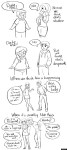
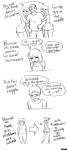
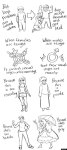
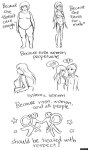
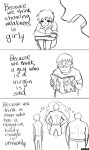
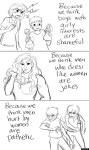
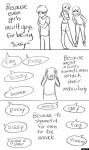

Reasons why sexism is wrong
I reblog this every time I see it. This means so much to me
lazerprincess is Leelah Alcorn for those who don’t know
i will always reblog
Reasons why sexism is wrong
I reblog this every time I see it. This means so much to me
lazerprincess is Leelah Alcorn for those who don’t know
i will always reblog
why is there such a stigma against wearing pads? like why is it that people who wear tampons are seen as ‘strong’ and ‘cool’? y’all know that someone people can’t wear them bc it hurts them or that they just don’t like them? stop making it seem like people who wear pads are childish and weak compared to those who wear tampons
Ok kids buckle up because I know the answer to this question because I am a bitter, vindictive person.
So my first semester of PhD work in a musicology program involved this horrible class with a professor that wanted to suck the life out of all of his students by constantly belittling them. We had to write a short paper each week and present them conference-style and then he would tear us to shreds and do it all over again next week. The purpose of the class was supposedly to have us write papers about materials that hadn’t really been looked at by musicologists yet, and my class had music in advertisements. I was also the only woman in the class and the prof was lowkey sexist so I kept trying to do feminist topics without losing my entire will to live.
So we get to the end of the semester and I am just completely out of fucks, I have one paper left to write and I say fuck it, let’s write about pads and tampons, there must be something there, right? It turns out there IS something to be said there (and this gets back to OP’s question). Early pad and tampon commercials were very similar to each other; basically here’s a product to help you stay clean during your period. But around 1980, suddenly there’s public outcry and panic over tampons due to TSS (Toxic Shock Syndrome). At that point no one really understood how TSS worked but they knew it had to do with tampons. So women freaked out and started switching to pads instead. Now the worst offender, Rely, was taken off the market and other tampon commercials got slapped with little warning signs like “This product could cause TSS” so women bought even fewer tampons. This is when the advertising strategies for the two products changed.
Pad advertisements were now about “cleanliness” and “purity” – they knew you couldn’t get TSS from pads and they were going to emphasize that fact. You’ve got women in white dresses with long hair slowly walking through fields of flowers with pastoral-y flutes in the background. And to fight back, tampon companies take it the complete opposite direction – they ignore TSS entirely and start showing businesswomen running to catch the subway, sporty women riding bikes, basically any sort either high-powered position or active woman showed up in these commercials with contemporary pop-song type music over the top. The clear intention was “yeah we know that these could cause TSS but they’re much better for your mobility, both physically and career-wise.”
I got done giving this paper and I look up to see my four male classmates and one male professor in varying shades of pale-ness and they just all sort of looked at me for a couple minutes without knowing how to respond. It’s one of the proudest moments of my PhD career so far.
Anyway the two products have been advertised basically the same ways ever since then. Now pads are much more comfortable and discreet, and we understand how TSS works and how to avoid it, but the commercial strategies are cemented. If you want to be a strong, on-the-go woman of COURSE you’ll wear a tampon because you don’t want to be one of those sissy ladies in the pastoral field of flowers over in pad-land, do you?
I really wanted to like this book. I liked Raising Blaze, his mother’s parental account. It’s a personal account by an autist, which I always want more of. I even liked the idea of the format, which I know from reviews here put some readers off. But this book’s unique style and presentation soured for me very quickly for one reason – the continual misogyny and male entitlement.
Blaze’s attitude to girls his own or near his own age is disturbing. If they’re a friend, he flies into rages if he so much as sees them talking to another guy. If they’re a new acquaintance, he immediately scouts them as a potential girlfriend and demands their number or email address, then flies into a fury again if they never reply/answer. (Spoiler: None of them ever do.) This jealousy and rage even extends to girls he’s never met or seen – if he meets someone new and finds out they have a sister, then discovers the sister has a boyfriend, he immediately ‘hates’ them. That’s right – hates. And not just in a passing annoyed way – he hates them enough for it to ruin his entire day or a song he liked at the time.
For those who might say ‘he’s a teenager’ or ‘he’s autistic, he can’t do regular relationships’, stop right now. This has nothing to do with age or autism, and everything to do with toxic masculinity. Blaze is the result of a society that tells men, especially quirky men, that they’re ‘entitled’ to whatever girl they like. That if they push hard enough the woman they want will say yes and become a reflection of their desires. Blaze’s incessant girlfriend hunt isn’t born of a desire for romance, intimacy or companionship. The book seems to make it quite clear – he wants a girlfriend because it’s the next achievement marker in life. That’s why he demands the numbers of every girl he meets. The individual woman doesn’t matter, because she’s just an object to be gained; a proof of his masculinity.
The book was written some time ago, so I hope that in the intervening years, Blaze has learned more about what it means to be a receptive, not aggressive partner. Because if he hasn’t… well, women deserve better.
This post is going to be a mess, because I’m just …untidily angry right now. It began with a series of tweets I made today about my ever-broken Datsun. The mechanic had told my husband that he was “working on that Datsun just as fast as I can because now that I’ve met her I can’t wait to get that little girl behind the wheel again.”
Little girl.
As I tweeted that I was 33 and had earned each of those years and thus preferred to be referred to as “Danger Smog-Dragon” or “Rage-Mistress” or “Ephemeral Time Lady” or “Maggie Stiefvater, #1 NYT Bestselling Author of the Raven Cycle,” a well-meaning fellow replied that perhaps I should “use [my] words, politely but firmly, to his face…” He further observed that he’d told his wife that “you know, Honey, unless you’re willing to SAY THAT to (those people), NOTHING is going to change”.
(note: please do not go search for this fellow on twitter to rage at him; this is not about him. He is set dressing, made more appropriate to the conversation at hand by the fact that he probably is a perfectly nice guy who really didn’t mean disrespect).
I told TwitterMan that I was tired of have to use my words.It’s been 33 years of using my words. Why is it my job to continuously ask to be treated equivalent to a male customer? Why is that when I arrive at a shop, I’m reminded that I have to push the clutch in if I want to start my own car? It’s 2015. Why is it still all sexism all the time?
I discovered that I was actually furious. I thought I was over being furious, but it turns out, the rage was merely dormant. I’m furious that it’s been over a decade and nothing has changed. I’m furious that sexism was everywhere in the world of college-Maggie and it remains thus, even if I out-learn, out-earn, out-drive, and out-perform my male counterparts. At the end of the day, I’m still “little girl.”
Possibly this is the point where some people are asking why this tiny gesture of all gestures should be the one to break me.
Here is the anatomy of my rage.
Step one: It is 1999 or 2000. I am 16. I go to college. A professor tells me I’m pretty. A married man in the bagpipe band I’m in tells me he just can’t control himself around me: he stays up nights thinking of myskin. Another man tells me he can’t believe that ‘a little bitch’ like me got into the competition group after a year of playing when he’s been at it for twenty years. After becoming friends with a professor’s daughter, I’m at her house sleeping on the couch, and I wake up to find the professor running his hand from my ankle bone to my thigh. I pretend I’m still asleep. I’m 17. “If something happened to my wife,” he tells me later, “I could be with you.” At my next visit to her house, I see the wife’s left a book on the kitchen table: how to rekindle your husband’s love.
Step two: It’s 2008. I finally buy the car of my dreams, a 1973 Camaro, and make it my official business vehicle. The first time I take it to put gas in it, a man tells me, “if I were your husband, I wouldn’t want you out driving my car.” I tell him, “if you were my husband, I’d be a widow.” The car requires a lot of gas. I get cat-called every other time I’m at a gas station. Once, I go into the gas station to get a drink, and when I come out, a bunch of guys have parked me in. They want, they say, to have a word with me,
little lady. We play automotive chicken which I win because I would rather smash the back of my ’73 Camaro into their IROC than have to stab one of them with the knife on my keychain.Step three: It’s 2011. I’m on tour in a European country, on my own, escorted only by my foreign publisher. I am at a business dinner, and say I’m going to my room. My female editor embraces me; my male publicist embraces me and then puts his tongue in my ear, covering it with his hand so that the crowd of twenty professionals does not see. My choices are to say nothing to avoid making a scene in front of my publisher’s people, or to say FUCK YOU. I apparently was never offered the choice of not having a tongue in my ear.
Step four: It’s 2012. I buy a race car. Well, a rally car. Someone asks my male co-driver if I’m good in bed. Someone asks me if I got sponsorship because someone was ‘trying to check the woman box.’ People ask me if I drive like a girl. Yeah, I do, actually. Let’s play a game called: who’s faster off the start?
Step five: It’s 2014. I’m driving my Camaro cross-country on book tour. It breaks down a lot. I’m under the hood and a pick up truck stops beside me. “Hey baby,” asks the driver, “do you need any help?” “Yeah,” I reply, “do you have a 5/8 wrench?” He did not.
Step six: It’s 2015. It’s sixteen years after I learned that I was a thing to be touched and kissed and hooted at unless I took it upon
myself to say no, and no again, and no some more, and no no no. My friend Tessa Gratton points out that a male author used casually sexist language in a brief interview. She is dragged through the muck for pointing out how deeply-rooted our systemic sexism is. The publishing industry rises to the defense of the male author as if he has been deeply wronged. I tweet that the language was indeed sexist, though I didn’t think it was useful to condemn said male author. A male editor emails me privately to ask me if maybe I wasn’t being a little problematic by engaging in the discussion?Step seven. Still 2015. Someone very close to me confesses
that her college boyfriend keeps trying to push her past kissing, and she doesn’t want to. I tell her to set boundaries, and leave him if he doesn’t. A month passes. This week I find out she just had sex for the first time after he urged her to have several glasses of wine. She doesn’t drink. She was crying. She says, “I didn’t say no, though.”It’s been sixteen damn years. I’m tired of having to say no. I’m tired of the media telling me that it’s mouth breathing bros and rednecks perpetuating the sexism. No: I can tell you that the most insidious form is the nice guy. Who is a nice guy, don’t get me wrong. I carry my own prejudices that I work through, and I don’t believe in demonizing people who aren’t perfect yet — none of us are. But the nice guy who says something sexist gets away with it. The nice guy who says something sexist sounds right and reasonable. The nice guy’s not helping, though. It’s been sixteen years, and the nice guys are nice, but we’re still things to be acquired. We are still creatures to be asked on dates. We are still saying no, still shouting NO, still having to always again and again say “no, please treat me with respect.”
I was just invited to a car show; the well-meaning guy who asked wanted me to bring my souped up Mitsubishi. I clicked on the event page. It’s catered by Hooters. I’m not going. Yeah, it’s a little thing, but I have a lifetime of them. I’m taking my toys and going home.
“I can’t wait to get that little girl behind the wheel
again.”
On respect.
In the world of superheroes, because it’s such a melodramatic world with operatic undertones to it, most of the best ones have some sort of tragedy, deformity, or disability that is meant to add depth and poignancy to their heroism, whether that’s Bruce Wayne sobbing over his parents’ bodies or Bruce Banner forced to live a life of emotional repression in order to keep his dark side at bay. You could argue that Peggy’s cross to bear is Steve’s death, but we’d argue right back that she’s mourning him in a more or less normal, human way and her grief seems to be following a healthy evolution. No vows to dress like a flying rat over his grave or anything. She’s just taken what she’s learned from him and letting his memory inspire her. No, her cross is even more basic than that. In order to protect her mission from her co-workers, Peggy has to become the bumbling, ineffective Clark Kent/Peter Parker type, hiding her victories and strength from the very people she so desperately wants to notice them. And because this show is using the patriarchal and chauvinistic attitudes of the day as a backdrop for this story, Peggy’s sacrifice becomes all that much more poignant. She has to pretend to be dumber than she is and take no credit for her work in front of a group of men who already think it’s an insult that she be allowed to work alongside them at all. Peggy Carter’s kryptonite IS the patriarchy.
And yet fanfiction is an inherently transformative work which, by its very nature, strives to address or change some flaw that exists in canon, even if that flaw is “why isn’t there more of this thing?!” Fanfiction has addressed the lack of gay men by making straight characters gay; it’s addressed countless cultural misappropriations with wildly varying AUs; it’s addressed canon plot holes and timeline issues with fix-it fics and crossovers. Fanfic is the show your show could be like, if only you dared to dream.
But for all its transformative nature, fanfiction and fandom still suffer from a real dearth of femslash. Beyond the simple fact that very few girls exist in canon materials, the societal emphasis on the male gaze seems to have affected fanficcers’ creativity to such an extent that even in our own fantasies, we cannot give women a fair shake. Just as the answer to “Why is there so much slash?” cannot be boiled down to “ Well, straight girls are horny”, the answer to “Why isn’t there any femslash?” cannot be boiled down to “Well, straight girls don’t care.” The bias against female characters and female pleasure is an ingrained, institutionalized problem which won’t go away on its own.
interesting
(via spiralstreesandcupsoftea)
breaking news: someone admits they were wrong on the internet.
thank you, Agent Carter, for being the hero we need and the hero we deserve.
I really give a lot of kudos to the men who are strong enough and fair-minded enough to realize they were wrong, and to admit to it after realizing it and changing their thinking. This is great. And it gives me hope that we can turn the tide against sexism.
I certainly don’t think former assholes deserve a parade just for having an epiphany, but this comment is a good example of the right way to acknowledge that you’ve been doing it wrong and want to change.
IN THE MARVEL CINEMATIC UNIVERSE THE AO3 PROBABLY HAS A WHOLE SECTION ON THE CAPTAIN AMERICA ADVENTURE HOUR.
I BET PEOPLE GET INTO FIERCE FIGHTS OVER WHETHER IT COUNTS AS RPF OR FPF
Bucky/Steve was probably the Kirk/Spock of the MCU.
Also? You just know there were little girls who wanted to play and write fic where Betty Carver was a badass lady who worked to take down Hydra no matter what Cap did.
And said little girls were probably told they were doing Betty totally OOC and to stop making her into such a Mary Sue.
HEY SO LET’S TALK ABOUT THIS BECAUSE THIS IS MAYBE THE MOST IMPORTANT ADDITION TO ANY POST ON TUMBLR AND I’M INCLUDING THE PERSON WHO DEFENDED THE EYEBROWS-ON-MONA-LISA PERSON BY TALKING ABOUT PARENTS MEETING IN CLOWN CARS IN THIS ESTIMATION.
Because this is it. This is the meta-statement we’ve been waiting for. This is the explicit textual acknowledgment, within the Marvel universe, that some of the earlier beloved stories about favorite characters got things wrong. They misrepresented things. They played up the accomplishments of (say) the dashing straight white man, while minimizing the role of others.
This is the closest we’re probably ever going to get within the universe, rather than within the metatext, to the idea that women as “Mary Sues” is bullshit, and the real truth is that women were amazing all along and the text was biased towards a straight white male perspective.
This is the permission (not that we ever needed it, but good to be granted anyway) that we can look at early comics and movies and say “Oh, I see, this is the part where Pepper or Peggy or Betty or Jane or whoever saved the day but the story had to pretend it was the guy.” By making this explicit within the MCU, they are (perhaps inadvertently, IDK) giving the same permission to us in the real world.
I’m not saying this is actually what was intended, but I would argue this is a valid reading supported by the text.
This reading works really well on the Fantastic Four. The earliest stories tended to concentrate more on the three men, but Sue eventually got “powered up” so she was on par with them. This can easily be interpreted as the stories slowly having to catch up with what was actually happening.
YES.
Some poor comics editor in this ‘verse had to be like “Sir, we have a problem. People are finding these comics unbelievable.” “Is it the man on fire or the man made of rock?” “No, those are fine, obviously. It’s just- seeing how competent the Invisible Woman is on the streets of their hometowns is making them question the Invisible Girl in our stories.”
 knitting in the dark