Resistance can take many forms – from education to litigation, from within a small community to throughout the globe. Though I have omitted highly important figures like Yuri Kochiyama and Fred Korematsu, I wanted to spotlight lesser-known individuals who resisted injustice in a variety of ways. They demonstrate that we too can act against oppression and inequality, however we are able.
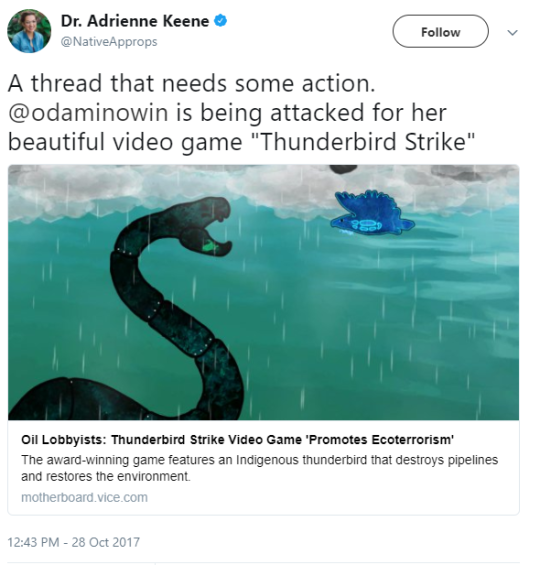
In Thunderbird Strike, a new side-scrolling game that launches at the ImagineNATIVEfestival this week in Toronto, players can control a thunderbird—a symbol in several Indigenous cultures—that destroys as much of the oil industry’s machinery and pipelines as it possibly can. And it’s so satisfying.
The game was created by Elizabeth LaPensée, an Anishinaabe, Métis, and Irish games developer, and assistant professor of media and information at Michigan State University. She told me in an interview that she wanted to create a game where Indigenous players could reclaim some agency around oil pipelines, even if through a video game.
“Especially when we’re talking in the context of pipelines, and the oil industry, there are some wins we can have. But ultimately protectors will be pushed out and the processes are going to move forward. It’s happening with mining and it’s happening with pipelines,” LaPensée told me over the phone.
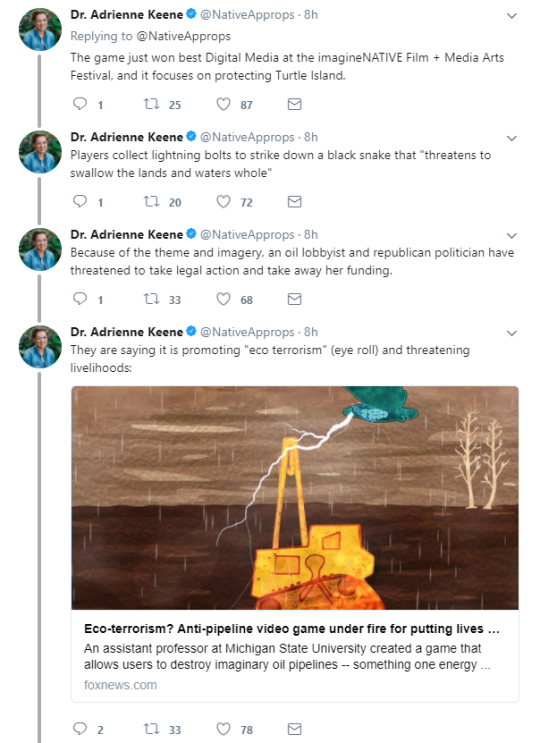
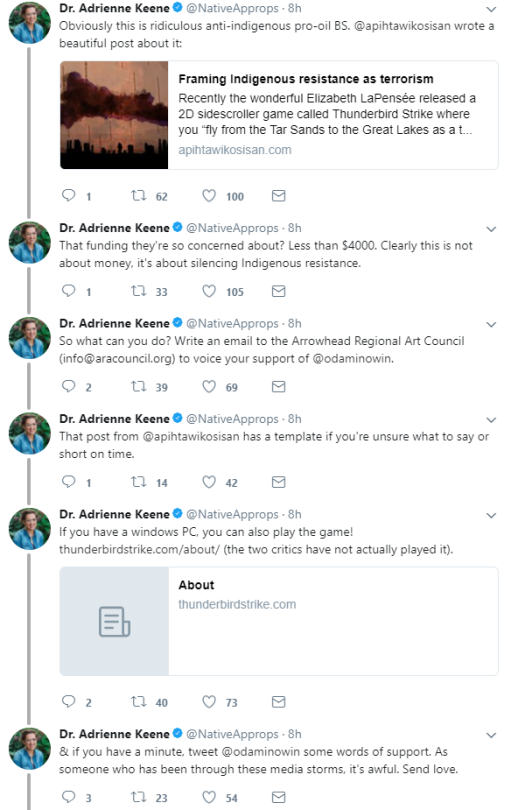
The creator of this game is getting attacked and defamed by oil lobbyists and racists
(and let’s be honest, the venn diagram circle of “oil lobbyists” is just a small circle in the larger circle of “racists”) and could really use support and advocacy:
A comic about looking after yourself, your loved ones and your mental health during the tough times ahead. I started this last November, when people were hurting so hard it was difficult to function – I’m sorry it took me so long to finish it.
This is really important for those of us with chronic illness, mental illness, and disabilities, for whom marching is a dream, for whom calling politicians is an impossibility. I am queer, mentally ill and developmentally disabled. Any of these alone makes me marginalised in a society that lauds the healthy, the efficient, the successful, the conventional. Just by existing, just by refusing to pretend I’m anything but what I am, I am fighting. And by stimming in public, by wearing clothing that is both comfortable and reflective of my political beliefs, by holding hands with my partner, I am being the change I want in the world. I am carving a niche for myself and taking the space people would deny me. I am fighting for those who cannot do as much as I can.
 knitting in the dark