Hi! It’s been a long time since I’ve been on Tumblr, so thanks if you’re still following me!
Today is the paperback release of my second book, Little & Lion (how beautiful is that new cover?), and since a few people have asked about my Stonewall speech, this seemed like the perfect time to post it! I forgot to have someone record it, so you don’t get to see me cry, but I’m posting the text below. Thanks for reading!
It is such an honor to be here. Thank you to the Stonewall committee for this award, which is such a highlight of my life and career.
People often ask why authors write the books that we do, and the answers always vary. I wrote this book for several reasons, but I asked myself a few times why I was writing a queer character when I myself do not identify on the LGBTQ spectrum.
I was born and raised in Springfield, Missouri, a conservative town in a conservative state with a population that is overwhelmingly white, Republican, and Christian. I was raised in one of the few black families in our town; I’ve written and talked about the history of racism in Springfield, but suffice to say I was no stranger to the intolerance that wove its way through the southwest pocket of the state. Most places I went, I was seen as “different”—constantly reminded of my darker skin and tightly curled hair.
The first time I remember seeing someone “different” from me was when I met a girl named Kathy Z in first grade. Kathy was a sweet girl with white-blond hair and a gap between her two front teeth. She was also born with a congenital hand deformity. When I went home that day, I immediately asked my parents about Kathy’s hand. I wanted to know if it was okay to hold her hand at recess like the rest of the girls and I did. My parents exchanged a glance before they told me that her difference didn’t mean anything other than that—her hand was different from mine.
My parents made it very clear that “different” wasn’t synonymous with bad. And they told me plainly that I wasn’t better than anyone else, and that was no one was better than me. I’ve never forgotten that.
But it also became clear from a pretty early age that most people in our town didn’t think that way. I grew up fielding assumptions based on my skin color from people who didn’t know me, and from people who should have known better. And I wasn’t the only one.
Queerness wasn’t something that was accepted or openly discussed where I grew up. Homosexuality wasn’t decriminalized in Missouri until 2003, when the Supreme Court case Lawrence v. Texas invalidated sodomy laws in the remaining fourteen states that upheld them. Conversion therapy is still legal in Missouri, and one of the current US senators from the state proudly voted against marriage equality.
This is the environment I grew up in. It is the sort of environment that likes to constantly remind you of what you are if you are not straight, cisgender, white, and able-bodied.
I don’t recall the first time I recognized queerness, but I watched a lot of television as a small child in the ’80s, MTV in particular, so I’m pretty sure it was George Michael in the video for “Wake Me Up Before You Go Go.” I also went to a black Baptist church every Sunday, and it was there that I learned queerness was considered a sin in the Bible. That never sat right with me, even before I was old enough to truly understand what it meant. There were not-so-quiet rumors swirling through the church about the man who played piano for the gospel and youth choirs. He brought such joy to the congregation each week with his music, but even if he hadn’t, I didn’t understand how he could be more of a sinner than everyone else simply because of whom he loved.
I worked at a hardware store throughout high school and college, and one of my favorite coworkers was a man named Kyle. He was funny, charming, and the first openly gay person I’d ever known. I was eighteen years old. We became fast friends, and, shortly after, his boyfriend, Fred, began working there. They were eventually married in a civil union that was, of course, unrecognized by the state of Missouri in the late 1990s. For years, I was the only black person to work in our store of more than two hundred employees, and Fred and Kyle were the only openly queer people there. I always felt a camaraderie with them. Maybe it was because we were all considered “different” in our small town and in that big store. Maybe it was because no matter how “different” the three of us were, we always demanded respect from our coworkers and customers, and in most cases, we received it.
I continued to live in Springfield throughout college, and less than a month after graduating with a journalism degree, I packed up my things and moved across the country to Los Angeles. In Little & Lion, Suzette is sure that she witnesses Lionel falling in love at first sight with her crush Rafaela. I am certain if someone had captured the look on my face when my U-Haul touched down in Los Angeles, they would have seen that same expression.
I was instantly smitten with L.A. Of course the weather was perpetually gorgeous, the city was surrounded by beaches and mountains, and sixteen years later, I still can’t get over the palm trees. But what struck me the most was how everyone in Los Angeles was allowed to just be. There were people all different shades of brown, speaking different languages and not drawing strange looks because of it. There was a neighborhood predominantly populated by Orthodox Jews, and there was Boyle Heights, Chinatown, Little Tokyo, Koreatown, and Leimert Park, all ethnic neighborhoods celebrating long histories of strong cultural identity. My mouth dropped open the first time I spotted a police car in the city of West Hollywood. I couldn’t believe what I was seeing: Their cruisers all have rainbow flags emblazoned on the side. Los Angeles felt so good to me because you didn’t stand out for being different—everyone was different, and those differences were celebrated.
I’ve heard that some readers believe Little & Lion is “too diverse.” I write to reflect the world around me, and my world in Los Angeles is incredibly diverse and rich with various cultures. To imply that a story is unbelievable because it depicts a bisexual Jewish black girl falling for a pansexual Latina and a half-Korean half-black boy is insulting to the very people living those lives.
I was once a little black girl in a very white town, dying to read about someone who looked like me. To validate my existence. I was in college before I saw myself in books, and it instantly made me feel less alone. As an author, it is a privilege to write books that can serve as a mirror. But Suzette is not me. I have, sometimes to my great consternation, always been a bit “boy crazy.” I don’t know what it’s like to be a bisexual girl, and I was worried I’d overstepped my bounds in writing her story, despite the work I put into making her experience read as authentically as possible. I can empathize through my experiences living with racism, but I’m well aware they aren’t the same experience.
By the time the Stonewall committee called to share the good news earlier this year, I’d convinced myself that I should not have written this book. I don’t think anyone was more shocked than me, though, when statistics were released on the number of books published with black girl protagonists written by black women in 2017. The numbers were bleak, but even bleaker was the fact that Little & Lion was the only one of those books to feature LGBTQ content.
It’s my wish that in the very near future, there are so many books about queer black girls—hopefully written by queer black authors—that we don’t have to count them. And it is my lifelong hope that we remember to love and respect each other, and continue to celebrate everyone’s differences and identities. I truly cannot wait for the day that “diversity” isn’t a buzzword or an initiative, and when inclusivity is an integral part of publishing and the world.
I am extremely honored to receive this recognition for Suzette’s story, particularly during LGBTQ Pride month. Thank you to the Stonewall Award committee for recognizing my work, especially in a year that saw so many beautiful, groundbreaking books published about teens spanning the LGBTQ spectrum. I am so grateful to my editors, Alvina Ling and Kheryn Callender, who gave me the smart and honest feedback I needed to make Little & Lion the book it is today. And I would not be standing here without the incredible support and love of my agent, Tina Dubois, who championed this book in its early stages and encouraged me to write what was in my heart.
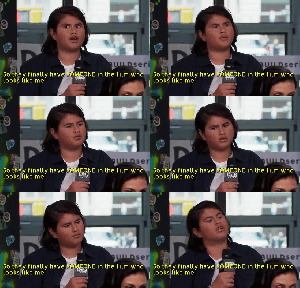
Julian Dennison is out here preaching about the importance of body diversity and representation in the media and I’m honestly so here for it.
“Deadpool is a quirky universe, which is all about being outside of the box, unlike a normal superhero film,” he says, adding that he’s always been confident and comfortable with his body image. “For me, personally, it’s really cool to play someone who other people can finally look at it and see that a bigger person can portray this awesome character.” [x]
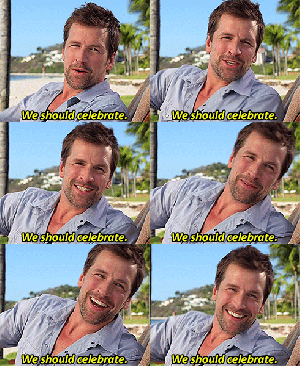
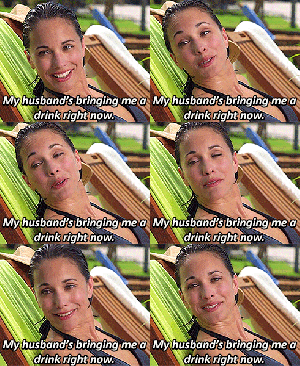
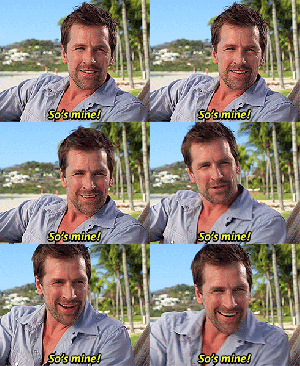
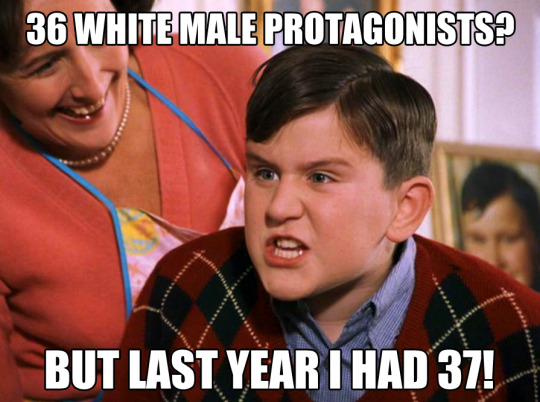
i had a moment today while watching a whiny shitlord complain about the injustice of new sci-fi media having more female leads, i suddenly felt the strangest sense of déjà vu. i couldn’t pintpoint it at first but then out of nowhere, it fucking dawned on me
This is the single greatest meme in the history of the Internet everyone can stop making memes now we don’t need any more ever again
I think I’ve already reblogged this but I don’t care it’s just pure gospel
React just did an episode where their reactors got to see a full screening of the movie, and it’s great! Especially since over half of the reactors they had (Danny, Morgan, Sharon, Jonathan, and Dionte) are gay and shared their stories and how much the movie affected them. Also everybody was crying.
Other than that this was a genuinely great book, after reading it I immediately passed it on to my best friend, a gay man, and I’m super psyched about the film??
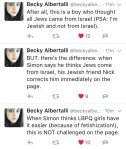
Also: Becky’s new book, Leah on the Offbeat, is about Simon’s friend Leah realising she’s bi so maybe she’s gonna help Simon unlearn some of his misconceptions and prejudices? Keep an eye out – the book releases in late April 🙂
Actually just on that, Becky has said that Leah has known since she was 11 that she was bi!








 knitting in the dark