The only reason “coming out” is still even a thing is because it’s presumed that people are straight until they tell us otherwise. “The Other must identify itself, or else it is decieving us” is a fucked up, dangerous idea.

Anon (via victor-the-richter)

Fuck, such a good point!

(via phiasmir)

It also feels very similar to this when revealing you have an invisible or mental disability. People are somtimes angry that they weren’t told right away as though it changes everything about you.

(via ericadawn16)

You are 12. You’re at the library looking for some generic young adult fiction novel about a girl who falls for her best friend. Your dad makes a disgusted face. “This is about lesbians,” he says. The word falls out of his mouth as though it pains him. You check out a different book and cry when you get home, but you aren’t sure why. You learn that this is not a story about you, and if it is, you are disgusting.

You are 15. Your relatives are fawning over your cousin’s new boyfriend. “When will you have a boyfriend?” they ask. You shrug. “Maybe she’s one of those lesbians,” your grandpa says. You don’t say anything. You learn that to find love and acceptance from your family, you need a boyfriend who thinks you are worthy of love and acceptance.

You are 18. Your first boyfriend demands to know why you never want to have sex with him. He tells you that sex is normal and healthy. You learn that something is wrong with you.

You are 13. You’re at a pool party with a relative’s friend’s daughter. “There’s this lesbian in my gym class. It’s so gross,” she says. “Ugh, that’s disgusting,” another girl adds. They ask you, “do you have any lesbians at your school?” You tell them no and they say you are lucky. You learn to stay away from people.

You are 20. You have coffee with a girl and you can’t stop thinking about her for days afterwards. You learn the difference between a new friendship and new feelings for a person.

You are 13. Your mom is watching a movie. You see two girls kiss on screen. You feel butterflies and this sense that you identify with the girls on the screen. Your mom gets up and covers the screen. You learn that if you are like those girls, no one wants to see it.

You are 20. You and your friends are drunk and your ex-boyfriend dares you to make out with your friend. You both agree. You touch her face. It feels soft and warm. Her lips are small and her hands feel soft on your back. You learn the difference between being attracted to someone and recognizing that someone you care about is attractive.

You are 16. You find lesbian porn online. Their eyes look dead and their bodies are positioned in a way that you had never imagined. You learn that liking girls is acceptable if straight men can decide the terms.

You are 20. You are lying next to a beautiful girl and talking about everything. You tell her things that you don’t usually tell anyone. You learn how it feels not to want to go to sleep because you don’t want to miss out on any time with someone.

You are 15. Your parents are talking about a celebrity. Your dad has a grin on his face and says, “her girlfriend says that she’s having the best sex of her life with her!” You learn that being a lesbian is about the kind of sex you have and not how you love.

You are 18. You are in intro to women’s and gender studies. “Not all feminists are lesbians- I love my husband! Most of the feminists on our leadership team are straight! It’s just a stereotype,” the professor exclaims. You learn that lesbianism is something to separate yourself from.

You are 21 and you are kissing a beautiful girl and she’s your girlfriend and you understand why people write songs and make movies and stupid facebook statuses about this and time around you just seems to stop and you could spend forever like this and you learn that there is nothing wrong with you and you are falling in love.

You are 21. And you are okay.

a thing I wrote after arguing with an insensitive dude on facebook all day or Things Other People Taught me about Liking Girls (via squidterritory)

I will never not reblog this.

(via vanguardvivian)

Kelly Sue DeConnick Explores Gender Dynamics and Defiance on Bitch Planet

kellysue:

Paste: The way that the word “compliant” is used, and takes on these incredible sinister connotations throughout the first issue…when did you arrive on that?

DeConnick: Everyone who works in the medical field hates me for that choice, by the way. Apparently, non-compliant patients are nothing you want to cheer for. I don’t remember making that decision. This is a thing I see with my daughter. My daughter is a very spirited 4-year-old girl. And with my daughter more than with my son — when my son is, let’s say spirited, it tends to be, “Boys do that; that’s boys.” And it’s chuckled at, if not encouraged. And when my daughter has initiative or is disagreeable or has a different idea about how she wants to do things, she’s a pain in the ass. She’s a troublemaker. She needs to smile and act nice and not disrupt the system. And I want so badly to protect this[, this] thing about my daughter that I most treasure right now: Tallulah does not give a fuck if you like her. I am so proud of her for that. And I know that there are parents that that will horrify. Please understand that we have a saying in our home, that you don’t have to be nice, but you must be kind. And what we’re trying to emphasize is you don’t have to be compliant; you don’t have to just go along with the way of things.

Full interview in LINK

I haven’t read Bitch Planet or Pretty Deadly yet, but I have to say I approve of the word usage of ‘complaint’ here. Many people, many of them disabled, many of them female or queer or people of colour, have the label ‘non-compliant’ attached to their files simply because they have opinions about their own medical or psychiatric care that do not mesh with those of their primary physician. This isn’t a benign thing – people’s accounts of their symptoms are dismissed, they are forced into courses of treatment or medications that are unsuitable for them, forced into institutions or even die through improper medical or psychiatric care, all because a physician decided their patient was too uppity and didn’t have a right to independently research their condition or make informed choices about what treatment was right for them. Given that disabled people, women, queer people and POC are more likely to be subjected to these forms of social control by medical practitioners, government agencies and law enforcement, the use of the word compliant rings true to many people who have been subject to the whims of these agencies in the course of their lifetime. Just my two cents, from a disabled autistic queer girl, for whom the world has been difficult, but not as horrific as it has been for some of my fellows.

Is the fact that Bucky is Jewish canon? Cus I never heard that, but that’s so so cool

superhumandisasters:

potofsoup:

Pretty sure it’s not canon, but it’s got quite a bit of fanon support.

I am fully on-board with the MCU Bucky being a Bucky Barnes/Arnie Roth combo character as far as backgrounds go.

Personally, I figured Buck for another primarily Irish-stock kid, albeit better off financially and less fresh from the boat than the Rogers family, but I wouldn’t be in fandom if I didn’t love different character interpretations, and Jewish Bucky is totally valid, especially if you take the Roth influence into account.

One of the most interesting aspects of the Captain America lore, to me, is how often Cap has been mythologized in his own universe. In the earliest comics, Bucky is the child companion to super-soldier Steve Rogers. Which is… kind of bizarre and creepy given the WWII context? It didn’t take long for other writers to realize this, so in later iterations — like the Waid or Brubaker runs, for example — Bucky being a kid is ret-conned, except it’s framed in a way that doesn’t invalidate the earliest Cap stories. Rather, they’re treated as sanitized versions of the “real” story, which is that Bucky was either a war photographer who befriended Steve and/or at least 16 when he was sent out to accompany Captain America as an orphan who was raised on-base to become a specialist in scouting and wet-works, who did things in the dark that an icon like Cap wasn’t allowed to do in the light. SUBTEXT.

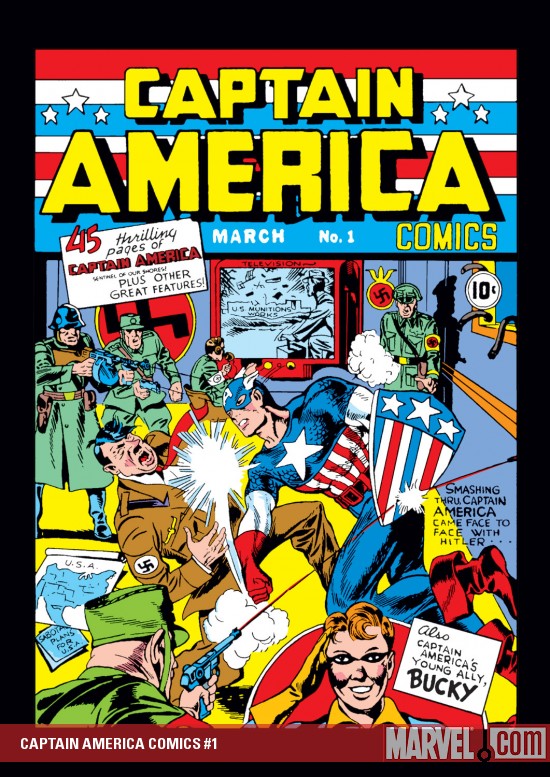
The result is a pretty amusing comics meta, where we get to see the “real” Bucky complain about his 40’s GEE WHIZ, CAP portrayal on-screen — or rather, on-panel — and in the MCU, we get to see kids grabbing at Captain America comic books generated while Steve is on his publicity tours, which are in fact reproductions of the actual Captain America Comics #1.

image

Published in our world in 1941, and yeah, he’s totally punching Hitler. Did I say meta? IT’S ALL VERY META.

Another example of an in-universe non-ret-con is when WWII ended and Steve Rogers was floundering as a character (what to do with a Hitler-puncher when you have no Hitlers to punch?) but the Cold War was gearing up and McCarthyism was hot, so the best (??? lol) way to make him relevant was to go anti-Communism. Cap was even billed as CAPTAIN AMERICA, COMMIE-SMASHER!! before the title was altogether cancelled in the 50’s.

When Stan Lee revived him in the 60’s, he decided that the REAL Steve Rogers had been frozen since WWII, and the Anti-Commie 50’s Cap was an impostor. 

But wait, this was about Bucky.

So, in none of the non-MCU iterations was Bucky actually Steve’s BFF from childhood. As of 1982, Steve DID have a childhood bestie, though. Arnold Roth. They met as weakling kids getting their respective asses handed to them in back alleys, then Arnie was like, “Screw this, I’m going to take up boxing.” So he did. And he got buff and used his new buffness to protect the still-sickly Steve Rogers from bullies on the daily. Thus continued their Best Friends Ever relationship, to the point where Steve considered the Roths a second family, and Arnold his biffle big bro. Also, Arnie developed a girl-chasing Romeo persona during their teens. I’m sure you can all see the parallels here. 

However. The lady-killer rep was due to Arnold realizing he was gay and trying to over-compensate to hide his real desires, resulting in him eventually drifting apart from the more quiet Steve.

He later joined the Navy during WWII, and a whole bunch of other junk happened, (GAMBLING! ABDUCTION! DEATH! FRIENDSHIP!) but 616 Arnie Roth is canon Jewish and canon Steve’s larger, stronger, brunet age-mate protector. Make of it what you will.

mooncoffin:

giveaway!

we are: a household of three non-binary autistic folks, two of whom have bpd, one of whom is schizophrenic, all of whom struggle with anxiety/depression stuff with all the trimmings.  we know brain weird, and we know how hard winter (and especially the holiday season) can be for people like us—cold dim days, noisy crowds everywhere, flashing lights, extra-busy retail jobs, dealing with relatives who don’t get it.  we’ve been there, and we want to help ease the passage into the new year with nice things.  that’s why we’re making self-care surprise kits to start 2015 off on a good note!

if you are: neurodivergent and/or mentally ill, especially if you’re those things and also trans and/or non-binary, reblog this post to enter our giveaway!  (if you simply want to boost this post for your followers to see, please tag accordingly so we know.)  be aware that if you win, you will need to give us a mailing address, so if it’s not okay to send a parcel to where you live/get your mail, we’d be happy to send it to a friend who can receive it for you!

self-care kits will include some or even all of the following:

  • a LUSH gift card
  • a bath & body works gift card
  • a handmade beaded bracelet with an uplifting message
  • a soft little plush friend you can keep in your pocket
  • an expertly-crafted chain maille stim/fidget toy
  • unscented candles (we know sometimes scents can be overwhelming)
  • happy drawings that you can look at when you feel down
  • LUSH products such as lotion, bath bombs, soaps, etc
  • stickers
  • cute bandaids
  • a link to a little song written especially for the winners
  • other surprises!

giveaway ends january 1, 2015, when we will select four winners at random out of those who have reblogged this post.

even when you feel alone, there are people out there who understand what you’re going through.  your experiences are valid, your needs are important, you are believed, and you matter. ♥

(obligatory disclaimer: we are not associated with or endorsed by tumblr or any company in any official capacity, this is just giving presents to people we haven’t yet met.  if you are under the legal age of majority where you live, please consult a guardian before giving out your personal information.)

Do you ship Johnlock in the ACD canon? Do you think that ACD intended to write them as in love? Because as my thought process goes, there’s a pretty good chance that he, as a product of his time, was homophobic, maybe not to the point where he wouldn’t befriend a gay man (Wilde) but to the point where he might not intentionally write gay characters. Just a thought.

hiddenlacuna:

wsswatson:

I absolutely ship them in the ACD canon. I think there’s a lot of suggestion that Holmes and Watson were (very implicitly, of course) queer and in love in the canon, for instance:

Sir Arthur Conan Doyle was way ahead of his time in many ways and loved flying in the face of convention. He has my faith.

Yep! And I cannot recommend the last link given enough, to nekosmuse’s Decoding the ACD subtext site, where they go through each of the canon stories and draw out all the nuggets of nuance. Very good read, although it’s best to read the original story either just before or just after for maximum goodness.

I think everyone needs to talk more about how in love ACD/Granda Holmes and Watson are. I mean, for a time when it was illegal, they were quite obvious about it…. (Don’t even get me started on The Dying Detective or The Three Garidebs)

tiger-in-the-flightdeck:

Oh, honey. I don’t stop talking about that!

The Post Return stories are the most romantic things I’ve ever read. I like to think of them as the second honeymoon stories. Before the Final Problem, the stories were a lot more carefully written. Aside from ridiculously obscene descriptions about Sticky Spearheads, and Holmes’ O face, you had to pick deeper for the coding. After the Return, though? Watson crammed as much romantic imagery into each description as possible. And the events were far more romantic. Holidays on the Cornish Coast, sharing a small seaside cottage for example.

And of course, the most flashing, big arrows pointing ‘code’ in the entire series (A series which includes private couches in bathhouses, a lot of time spent in France, and…. It includes The Blanched Soldier for crying out loud.)  is the opening of The Three Students:

It was in the year ‘95 that a combination of events, into which I need not enter, caused Mr. Sherlock Holmes and myself to spend some weeks in one of our great university towns

This is it. This is my favourite piece of evidence pointing to a romantic, sexual relationship between Holmes and Watson. The Three Students takes place at the beginning of April, in 1895. Our great detective and his constant companion are not out of London for a case, and Holmes is rather irritated at not being there. The pair are staying away long enough that they need to rent furnished rooms, rather than staying in a hotel, and judging by the fact that Holmes has none of his own equipment or books with him, they had to pack in a hurry. Almost as if they were fleeing London. 

What combination of events would have taken place at the beginning of April, in 1895, so well known to all of London that Watson feels he doesn’t need to remind his readers of what it was? That had queer men running from London for their own safety?