Hey, remember that time that I wrote a short story in the world of The Abyss Surrounds Us? INTO THE ABYSS, the story of the day Swift met Santa Elena, is now available for purchase!
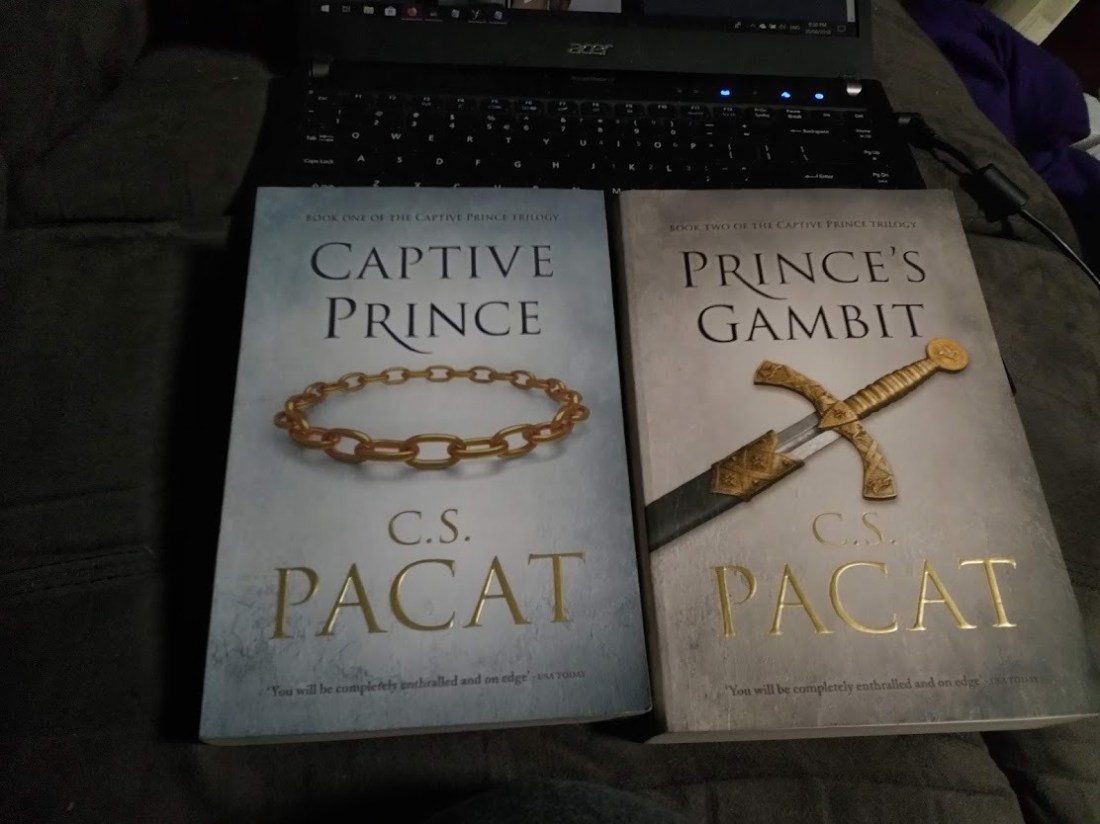
[Copies of Captive Prince and Prince’s Gambit from the Captive Prince Trilogy]
So, my curiosity got the better of me. I saw these first in the Smith Family store, then a week later in my local second-hand bookstore, Elizabeth’s (someone either read fast or quickly realised their mistake and traded them in, is my guess), where they’ve been for at least three weeks. So, I gave in. Slave!fic isn’t usually my thing, but people won’t shut up about this series, and though there’s a lot more queer fiction than there used to be, beggars can’t, and all that. If it’s not to my taste, I’m sure there’ll be someone out there willing to take them off my hands. $8AUD each, which isn’t the cheapest, but a lot cheaper than if I wanted to buy new.
I got a free-to-review queer ebook, set in a summer camp for disabled kids. (The MC and LI were staff, not kids.)
I had to nope-out by halfway, after pervasive, persistent ableism.
(Oh, and one reference to the Gestapo, when the parents were seeing their disabled kids off. I guess the author doesn’t know – or doesn’t care – that the Nazis used disabled kids as their test subjects for the Final Solution. Thousands of them.)
Please, writers. Disabled and neurodivergent people don’t need you to labour every other page how much of an inconvenience we are, how ‘quirky’ our mannerisms are, how emotionally exhausting we are, how disgusting our bodily functions, how annoying our routines and dietary and sensory needs are. How we’re sucking the life from our families like vampires.
You never have to tell us. You never let us forget.
(No, I’m not going to name-drop the author or the book. I just need to vent.)
EDIT: I will add that this wasn’t just a ‘ugh, won’t read any more’ situation. This book gave me a severe anxiety spiral requiring a long hot bath with a Lush bath bomb, a valium, and I’ve been sitting here rocking most of the day, something I generally only do when my anxiety is most severe. I very, very rarely leave a book unfinished, but this was a ‘for my own safety’ situation. Ableism is toxic, y’all. Get a sensitivity reader. Not a professional, not a family member, but an actual disabled person who feels comfortable enough to call out your bullshit.
EDIT 2: The author contacted me and was really respectful and thankful for my review, so, guys, THAT IS HOW YOU DO IT when a marginalised person has genuine concrit of your thing, when you have asked for an-honest-review-for-free-book. Even if you don’t 100% agree with the reviewer, it costs you nothing to respect the feedback and the position of the reviewer as an expert in their own experience.
The Lifeline Signal by RoAnna Sylver Failure to Communicate by Kaia Sonderby An Unseen Attraction by KJ Charles…
IT’S HERE.
And honestly, as lovely as the cover is in a photo, it is utterly stunning in person. It’s a texturally pleasant matt finish and the colours are luminous.
Do you like to read? Do you like to read books featuring women who happen to like other women? Do you enjoy good karma points from the universe? If so, help this CMU grad student with her LGBTQIA Readers Survey! It takes less than 10 minutes and answers are anonymous.
More info from the graduate student running the study:
“I’m Hope, a graduate student in the Master of Science in Administration program at Central Michigan University. My capstone thesis study, underway now, examines the LGBTQIA fiction market and its readers – especially for women who love women. The data collected will provide useful information and help us understand how authors and publishers can make better LGBTQIA content for readers.
My target participation goal is approximately 400, and I’m hoping to capture a healthy portion of responses from outside the USA. The results of this study are only useful if it accurately captures the needs and interests of the LGBTQIA fiction community. I’m happy to share a summary of the study once it’s finished – please contact me at my academic email for more information or questions: croni1h@cmich.edu.
Thanks for your time and support of this project! Your voices and your stories matter!
I’ve been asked to spread this among my followers because whom best to get the statistics from than wlw readers themselves! The survey is really short so do it if you have a few minutes free.
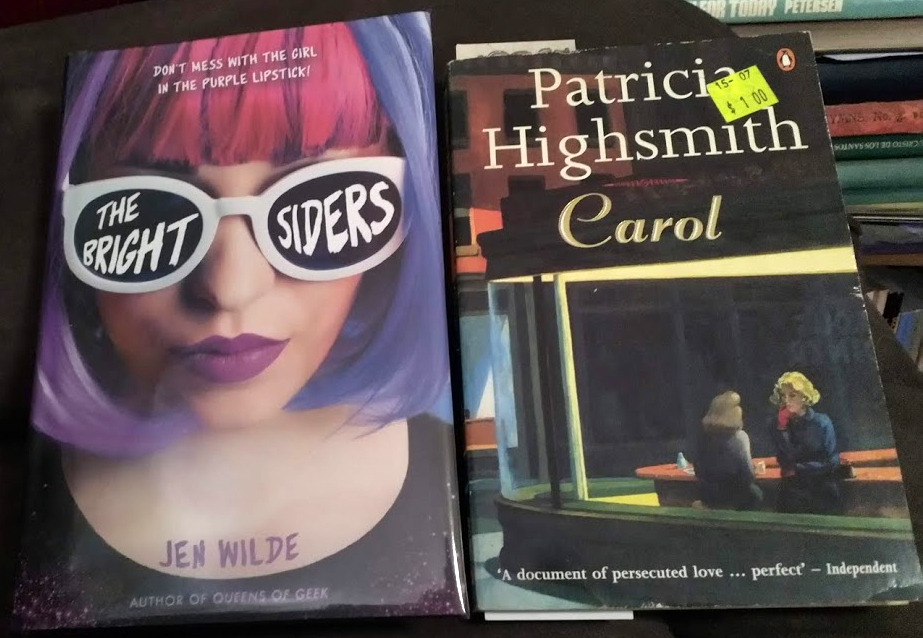
Finally got myself a copy of The Brightsiders! It’s been super hard to find in Australia, for some reason.
Also, decided it was due time I read Carol/The Price of Salt. When I got my copy off the shelf, I realised for the first time that the cover is a pastiche of Nighthawks, which, so far, seems to suit the mood of the prose really well.
In today’s guest post you get to learn a bit about Lisa Jenn Bigelow, the author of middle grade f/f novels Starting From Here and newly released Drum Roll, Please, and about her experience growing up and becoming a writer.
Drum Roll, Please: How an F/F Tween Novel Was Born, Grew Up, and Came Out of the Closet By Lisa Jenn Bigelow
1995
Senior year of high school. After two years of questioning, I’d decided I was gay. Probably. Aside from a trip to the mall with a skater boy, I’d never dated. Everything felt hypothetical.
I’d scoured libraries and bookstores for queer books. (This was before I had Internet access.) Those I found were mostly about gay men, mostly about AIDS. Nothing for teens. There was a lesbian bookstore downtown. I’d read about it in the paper, seen its rainbow flag flying. I mustered the nerve to go in. There, I found a flyer for an LGBTQ teen support group. The group had its own library, packed into a Styrofoam picnic cooler. There was Annie on My Mind, by Nancy Garden. Tales from the Closet, by Ivan Velez, Jr. Queer YA existed after all.
I wish I’d discovered these books earlier, before I started to question myself. I wish there had been more of them. I wish they’d all had happy, or at least hopeful, endings. My life today is still shaped by those early years of feeling alone, afraid, and inferior. I was fortunate to feel confident of my parents’ and closest friends’ support, whenever I came out. But school was a homophobic environment. The local paper regularly printed homophobic letters to the editor.
Day after day, the headlines debated whether gay people deserved the same rights as straight people. President Clinton passed “Don’t Ask, Don’t Tell” and the Defense of Marriage Act. Homosexuality was technically a crime in many states.
I didn’t think I’d ever be allowed to marry. I didn’t think I could ever have children. But those books in the cooler were a ray of hope.






 knitting in the dark