FDA Designates MDMA As ‘Breakthrough Therapy’ For Post-Traumatic Stress

naamahdarling:

My heart is breaking inside my chest I am so happy for the people this will be able to help.

In Phase 2 trials completed by MAPS, 61% of the 107 participants no longer qualified for PTSD two months after they underwent three sessions of MDMA-assisted psychotherapy, according to the group. After a year, that number grew to 68%, and among participants who had all suffered from chronic, treatment-resistant PTSD, on average for 17.8 years.

Do y’all even know how tremendous that is?  That MASSIVE percentage is just people who no longer qualified for PTSD, that’s not including the ones who were helped.  At 17.8 years, these people were well outside the window where PTSD usually spontaneously resolves (as it actually does for many, many people), this isn’t a fluke, this is real, and huge.

I will look into the study more thoroughly at a later time, but this is poised to be absolutely tremendous.  We’ve known that MDMA + psychotherapy is a revolutionary treatment for PTSD for a long time, and the day when that is within reach of people with PTSD is now even closer.

Phase IV is still ahead, and it’s possible it ultimately won’t be approved, but the FDA has known about this for decades and known it has had merit for certain mental health issues for decades, and if they are letting it get this far, I’m hopeful.

Full text under a cut so nobody has to go to fucking Forbes to read it:

Keep reading

FDA Designates MDMA As ‘Breakthrough Therapy’ For Post-Traumatic Stress

lierdumoa:

inqorporeal:

chronicreality:

xzienne:

skary-child:

cruzfucker69:

i hate when the teacher’s like “write about a bad time in your life” like i ain’t tryna get a social worker up my ass, thanks tho fam

This ain’t no joke I had to write a essay about what your scared of so I did it (I was scared of growing up and where my life was going) it was great got a 100 but then I got sent to councilors office and was sent to therapy cause they thought I was suicidal and on the verge of breaking…Apparently they ment like spiders or some shit…

Also like, not everyone finds that at all useful or cathartic.

“Write about some difficulty you’ve experienced personally.”
“Aight fam let me just break down into tears and skip the rest of my classes.”

Yes! I had a psych professor ask us to discuss outloud the hardest thing that ever happened to us literally two days ago and I said “you realize the position you’re putting us in? I feel obligated to lie to not only save my peers the awkwardness but also because I will find no relief in answering honestly but rather anxiety. The hardest thing in my life is having people repeatedly tell me I should find some sort of catharsis in reliving my trauma so someone else can feel pity for me!”

The whole class backed me up because they didn’t want to either! Those kind of exercises are only helpful for people who don’t have any real past/current issues– which is no one btw.

On par with this are those fucking self-assessments where they want to to be optimistic and positive about the future. You’re sitting there drowning in college stress and anxiety so bad you can’t look another human in the eye, fighting depression so that you can eventually achieve a piece of paper that might get you a better job if the economy doesn’t tank itself (guess what, it did), and the most optimistic thing you can think of is that the class ends in 20 minutes.

#why do they do this though ~ @inqorporeal

OH! I KNOW THE ANSWER TO THIS!

There’s a WIRED article that explains the history behind this practice. 

Basically, this guy named Jeffrey Mitchell had a traumatic experience, then after months of PTSD, he told a confidant about the event that traumatized him. Retelling the event to a confidant was so cathartic for Mitchell that his PTSD went away after. He did a bunch of research to see if his personal experience of catharsis and relief could be replicated in other people suffering from PTSD. Years later he published a paper proposing a formalized psychiatric treatment revolving around this idea that expressing a traumatic experience helps relieve it. The paper was so influential that the whole psychiatric community adopted “critical incident stress debriefing” (CISD) as a standard treatment for PTSD.

Unfortunately … it’s bullshit.

Not only does the CISD treatment program Mitchell came up with not help the majority of patients who try it, but it actually makes PTSD worse in the majority of patients who try it.

The WIRED article explains why:

CISD misapprehends how memory works…. Once a memory is formed, we assume that it will stay the same. This, in fact, is why we trust our recollections. They feel like indelible portraits of the past.

None of this is true. In the past decade, scientists have come to realize that our memories are not inert packets of data and they don’t remain constant. 

…the very act of remembering changes the memory itself. New research is showing that every time we recall an event, the structure of that memory in the brain is altered in light of the present moment, warped by our current feelings and knowledge. 

Basically, Mitchell waited until he had some emotional distance before trying to recall the memory, and he had full control of the situation. It was fully his decision. Nobody was pressuring him to talk about it. So he felt safe. Thinking about the memory from a place of safety allowed his brain to re-contextualize the memory as harmless.

Conversely, pressuring a patient to recall a traumatic memory, particularly when it’s still fresh in their minds, makes the patient feel very unsafe. Recalling a bad memory in this unsafe context only serves to re-traumatize the patient. 

[link to the whole article]

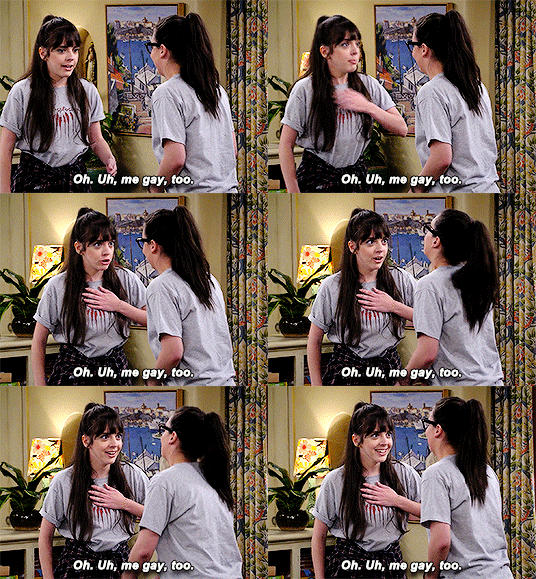
Calling all One Day at a Time fans and pro-LGBTQIA+ and Latinx representation folks – this is not a drill!

profeminist:

image

This message is from a co-showrunner of One Day at a Time on Netflix.

They need viewers over the next few days to watch at four or more shows to help keep it on the air! LET’S DO THIS!!!

The show has an out teen lesbian main character!

image

Who now has a non-binary sweetheart!

image

A single Latinx mom who is out of the military and working on her PTSD.

image

RITA MORENO!!!

image

WE CAN’T LET THIS GIFT TO THE WORLD GO AWAY. PLEASE PLEASE PLEASE WATCH 4 OR MORE EPISODES THIS WEEK IF YOU CAN, AND PLEASE SHARE!!!

5 Things People Don’t Get About Borderline Personalities

rebelfeathers:

The whole article seems a bit all-over-the-place to me, BUT it had one of those sentences in it where as soon as your eyes hit it the penny drops and your heart skips:

“Harvard professor Judith Herman even believes that BPD may not exist at all, suggesting that it’s actually a form of PTSD that has turned into a label to be slapped on troubled women because it fits so neatly into our ideas about them, conveniently allowing them to dismiss us as “born bad.” Add the fact that most people diagnosed with BPD have experienced severe trauma to the list of things that are probably not coincidences.”

5 Things People Don’t Get About Borderline Personalities

jabberwockypie:

thebibliosphere:

cedarrunn:

angstriddentrashhuman:

misangremellama:

panda-pear:

misangremellama:

Reminder for parents that though you may be struggling, it is never appropriate to use your child as your therapist/counselor. It’s unhealthy for the both of you. 

Can I ask why? I’m genuinely curious

There’s a few reasons as to why its wrong.

For one, a kid is not equipped to handle a parent’s problems. I’m not saying to never express your feelings or say that you’re having a problem to a child. That can be healthy. But to use them to just dump on is too much. Children just aren’t equipped to deal with the heaviness of adult problems, especially if they’re already going through things themselves.

Two, the inherent power imbalance makes it really uncomfortable. Your child isn’t your friend, they’re your child. Even if they can offer advice, this sort of thing can become like a role reversal. They also would have a hard time separating themselves from it when it becomes too much. A lot of parents feel entitled to their childrens’ time and space, so the children can become overburdened with no reprieve and no way to express that this isn’t their job. 

There’s probably more and better ways to explain this, but that’s my two cents on this.

Because I was the oldest child when my parents marriage was collapsing both of them used me to vent about the other, forcing me to justify their negative feelings about a person that I loved by virtue of their place in my life. At 10 years old I was attempting to negotiate the workings of an adult relationship that had never worked and validate their emotions without being harmful to the other. All the while I was deteriorating into an even more depressed and anxious reclusive child, losing friends and and missing out on normal experiences. I felt like I was responsible for the survival of their relationship, above my own well-being I had to figure out how to save them from divorce, from splitting the family up. I never felt like I had the right to tell them I couldn’t handle it. So I shoved everything down and became weirdly mature, too aware of the fact that I was an adult even if I didn’t want to be. Now I have severe anxiety, depression, and PTSD and I can’t even keep a job. I’m 28. Don’t do this to your kids. Please.

This is one form of whats known as parentification.

https://www.washingtonpost.com/news/parenting/wp/2017/03/23/your-child-is-not-your-confidant/

My father, having zero support from my mother, would seek me out during his depressive bouts and tell me about how much he wanted to die, over and over. Sometimes I even cleaned and bandaged the wounds. He told me he couldn’t talk to anyone else and I was his entire lifeline. I was nine. 

In a similar vein my mother blames me all the time for not leaving my father when she wanted to. She would vent to me about how awful a man he was, how much she hated him and wanted to leave him. And then tell me it was my fault she didn’t because of what I had said. I was twelve. The fuck did I know about life other than it was awful and I was having to hide shit from social work and feeling like it was my fault

I’m 30 now and they still do this to me. They still try to find ways to other themselves from their failure to protect me and my brother from themselves and make it my responsibility, then try to sugar coat it with “but you were such a good child” or “you’re such a great listener” or “you were so much older than your years”, like yea, cause someone fucking had to be.

Please, do not do this to your children. Please. Get help from an appropriate source, for your sake and theirs. I cannot stress how damaging this shit was to my psyche.

It’s also sometimes called Covert Incest or Emotional Incest.

My ex-mom started telling me about all of her emotional bullshit around the time her marriage to my stepfather was falling apart.  I was 10 ½.  (This was after a period of about two years of being utterly emotionally ABSENT because she was depressed.  So on the one hand, being a child, it was kind of “Oh, hey! Mom’s paying attention to me again!  Wait, no, this is actually terrible, what the fuck.”)

She put herself on this pedestal of being Amazing for not “dragging lots of men through her children’s lives”, meanwhile I was 11 and was a PARENT to my infant brother, doing a frankly-insane number of household chores, and having to be reassuring AND the family scapegoat, while being – shockingly – depressed and anxious all the time.

“I’m just venting, I don’t want you to FIX IT.”  When you’re 12 or 13 and depressed-as-fuck yourself and your only PARENT has talked about being suicidal?  You want to FIX IT.  (If only because said parent has also told you horror stories about why foster care would be worse.)

Even later on, as an older teen and later an adult, when I saw a clear solution to a household problem or a budgeting concern, it went to “Well no, you’re just a kid”.  Like “… Yes, but you’ve been talking to me about adult shit for YEARS and I’m actually right”.   (Same thing with parenting my brother, really.  I read PARENTING BOOKS and shit, but it’d be “You are not Sam’s parent.”  Okay, but who has actually been here to witness more of his life?)

Yeah, guess who has Complex PTSD and severed contact with her biological family.  Guess who – upon having a bad flashback – still defaults to trying to act as something between a secretary (to anyone older) and a parent (to any child-type-people around)?  With a side of “Must shield kids if they are in trouble and deflect blame onto myself”?  (Though I’ve been better about that one.)

Because even if life was falling apart, even if I was exhausted, some things had to keep being taken care of because nobody else was going to fucking do it.

I mean those aren’t the ONLY reasons, but it’s a reasonable sized chunk of it, and it ended up acting as a catalyst for a lot of the other stuff.

After I disclosed my father’s sexual abuse of me, my mother used me in this way until I left home, aged 22. Among other things, she unburdened herself at length about her attempts to ‘save’ her marriage, including her sex life with my paederast father, through my whole teen years. She would do this often while driving, so there was no way for me to escape. I still dissociate regularly in her presence, and I seriously think she might have done more damage to my psyche than incest between the ages of four and twelve did. She forgets anything she doesn’t want to think about, so talking frankly with my brother in recent years has given me very much needed collaboration and validation that things I recalled actually happened, because her revisionist memory gaslit me hugely and made me constantly doubt myself. And she thinks she was a great parent, because she thinks my brothers and I are nice people. She’s proud of her work.

neveryoumindhowthetrainislost:

taranoire:

princessfailureee:

clarknokent:

strawberryhorrorshow:

Being abused made me such a “good kid.”

I was

  • Always polite
  • Never acted without permission
  • Never spoke out of turn
  • Always did what I was told

And it’s shitty that I was considered mature and praised for those things, and all of those characteristics have translated into me being an immature, “bad adult.”

Now I

  • Have difficulty making a keeping friends
  • Can’t act without permission/am dependent on others for direction
  • Am terrible at communicating
  • Have no agency/personal compass

It’s a really difficult thing for people who were abused as children to grapple with.

What made us good children make us bad adults.

This is Important

THIS IS MY LIFE WOW

Conversely, while 90% of the time we’re kind and polite and accommodating, we get super fucking angry and have major outbursts when we feel threatened
Which is not a good look either

Additionally: not knowing how to stand up for yourself or how to talk about difficult things because the default is to shut down and take it. Because standing up or showing emotion when doing so is seen as having an attitude.

jabberwockypie:

PTSD is your brain trying to make sure you DON’T DIE.

Humans are really good at adapting so that we don’t die.  That’s kind of our whole *THING*.  We adapt.

If something BAD and SCARY and DANGEROUS happens, your brain tries to teach you to react better next time.  If the Bad Scary Dangerous thing happens a lot, that’s reinforcing it.  With CPTSD, the Bad Scary Dangerous thing happened often enough and frequently enough that your whole psyche developed around it.

You learn to notice the tiny things that signal the Bad Scary Dangerous Thing might happen – even if you don’t consciously know that you know that – so that you are braced to react and defend yourself.  They become triggers so that you are primed to respond.

Hypervigilance? Better to panic unnecessarily than to get dead because you didn’t recognize a threat in time, right?  It’s uncomfortable and a waste of energy but you’re not dead.

Nightmares about the Bad Thing?  Dreams are PRACTICE.  You are trying to learn how to react better or faster or more effectively next time.

Avoidance? Dissociating is better than just completely breaking and shutting down entirely.

The thing is, even if you are not in that situation anymore, your brain did not get the memo.  It is trying! But it takes a lot of work to convince it that “No really, it is safe now!”

I guess what I’m saying is cut yourself some slack.  You are doing your best and you’re not dead. ❤

Back atcha, sweetie. You said it better than me, and you need to hear it from someone besides yourself. (I know I do.)

iamshadow21:

cameoamalthea:

greenjudy:

pyrrhicgoddess:

thgchoir:

no offense but this is literally the most neurotypical thing i have ever seen

Uhhhh… no.
This is what they teach you in therapy to deal with BPD and general depression.
When I got out of the hospital after hurting myself a second time, I got put into intensive outpatient program for people being released from mental hospitals as a way to monitor and help transition them into getting them efficient long-term care.
This is something they stressed, especially for people with general depression. When you want to stay at home and hide in your bed, forcing yourself to do the opposite is what is helpful. For me, who struggles with self harm- “I want to really slice my arm up. The opposite would be to put lotion on my skin (or whatever would be better, like drawing on my skin) the opposite is the better decision.” It doesn’t always work because of course mental health isn’t that easy, but this is part of what’s called mindfulness (they say this all the time in therapy)

Being mindful of these is what puts you on the path to recovery. If you’re mindful, you are able to live in that moment and try your best to remember these better options.

I swear to god, I don’t get why some people on this website straight up reject good recovery help like this because either they a)have never been in therapy so don’t understand in context how to use these coping tactics. Or b)want to insist that all therapists and psych doctors are neurotypical and have zero idea what they are talking about. (Just so ya know, they teach this in DBT, the therapy used to help BPD. The psychologist who came up with DBT actually had BPD, so….a neurotypical women didn’t come up with this.)

I have clinical OCD and for me, exposure therapy–a version of “do the opposite”–has been fundamental. I’ve had huge improvement in the last year, but I’m 100% clear that if I hadn’t done my best to follow this protocol I’d be fucked. I have a lot of empathy for that moment when you’re just too tired to fight and you check the stove or you wash your hands or go back to the office at midnight to make sure the door is locked. But the kind of therapeutic approach outlined above has been crucial for me. 

It’s hard to do. I’ve weathered panic attacks trying to follow this protocol. But I’ve gotten remarkable results. I was afraid to touch the surfaces in my house, okay? I was afraid to touch my own feet, afraid to touch my parrot–deliberately exposing myself to “contamination” has helped me heal. I can’t speak for people with other issues, but this has helped my anxiety and OCD. 

I feel that tumblr, in an effort to be accepting of mental illness, has become anti-recovery. Having a mental illness does not make you a bad person. There is nothing morally wrong with having a mental illness anymore than more than there’s something morally wrong with having the flu. However, if you’re “ill” physically or mentally, something is wrong in the sense that you are unwell and to alleviate that you should try to get better. While there is not “cure” for mental illness, there are ways to get better.

There was a post on tumblr where someone with ADHD posted about how much you can get done when you focus and was attacked for posting about being “nuerotypical” – when she was posting about the relief she got from being on an medication to treat her illness. 

I saw another post going around tumblr that said something along the line of “you control your thoughts, why not choose to have happy thoughts” which again was shot down as “nuerotypical” but while you don’t have control over what thoughts come into your mind, you absolutely can and should choose to have happy thoughts. In DBT we call this “positive self talk”.

I’m in DBT to help treat PTSD stemming from child abuse. The abuse and abandonment I experienced destroyed my self esteem and created a lot of anxiety over upsetting other people. DBT has taught me to recognize when my thoughts are distorting realty ‘no one likes you’ and answer back ‘plenty of people like you, you don’t need everyone to like you, especially if the relationship doesn’t make you happy’, to respond to the thought ‘I’m so worthless’ with ‘you’re really great and have accomplished something’ 

And it’s not easy to challenge your thoughts, it’s a skill that’s learned and it’s hard to force yourself to think something that doesn’t seem authentic or even seems wrong to think – it’s hard to be encouraging towards yourself when you hate yourself – but you force yourself to be aware of your thoughts and push back when you fall into unhealthy patterns 

That isn’t “so neurotypical” that’s recovery. 

Not shaming mental illness doesn’t mean shaming RECOVERY.

Pro-Recovery isn’t anti-disability. 

Do not shame healthy behaviors as “neurotypical”.

Learning healthy behaviors and taking steps to treat mental illness and disorders including taking medication if that’s what works for you is important. You shouldn’t be ashamed if you have mental illness, but you shouldn’t say ‘well I’m not neurotypical therefor I can’t do anything to get better’ – while there is no cure for mental illness, there is a lot you can do to get better, to function better, to manage your mental illness and be safer, happier, and healthier for it. 

I’m sort of on the fence here, because sure, there are things I can do as someone with depression/anxiety/PTSD to get myself out of negative patterns of behaviour and thought. These things are hard, almost always harder than just defaulting to how I feel and think without challenging them, but that doesn’t mean I shouldn’t try.

BUT.

I am also an autistic person who probably also has inattentive type ADHD, and ignoring my body and mind telling me “okay, I need to leave now, I need to shut down for a while, I need to recharge, I need to get out of this environment” and pushing into areas of sensory and social discomfort CONSTANTLY is a great way for me to end up in meltdown, shutdown, and maybe even end up with a “hangover” for days where all I can do is sleep and watch TV. I was constantly told, as an undiagnosed autistic person, that these sensory and social limits didn’t exist, that “everyone else” was just fine, so these messages were fake and that I was just “shy” and “high strung” and needed to push myself. Scared in social situations? Do public speaking! and so on, and so forth. Neurotypical standards of what was resonable to “push through” resulted in periods of being housebound, temporarily nonverbal, and so anxious and depressed I couldn’t do anything. It absolutely tanked my self-worth. It made me disregard these warning signals my autistic brain gave me that could have helped me avoid burnout. Learning how to notice and respect these warning signals has been an incredibly difficult process, because ignoring them was reinforced so often, for the first twenty-five years of my life.

So, lists like this have their place, but for neurodiverse people, they are only useful if they have the self-knowledge about what is useful and what is going to be harmful. This is something I didn’t have until very recently, and something I still struggle with. It’s lists and advice like this that made me continuously force myself into situations that harmed me, and made me ruthlessly repress stimming and selfcare that may have helped me. Those stimming and selfcare behaviours didn’t conform with the list/advice, you see. They were particular to my neurotype, and were things I had to discover/rediscover for myself, because no professional or well-meaning non-professional ever knew they were needed, BECAUSE NONE OF THEM WERE MY NEUROTYPE.

So, yes, challenge negative behaviour and thought patterns.

And yes, it’s the most neurotypical thing I’ve ever seen.

Listen to your body and your mind and take care of your SELF. Because there is no ‘one size fits all’ for mental health.

Also, I have Feelings about ‘forgiveness’ being the advised ‘good’ thing for betrayal. This anchors in heavily with the way people treat victims/survivors of abuse.

You don’t get to decide that someone else who’s been abused in any way should ‘forgive’.

You never have to ‘be the better person’ and forgive those who hurt you.

You never have to listen to those who tell you if you don’t forgive your abuser, you’ll be living with that abuse for the rest of your life.

You never have to look at your abuse and say, “Actually, I feel okay with my past and what you did to me and have love and acceptance in my heart for it all, and forgive what you did.”

It is absolutely fine for you to live your life without forgiving.

But gosh, you think, won’t it make me a toxic, bitter ball of hatred, unable to process trauma and move on? That’s what all those well-meaning people tell me.

No.

Actually, what happens is you work out that your abuser is irrelevant. Gradually, you won’t think about them every minute, or every hour, or every day. Eventually, you’ll go longer and longer, until you barely think of them at all, and your life will be as full as anyone else’s of things that are not the abuse or abuser.

That’s where I’m at. And I never had to forgive my abuser to get there.

cameoamalthea:

greenjudy:

pyrrhicgoddess:

thgchoir:

no offense but this is literally the most neurotypical thing i have ever seen

Uhhhh… no.
This is what they teach you in therapy to deal with BPD and general depression.
When I got out of the hospital after hurting myself a second time, I got put into intensive outpatient program for people being released from mental hospitals as a way to monitor and help transition them into getting them efficient long-term care.
This is something they stressed, especially for people with general depression. When you want to stay at home and hide in your bed, forcing yourself to do the opposite is what is helpful. For me, who struggles with self harm- “I want to really slice my arm up. The opposite would be to put lotion on my skin (or whatever would be better, like drawing on my skin) the opposite is the better decision.” It doesn’t always work because of course mental health isn’t that easy, but this is part of what’s called mindfulness (they say this all the time in therapy)

Being mindful of these is what puts you on the path to recovery. If you’re mindful, you are able to live in that moment and try your best to remember these better options.

I swear to god, I don’t get why some people on this website straight up reject good recovery help like this because either they a)have never been in therapy so don’t understand in context how to use these coping tactics. Or b)want to insist that all therapists and psych doctors are neurotypical and have zero idea what they are talking about. (Just so ya know, they teach this in DBT, the therapy used to help BPD. The psychologist who came up with DBT actually had BPD, so….a neurotypical women didn’t come up with this.)

I have clinical OCD and for me, exposure therapy–a version of “do the opposite”–has been fundamental. I’ve had huge improvement in the last year, but I’m 100% clear that if I hadn’t done my best to follow this protocol I’d be fucked. I have a lot of empathy for that moment when you’re just too tired to fight and you check the stove or you wash your hands or go back to the office at midnight to make sure the door is locked. But the kind of therapeutic approach outlined above has been crucial for me. 

It’s hard to do. I’ve weathered panic attacks trying to follow this protocol. But I’ve gotten remarkable results. I was afraid to touch the surfaces in my house, okay? I was afraid to touch my own feet, afraid to touch my parrot–deliberately exposing myself to “contamination” has helped me heal. I can’t speak for people with other issues, but this has helped my anxiety and OCD. 

I feel that tumblr, in an effort to be accepting of mental illness, has become anti-recovery. Having a mental illness does not make you a bad person. There is nothing morally wrong with having a mental illness anymore than more than there’s something morally wrong with having the flu. However, if you’re “ill” physically or mentally, something is wrong in the sense that you are unwell and to alleviate that you should try to get better. While there is not “cure” for mental illness, there are ways to get better.

There was a post on tumblr where someone with ADHD posted about how much you can get done when you focus and was attacked for posting about being “nuerotypical” – when she was posting about the relief she got from being on an medication to treat her illness. 

I saw another post going around tumblr that said something along the line of “you control your thoughts, why not choose to have happy thoughts” which again was shot down as “nuerotypical” but while you don’t have control over what thoughts come into your mind, you absolutely can and should choose to have happy thoughts. In DBT we call this “positive self talk”.

I’m in DBT to help treat PTSD stemming from child abuse. The abuse and abandonment I experienced destroyed my self esteem and created a lot of anxiety over upsetting other people. DBT has taught me to recognize when my thoughts are distorting realty ‘no one likes you’ and answer back ‘plenty of people like you, you don’t need everyone to like you, especially if the relationship doesn’t make you happy’, to respond to the thought ‘I’m so worthless’ with ‘you’re really great and have accomplished something’ 

And it’s not easy to challenge your thoughts, it’s a skill that’s learned and it’s hard to force yourself to think something that doesn’t seem authentic or even seems wrong to think – it’s hard to be encouraging towards yourself when you hate yourself – but you force yourself to be aware of your thoughts and push back when you fall into unhealthy patterns 

That isn’t “so neurotypical” that’s recovery. 

Not shaming mental illness doesn’t mean shaming RECOVERY.

Pro-Recovery isn’t anti-disability. 

Do not shame healthy behaviors as “neurotypical”.

Learning healthy behaviors and taking steps to treat mental illness and disorders including taking medication if that’s what works for you is important. You shouldn’t be ashamed if you have mental illness, but you shouldn’t say ‘well I’m not neurotypical therefor I can’t do anything to get better’ – while there is no cure for mental illness, there is a lot you can do to get better, to function better, to manage your mental illness and be safer, happier, and healthier for it. 

I’m sort of on the fence here, because sure, there are things I can do as someone with depression/anxiety/PTSD to get myself out of negative patterns of behaviour and thought. These things are hard, almost always harder than just defaulting to how I feel and think without challenging them, but that doesn’t mean I shouldn’t try.

BUT.

I am also an autistic person who probably also has inattentive type ADHD, and ignoring my body and mind telling me “okay, I need to leave now, I need to shut down for a while, I need to recharge, I need to get out of this environment” and pushing into areas of sensory and social discomfort CONSTANTLY is a great way for me to end up in meltdown, shutdown, and maybe even end up with a “hangover” for days where all I can do is sleep and watch TV. I was constantly told, as an undiagnosed autistic person, that these sensory and social limits didn’t exist, that “everyone else” was just fine, so these messages were fake and that I was just “shy” and “high strung” and needed to push myself. Scared in social situations? Do public speaking! and so on, and so forth. Neurotypical standards of what was resonable to “push through” resulted in periods of being housebound, temporarily nonverbal, and so anxious and depressed I couldn’t do anything. It absolutely tanked my self-worth. It made me disregard these warning signals my autistic brain gave me that could have helped me avoid burnout. Learning how to notice and respect these warning signals has been an incredibly difficult process, because ignoring them was reinforced so often, for the first twenty-five years of my life.

So, lists like this have their place, but for neurodiverse people, they are only useful if they have the self-knowledge about what is useful and what is going to be harmful. This is something I didn’t have until very recently, and something I still struggle with. It’s lists and advice like this that made me continuously force myself into situations that harmed me, and made me ruthlessly repress stimming and selfcare that may have helped me. Those stimming and selfcare behaviours didn’t conform with the list/advice, you see. They were particular to my neurotype, and were things I had to discover/rediscover for myself, because no professional or well-meaning non-professional ever knew they were needed, BECAUSE NONE OF THEM WERE MY NEUROTYPE.

So, yes, challenge negative behaviour and thought patterns.

And yes, it’s the most neurotypical thing I’ve ever seen.

Listen to your body and your mind and take care of your SELF. Because there is no ‘one size fits all’ for mental health.
cryptfly:

asperqueer:

asksecularwitch:

greatmoustachesploosh:

foxinu:

nsfwjynx:

the-pink-mist:

There was a split second there where his like, “wait, what? bro what are you doing?” 

On more serious note, PTSD dogs for veterans are so fucking therapeutic. They’re like the one person you can spill your guts to and never worry about ever being judged or have that secret divulged. There are times when I definitely prefer the company of a dog over a human. 

Therapy animals save lives.

These dogs are even still so much more amazing. They check rooms before their handler enters, so they can clear it to help the person feel safe. Like in the gif, they are there when panic attacks or nightmares occur, to be something for the person to help ground themselves on, or yes just to turn on the lights. Even more amazing, many people are able to reduce their medication when they have a PTSD service dog there to help them. These dogs are useful for not just veterans, but also victims of abuse, accident trauma, natural disasters, and others. Their training allows them to be useful in situations where medical assistance is needed, as well. Some PTSD dogs are trained to recognize repetitive behaviours in handlers, and signal the handler to break the repetition and stopping the behaviour and possibly injury. 

Service dogs in general are just awesome. Remember to respect any that you see out in public. They are not there for you to walk up to and play with, even the puppies!

I was reading an article of a service dog helping a person with schizophrenia. she stated that when she was seeing or hearing things and notices the dog is not reacting in any way, then she is able to ground herself, realizing what she was experiencing was not real and could work through it easier and is more able to ignore the delusions. And she pointed out she feels more comfortable with a service dog as well because well, dogs don’t judge and get angry for things like this

I teared up about this whole post to be honest.

i’ll never not reblog this post. it is so important.

I cried a little about this