this local woman who has a tomboy kid reached out to my butch group to see if a few of us wouldn’t mind having brunch with her family and a couple more of the girls tomboy friends, cuz she read that it’s important for your development to have adult versions of “people like you” in your life when you’re growing up. which is definitely true. so we’re going over tomorrow. can you believe that? like, I’m gonna cry.
Op how did it go if I may ask?
Hi! Figure I’ll answer everyone at once here. It was kinda incredible… it was three little tomboy kids, 5 adult butch pals, and a couple of the parents, eating pancakes and muffins and playing games for a few hours. Learned a lot about each other and told each other stories, both good and bad. We lent the kind of advice that these good natured straight parents just don’t have the frame of reference for, and we talked about what we did for work and school, learned about what sports they play, suggested reading Tamora Pierce. Colored some protest posters too — the kids came up with all the words on their own, stuff like “were here whether you like it or not!”
It is awful to think about all the BS that these children have had to go through already — weird to think that we (the adult butches) know these stories of exclusion and hostility so VISCERALLY from our own and each other’s lives and childhoods, but hearing them come out of the mouth of a 10 year old girl is… something else. they have had to learn how to stand up for themselves, and they’ve got such thick skin now, but… most of us learn that so much later, or lose it as we leave childhood, and I’m so confident that at least THESE KIDS have a very real support system, parents who love them for who they are and want to encourage them to be happy and healthy even if it means life in the outside world will be harder. I dunno. I feel really hopeful.
Ok but can we talk about how emo, as a genre, defied gender roles in a big way? Like, everything about the culture, from the guys wearing makeup and womens’ skinny jeans, to the way they got unabashedly emotional in spite of the “men aren’t supposed to cry” narrative they’d obviously been socialized with, was just this complete “fuck you” to the idea that there’s a certain way to be a “man”.
And a lot of their detractors called them “girly” or “gay”. And they didn’t give a fuck! Fall Out Boy has a whole song entitled “Gay Is Not A Synonym for Shitty”, which referenced a famous Pete Wentz quote, where he basically said that if you thought his band sucked, to just say it sucked, and not be a “homophobic asshole” about it.
And, then, geez, My Chemical Romance took it a step further, and Gerard Way outright kissed one of his bandmates at concerts purely to infuriate homophobes who were at his shows.
A lot of these bands were openly for LGBT rights, for womens’ rights. I remember one instance where some band MCR was touring with asked women to flash their tits in exchange for backstage passes. And Gerard was so horrified by this, and told his female fans to “spit in the faces” of misogynists in the rock scene.
Like, god, these bands were so progressive. And they still are. Right after the Pulse tragedy, Brendon Urie literally danced around in a pride flag and told his queer fans what they meant to him. Pete Wentz said that “Uma Thurman” was meant to show his female fans that they could be “badass”, too. And Gerard pretty much admitted in an interview to somewhat identifying with the label “nonbinary”.
That’s the most lasting impact that emo is going to have. Showing fans of all genders that there’s nothing wrong with being whoever the fuck you are, that there’s no specific way to be a man or woman. And, god, I just fucking love that.
“So every day during my set, when I’m playing my own shows, I talk about people that are transgender. I talk about it a lot because everyday basically I say: …”
I feel like disco and emo should team up and that should be the next big music thing, sort of a defiant apocalyptic dance party, because disco did this sort of thing too, the rejection of straight white male heteronormativity, and that was basically why it was killed, so, like, emo plus defiant zombie disco would be the perfect thing to play in the Mango Menace era.
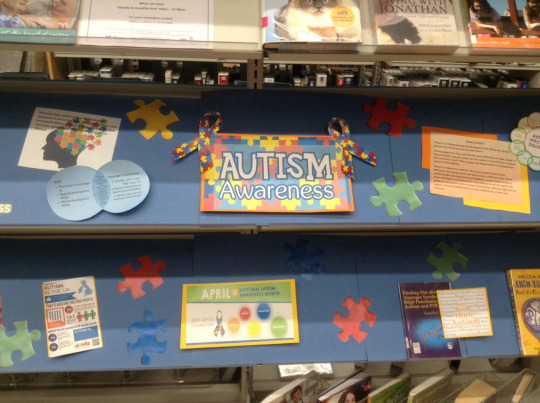
I’m at my local library and they’ve made a display for autism awareness month. This is a well meant effort, but…
As you can see, they’ve gone with the “autism speaks” motif. This is somewhat distressing for me, especially since I usually come here to de-stress. I’m going to write a letter for the library about why this is offensive to me as an autistic person, but I don’t want them to think it’s just me wigging out about it, so if you all would be so kind I’d appreciate it if you could reblog this post and add your own thoughts on autism speaks and the symbols of their organisation. I’m going to print off as many responses as I can and hand them over to the library along with the letter.
Thanks so much for your time, and I hope you all have a good autism awareness month
QUICK ADDITION TO THE POST
If you want to add your comments but feel uncomfortable posting them publicly, please please feel free to message them on anon. You should not be silenced because you are shy or self conscious. I will absolutely add every anonymous comment to the letter
Hey, thought I’d give an update for those of you wondering how this shook out. After the library didn’t contact me for a few days I decided to head down there to see what was going on and:
they’ve changed the display! I have to say, I wasn’t sure what the expect. I thought if they did anything it would just to be to change the colour and hopefully the puzzle pieces, but they actually changed the books and info that they have on there too, Including:
A notice explicitly debunking autism as an illness, and advocating how autism is different for everyone and always requires individual support
Books written by autistic people
Books about helping your kids with the challenges they might face, rather than guides for coping with having an autistic child
Even THIS book
Which I thought had a very suspect title turned out to have this passage inside:
You can even see that they’ve decided to promote the NAS, a society dedicated to helping autistic people live the lives of their choosing.
I’m very happy with the changes that have been made here. And I think it’s a good reminder that just because someone gets something wrong, doesn’t mean that they’re bad people. The important thing is being willing to listen and learn, and the staff at this library have done just that.
This feels to me like a good way to start autistic pride month. And remember, if you want to support people with autism this season – or throughout the rest of the year – be sure that you are speaking with us, not for us or over us.
This is so wonderful!! There’s a lot of good info there and I’m sure it’ll help a lot of people learn more about what autism really is.
I think you and the community have really made a positive difference here ❤
I’m literally crying this makes me so happy! This is amazing!
Im happy-crying too! bless you and that library!
[Image 1: A library display primarily using blue and puzzle piece motives.
Image 2: A library display with a red sign saying: “Autism Awareness Month”. The shelves are mint-coloured. There are no more puzzle pieces.
Image 3: A note reading:
“What is Autism?
Autism is a lifelong developmental disability that affects how people see the world and interact with others.
Autistic people see, hear and feel the world differently than other people. If you are autistic, you are autistic for life; autism is not an illness or a disease and cannot be ‘cured’. Often people feel being autistic is a fundamental aspect of their identity.
Autism is a spectrum disorder. All autistic people share certain difficulties, but being autistic will affect them in different ways. Some autistic people also have learning disabilities, mental health issues or other conditions, meaning people need different levels of support. All people on the autism spectrum learn and develop. With the right sort of support, all can be helped to live a more fulfilling life of their choosing.”
Image 4: A book titled “The reason I jump” by Naoki Higashida.
Image 5: A book titled “I’m not naughty – I’m autistic: Jodi’s journey” by Jean Shaw.
Image 6: A book titled “Sleep well on the autism spectrum” by Kenneth J. Aikten.
Image 7: A book titled: “Girls on the autism spectrum: overcoming the challenges and celebrating the gifts”.
Image 8: A book titled: “My child has autism, now what? 10 steps to get you started”.
Image 9: A page of the above book reading:
“Rules of thumb to live by
I know there is a lot to learn, but here are a few rules of thumb to guide you:
1. If something doesn’t work, try something else.
2. The only expert in autism is a person with autism.
3. Every child with autism is different – what works for one may not work for another.
4. You may not know autism, but you know your child and that is enough.”]
I made some happy flappy art! Everyone, feel free to reblog! (Also if someone could add an image description? I’m bad at those.)
My local Lush finally got stock back in of the Aromaco deodorant bar, so I went in to buy that, and the staff who served me hooked me up with samples of all but one of the tooth powder/pellets I wanted to try, too! (No Atomic, sadly.) So now I can try all of them and find one I like the taste of before I buy! For those who are curious, Penrith Lush has A+ service, very friendly staff, and none of them batted an eyelid at me stimming with a Tangle Jr the whole time.
Imagine that you’re a sparrow, living in a family of sparrows in a town of sparrows in a world of sparrows.
But you’re kind of a shitty sparrow. Kind of the worst sparrow, actually.
You can’t fly. You’ve been to doctors who have prescribed medicine to help with flying. But you still can’t. You try every day, and every day you fail and this thing which all the other sparrows tell you is critical.
For a while, you stop trying. Failing every day just wore you down and you couldn’t do it anymore, so you stopped trying to fly. It was nice in some ways, but you felt guilty because you weren’t raised to give up. It made a rift with your family. Flying is an important activity that sparrow families do together. Isn’t your family important to you? Don’t they deserve for you to at least make the effort?
So since it’s nothing medically wrong with you, you go to a therapist, who diagnoses you with a phobia of flying. You work on overcoming your fear. You’re lucky, your family is very accepting of mental illness (other sparrows are not so lucky, and it hurts your heart to think about that). They appreciate and admire how hard you’re working. They try to include you, so instead of getting together and flying, sometimes they get together and all sit in their nests. That sort of sucks too, but it’s a definite improvement.
You continue to try, and fail, to fly. You try harder. You try as hard as you can. Sometimes you can’t even make yourself flap your wings, it’s just such pointless bullshit and you feel like you’ll never succeed. Sometimes you go up on a chair and jump off and flap real hard and go splat anyway.
Sometimes mean birds make fun of you because you’re a terrible screw-up.
For 26 years, this is what your life is.
One day, almost out of nowhere, as an afterthought, an aside, something barely worth mentioning because it is so obvious, a doctor says, “by the way, you’re a penguin.”
Holy shit. You’re not a failure. You’re a penguin. You’re not lazy or stupid or weak. You don’t have messed up values. You’re a penguin. You have always been a penguin.
There’s nothing wrong with you, you’re a beautiful penguin. The most perfect penguin. But it’s just a fact, penguins can’t fly.
Now when you’re with you’re sparrow friends and they’re all sitting in nests, you sit in a bucket of ice. Mostly you bring your own. Some bird restaurants are really accommodating and will bring you a bucket of ice to sit in. Sometimes mean birds give you shit about your bucket, but it doesn’t hurt as much as it did before, because you know you’re a penguin and you’re just exactly what a penguin is meant to be.
You give yourself permission to stop trying to fly. Not failing all the time improves your mood and overall function. You finally feel confident declining when invited to flying outings. You don’t waste the energy feeling guilty about it.
You love your family of sparrows, but you also find a whole community of penguins to love too. Things you thought were just you, like preferring fish to bird seed, things you thought you were totally alone in and wrong for, are common and accepted. Some are even admired. Your new penguin friends think your flippers and chubby penguin belly are lovely. You bond over how and when you discovered you loved swimming.
Knowing you’re a penguin means knowing where you fit in a world you never felt like you fit into. It means all the things penguins can’t do, it’s not a personal failing when you can’t do them. You’re not supposed to be able to. You can do other things instead. Sparrows are actually quite poor swimmers. You feel good about the things you excel at.
This is why I think labels are important. This is why I think “we’re all birds, let’s focus on our similarities instead of our differences” is harmful. This is how my autism diagnosis was like breathing, after holding my breath for 26 years.
Thank you for the introduction. Hello friends, allies, and fellow a/Autistic people. The tone of my piece will be a little different today, but I’d like to start by sharing a piece of my story.
In my earliest memory, I am standing in a sunbeam. I move my hands so that the light scatters, becoming a golden glow, and watch the dust particles float like little cosmos and galaxies. I am three years old when a daycare employee grabs my fluttering fingers and squeezes so tight that tears make the world go dark.
I am four years old, and I hide under the table when the clatter and chatter of Christmas dinner becomes too much and grinds against my skull. A relative grabs me with their grown up hands and shakes me, and they hiss at me to sit in my seat and not move, that my bad behaviour is ruining everything. I have to bite my tongue to keep from moving.
I am five years old. I deliver all the lines along with my favourite film characters and sing at the top of my lungs, entire Disney scores by heart. I sing for my peers, but teacher says no singing outside of music class, so I recite my favourite scenes for them instead. No, teacher says, Use your own words. People don’t like to hear about movies, they can just watch them on their own. Are you dumb? Just use your own words.
I am six years old. I love to read. I read everything I can get my hands on, devouring books many grade levels above mine, but I have no friends. My teachers don’t understand me. My behaviour is attributed to laziness, poor discipline, bad parenting. It doesn’t occur to them to ask why I strike out, why I steal the other kids’ lunches, why I bite and cry and hide under tables. They just take away the book and pull me across the floor and force my small body into the carpet.
I am seven years old. I have one friend. Her name is Julie. She sits beside me and watches the teacher lean over me to still my happy flapping. Later, as we laugh together, she reaches over and stills my hands. My heart breaks. Just be happy like the other kids, she says. After our first sleepover, she tells me that I am too weird and my family is too weird, and that her mother said that I am not allowed to sleep over until I get better.
I am eight years old. I sit alone every lunch break and read books. Sometimes my classmates ask me if I want to play, but run further away every time I approach. I stop looking up when they laugh and call my name. The lunch monitor tells me that it’s the quiet kids who have violent thoughts, and that only disturbed people want to be alone. She makes an older student sit next to me. He punches me in the stomach when the lunch monitor turns her back. Anger replaces sadness, but it is myself I hurt in my anger.
I am nine years old when I realize that people don’t like me. A teacher tells me that I don’t know how to talk to people, but no one will tell me how to do it right. I offer up facts about animals, drawings of my favourite scenes from movies, long educational monologues on Ancient Egypt. One day an adult snaps, turning on me with sharp words. Shut up, they say, just shut up. No one cares. You are so annoying. I begin cutting myself off mid-sentence and apologizing for my passion. I feel the fight start to drain out of me.
I am ten years old when I realize what people think of me. My peers call me special, “in the bad way”. Short bus. Speddy. I am ten years old when a teacher asks me if my mother dropped me on my head, that any child could do this easily. I am ten years old when a trusted adult tells me that the way I move when I am excited makes me look like the R word, that real people don’t move like that.
I am ten years old when I try to end my life.
The only words I had had for myself were broken, stupid, freak. The R word. No one was there to tell me that there is nothing shameful about being different, that I am not less. That disability is not shameful. That there is nothing wrong with learning differently or being in special education. If I had had words like executive dysfunction, like meltdown, like sensory overload, like Autistic, I believe that I never would have tried to hurt myself.
It would be another long, dark ten years before I discovered the a/Autistic community. When I finally learned this truth about myself- that I am not a broken neurotypical person, that I am a whole, if bruised, Autistic person, my world was more than changed. It was a whole new world, and it was populated by people like me. Now I am closing in on twenty-five years, and I’m still working on accepting my disabled, chronically ill, Autistic self.
Now I wade back into the hate and the ignorance to spread understanding, trying to advocate for the children who still have a chance and lead a/Autistic adults home. Advocacy is my life, and the message I try to spread is one of acceptance, inclusion, and neurodiversity. This is more difficult than it may sound, because in many ways, I am still that child. I am in the same situation as many autistic adults- I am unlearning self hate and relearning how to be my true self.
When it comes to celebrating Autism, there are those who stand nearby, protesting, holding conditions and waving caveats. Autism acceptance is alright- for some. Sure, we can celebrate Autism- or a few specific, socially-acceptable ways that Autism can present in certain people, in certain situations. Sure, we can celebrate a/Autistic people’s strengths- in as far as those strengths are potentially profitable to capitalism. Sure, love and inclusion may work for those “quirky”, “high functioning” people, but real disability is too tragic, too messy and too uncomfortable, to ever be celebrated. Maybe tolerated. Never celebrated.
You have to watch out for tolerance. It’s not love or understanding that most of us learn for people who are different, it’s tolerance. Not how to accept, but how to put-up-with. There is no love in tolerance. Tolerance is inequality. Tolerance says, “Who you are is wrong and different, but I, as the right majority, will conditionally allow your unpleasant existence to go on”. Acceptance says “Who you are is a valuable, precious human being who deserves the same respect, rights, and opportunities as anyone else”.
For many, the concept of Autism acceptance is a stretch out of their bubble of privilege that they are not willing to make. The thought of accepting a/Autistic people exactly where we are, as we are, disabled and human, challenges and joys alike, is too much. They are too deeply entrenched in the culture of cure and its panic-perpetuating tragedy rhetoric. To these people, to these people who try in vain to separate the person from the neurotype, to cut out the autism, to mould a non-autistic child from an autistic one- the idea of accepting a/Autistic people as we are is outlandish. To these people then, to celebrate a/Autistic people, and even Autism as a neurotype, is disturbing.
The Mexican poet, educator, and humans rights activist Cesar A. Cruz said that art should comfort the disturbed and disturb the comfortable. Well, the a/Autistic community is uncomfortable, and more than that, we’re in pain, and the comfortable have all the power in the world.
Our resistance is small but mighty, made up of thousands of little lights, each flame carried by an a/Autistic person and protected by our allies. It’s for that reason that I choose to be art, and why, when I was asked to speak on “the Celebration of Autism”, I jumped at the chance to comfort and to disturb. It was only after I accepted the honour of speaking here today that I realized I wasn’t sure how to talk about celebrating autism. I had to decide first what celebration means. I had to think about what it meant to go beyond accepting and to reach celebration.
The celebration of Autism is something so powerful and so subversive, it makes people uncomfortable. It forces people to reconsider what they think they know, to question what the experts are saying, to look to the voices that should be elevated above all others- the voices of actual a/Autistic people.
The celebration of Autism transcends the shadows of ableism and the silence of tolerance. Celebration pulls first-person autistic experience and joy into the limelight. The celebration of Autism is the most powerful tool we have to hold back the dark of indignity, and to spread our message. In a world dark with pity, fear, and hatred for people with disabilities, celebration gets people’s attention. Celebration is radical.
To be able to celebrate parts of your identity and life experience, even if your identity is a marginalized one, even if your life experiences have been fraught with challenge and societal oppression, is not a right afforded to disabled people. We are the largest minority amongst humans, a minority group to which a person of any race, religion, nationality, gender or sexual orientation may belong, and the only minority group that any person can become a part of at any time.
To many of us, our disabilities are vital and intrinsic parts of ourselves, of our identities, the importance and meaningfulness of which cannot be denied. For many of us, disability is as an important aspect of our self as our race, religion, nationality, gender, or sexual orientation. But for too many people, disability is the last holdout of shame, of intolerance, of outright hate. Some of those people are disabled themselves and have internalized a lifetime of ableism.
Once I decided what constituted celebration of autism and how to define it and its benefits, I had doubts that I am qualified to talk on the subject. I’ve talked the talk, but have I walked it? Being autistic is to be different, and disabled. There are hard parts about being autistic. Being autistic in a world built for the non-autistic majority is tough, and it can be tough on us, and it can wear down on our self esteem. It can make it hard to see our lovely parts. I wondered in what ways I celebrate autism. I started looking at my life and thinking about the other a/Autistic people I know whose lives touch mine.
My work on my blog and through my Youtube channel puts me in contact with thousands of strangers. Youtube comments, questions to my blog, facebook comments, e-mails, messages. I would say that about half of these messages are from parents. I would say that the other half are from a/Autistic youths and adults who have found my videos and, for the first time, have words for what they have lived and the knowledge that they are not alone.
There are so, so many a/Autistic adults out there who went misunderstood and misdiagnosed, or undiagnosed. Our understanding of Autism Spectrum Disorders has increased greatly, and now we know more about how Autism presents, particularly in under-diagnosed groups like autistics of colour, autistic women, and autistic people with co-morbid neurological conditions or mental illnesses. But even ten years ago, doctors and professionals didn’t know what we know now, and so generations of a/Autistic children were missed, misdiagnosed, slipping between the cracks to grow into struggling a/Autistic adults.
When these a/Autistic teens and adults reach out to me, every single one of them talk about how incredibly difficult it was to grow up undiagnosed autistic in a non-autistic world. All of them have experienced peer abuse; most have experienced parental abuse, whether intentional or not; most report traumatic school experiences, including public shaming, isolation, restraint, and psychological abuse; many have been taken advantage of by people thought to be friends or abused by a romantic partner; many report experiencing child sexual abuse, and autistic women are many times more likely to be sexually assaulted than non-autistic women.
All of them talk of the deep pain of growing up without insight or explanation into their neurotype or impairments, the only available conclusion to a disabled child being, “I am bad. I am broken. There is something wrong with me and it’s my fault.”
But when they do find us again- when they learn the name we have for the ways their brain works and when they find the a/Autistic community- the wrong explanations used to fill the gaps aren’t necessary any more. You’re not lazy, you have executive dysfunction.
Yes, you are “too sensitive”, but it is a real and valid neurological condition called sensory processing disorder, and it’s okay to make yourself comfortable. You’re not stupid or a selective listener, you have central auditory processing disorder and you learn differently.
You’re not an embarrassment or childish for moving your body in ways that feel good and keep you healthy, but look different than how other people move. There are others who move like you, who rock and flap and spin, who collect information and who echo words and who love passionately and all consumingly. That you are not alone is life saving information. Learning that you are not alone is worth celebrating. Surviving is worth celebrating. And welcoming people back is a community celebration.
When I am openly and unapologetically Autistic, when I live my life in the way that is most healthy and happy for me, I believe that is celebrating. Choosing to share my experiences with you as a way to spread awareness and understanding, and when I get to talk about what I like about being Autistic or about how a/Autistic people are important and worthy of love, that is a form of celebration. Probably the most radical thing I have ever done is make a list of things that I like about being Autistic.
I like how deeply I feel- when I love I give my whole self.
I like how I notice the details that others miss.
I like how I see patterns and make connections.
I like how I see music, bright and rhythmic, flowing shapes and colour.
I like how every good feeling is more, and so much, my body can’t contain it.
I like how I get to feel what it’s like to sing with your body and dance with your hands.
I like when the world shrinks down to my special interest, and for a time, I can make sense of everything, and everything is good.
Another thing worth celebrating, and the thing that I feel most excited to talk about, is a/Autistic culture. It surprises people, but a/Autistic culture exists. a/Autistic community exists. That second one may seem like an oxymoron to people who are still lagging behind and thinking of Autism as strictly a social impairment, as if a/Autistic people are just like non-autistics, or we could be, were we not missing the “social” and “empathy” pieces of humanity.
We design and wear t shirts that say things like “I love someone who is Autistic (it’s me)” and “Neurodiversity is natural”. We craft jewelry for Autistic pride, collect buttons, trade zines. We share stim toy recommendations and post reviews of chewable jewelry.
We make gifs of ourselves stimming, videos about our special interests, and photos of ourselves wearing the faces God gave us, and we share them. We write poems, record podcasts, draw comics, sew weighted blankets and make stimming jars.
We start organizations, like the Autistic Self Advocacy Network, and we have meet-ups and conferences, and we get together to protest and to advocate.
And when I think of what it means to celebrate autism, this is what makes my heart glow with pride and happiness. All of us, the a/Autistic community. Those of us who live loudly and those of us who lead quiet lives.
Those who still struggle with shame, and those who are spreading messages of self-care and acceptance. Those of us who always knew we were autistic and struggled that way, and those of us who didn’t know until later and have our own sets of challenges. Loving and accommodating ourselves and others. Being honest about our limitations and working around them. Finding others with whom to share stories, experiences, interests, and who can really understand. Owning our stories, our selves.
It’s not a perfect community- we are hurting, and the world is still hostile, and many of us are still entrenched in cure culture and hate, or can’t yet escape. But it exists. And that is worth celebrating.
Every autistic that finds themselves again as a teen or adult is important and should be protected. I love to celebrate with them and welcome them back. There will always be room for those of us still meeting ourselves, our wings wet and still weak, just trying out our first flaps.
But imagine this: Imagine if we were to raise a generation of autistic children who don’t have to re-learn how to just exist a/Autistic, who don’t have to cut through scar tissue to let out the pain, to clean out the old wounds underneath, to let them heal.
Imagine if we could raise a generation of a/Autistic children who never had to hide who they are, force themselves into something they are not, only to burn out when the dam breaks and the strain of the act is finally too much. Who never have to hear the words epidemic, crisis, tragedy, burden, or mercy killing applied to them again.
Whose humanity, whose personhood and competence is never compromised or in doubt, whose dignity and rights are respected. A generation of children who love and accept themselves, and who can celebrate all of the parts of themselves worth celebrating.
To my fellow a/Autistic people, today I encourage you to think of one thing about your autistic self that you can embrace, and work towards celebrating that.
To the loved ones of a/Autistic people, I encourage you to look at the a/Autistic person you love and see with eyes that can see the value, the potential, the joy. And no matter who you are, I hope that, today and every day, you will join in celebrating a/Autistic people, our culture, our experiences, and in making a better and safer world for autistic children and adults and our families.
This morning my daughter, who is nearly four, saw the stretch marks on my hips and stomach. She ran her hands over them and asked what they were.
“I got them when I grew up,” I said, “and a few more when I had you.” I grinned down at her. “They’re my stripes. You’ll get stripes too when you grow up.”
She was overjoyed. “Really?”
I think she’s in her room now, pretending to be a tiger.
kelly sue celebrates passover the #teamhawkguy way
Hate to say it, but she’s no Kate Bishop.
Don’t you sass me, child.
I’m a 42 year old mother of 2. Yesterday, I *slept in* until 4:30am, got my babies up and fed, planned an Easter brunch menu, finished a batch of rewrites, worked all day writing more comics than you, managed to sneak in 30 minutes on the treadmill and a quick shower before grabbing my hilarious and brilliant husband, two amazing children and double-batch potluck dish and heading to a seder at the home of two of our best friends, where I *rocked* playing with my daughter and her new bow & arrow out on the porch.
Kate Bishop is great. I love Kate. But she’s a fiction, sweetheart, and she’s no fucking me.
Always reblog this.
Also, I may be a beginner at archery, but considering what she’s shooting with, her stance isn’t even that bad.




 knitting in the dark