Alexandra Graff, a Californian living in Paris, is a stained-glass artist whose synesthesia gives her the ability to see sounds in the form of colors. When she’s commissioned to create glass panels for the new Philharmonie, she forms a special bond with the intriguing Halina Piotrowski, a famous Polish pianist. As their relationship develops, Alexandra shows Halina the beautiful images her music inspires. But when it comes to a lasting future together, will Halina’s fear of roots and commitment stand in the way?
US/Canada: If you purchase the print edition of Concerto in Chroma Major before July 12, 2018 from the IP Web Store, you will automatically receive the multi-format eBook for free with your order.
International: Order the print edition by July 12, 2018 from your favorite book retailer and receive free multi-format eBook by submitting a copy of your receipt to contact@interludepress.com.
About the Author
Born and raised in Paris, France, Naomi Tajedler learned to love art from the womb when her father played guitar to her pregnant mother. Her love of books led her to a Bachelor of Arts in Book Restoration and Conservation, followed by a Master’s Degree in Art Market Management. Her first short story, What The Heart Wants, was published in SUMMER LOVE (2015), an LGBTQ Young Adult collection by Duet Books. In 2017, one of her flash fiction stories was published by Queer Fiction Press. She also contributed to the Cassandra Project, a collection of works sold for the benefit of Rrain. When not writing, Naomi can be found sharing body positivity tips on social media and trying recipes out on her loved ones.
EDIT: according to the author on Goodreads, it has –
Fat representation
Jewish representation (both secular and more traditional)
wlw
Synesthesia
Genderfluid representation
Good food
A tour of Paris, by a Parisian 😉
And, of course, music and art!
They’re here! Because you demanded it, and because I love you – more neurodivergent/Autistic Valentine’s Day cards! Please feel free to use and share these as you will. Just do remember to give me credit, please ❤
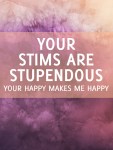
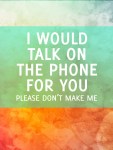
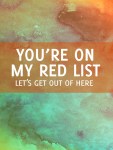
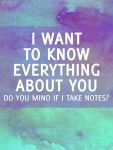
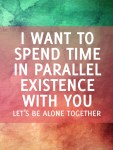
[Image description: A series of six Valentine’s Day cards featuring bright watercolor backgrounds with complimentary coloured bars containing white text. The cards read:
Your stims are stupendous; your happy makes me happy
I would talk on the phone for you; please don’t make me
You’re on my red list; let’s get out of here
I want to know everything about you; do you mind if I take notes?
I want to spend time in parallel existence with you; let’s be alone together
Your echolalia is enchanting; let’s back and forth
I think I would like this better if the ‘group picture’ contained the first two figures. Yes, there are autism stereotypes, but the implication by their exclusion is that these two do not exist in our multifaceted community, when the reality is, they are just as much a part of us as any other. So yes, portray diversely, but don’t leave those autistics who fit the stereotypes out in the cold. I’ve seen this kind of gatekeeping in queer communities, too, often to exclude people who fit the stereotypes about queer people too closely. The moment we tell people they’re letting us down just for existing and living as their true selves, the more we define a rigid idea as to what it means to be autistic, and become hypocrites. We should never make an autistic feel they have to change their movements, their dress, their special interests, stimming behaviours, or speech because they are overrepresented. Don’t make that autistic person feel shame because of who they are. That’s what neurotypicals do to us every day.
So, for the autistics who wear headphones, who love trains, who are ‘little professors’ with encyclopaedic knowledge of baseball stats or vacuum cleaners or planes, who are maths prodigies or synaethetes or have eidetic memories or are savants – YOU ARE WELCOME. YOU BELONG. YOU ARE JUST AS AUTISTIC AS ANY OF US. WE LOVE YOU.
If you’re trying to figure out whether
someone has a fake smile, look at their
eyes. When you have a genuine smile,
the corners of your mouth upturn, your
cheeks raise, and the skin around your
eyes crinkles. Known as the ‘Duchenne
smile’, it happens involuntarily when
you’re truly happy about something- so
a smile without eye crinkles is a good
indicator that someone was forcing it. SourceSource 2Source 3
ahahah oh boy science no.
i learned to fake that part of the smile when i was fuckin 14 and miserable, if i smile you ain’t knowin it’s fake unless i want you to.
Also, the info in the original post is super fucking ableist against people who have different expressions for whatever reasons. Autistic people, blind people, people with muscle or movement disorders or paralysis that affects the muscles of the face, etc., often have different patterns of expression. For example, autistic people often have smiles that look ‘fake’ to neurotypical people. It’s not that we’re not happy or genuine. Right now, my five year old nephew (moderate to severely deaf, probably autistic too) smiles with only one half of his face. The other eye and half of his mouth he screws up tightly like he’s wincing. That’s just how he smiles. Sure, there are times he expresses with his whole face like a quote normal person unquote, but nine times out of ten, it’s his quirky, atypical smile/grimace. And that’s fine. He’s a happy neurodiverse kid.
Also, tangentially, fuck all that noise about ‘eye contact means you’re not lying’. No, eye contact means nothing. There are a hundred different neurobiological, social and cultural reasons why people don’t do it. Body language and facial expressions can only tell you a small part of the story when you don’t know the person and their background. Just stop judging based on science invented by sadists who liked torturing homeless people in the name of ‘research’. (Google Duchenne, I’m not exaggerating.)
I was miffed that there was no new ThinkGeek Neurodiversity shirt today, so I made a thing. Not that this needs to go on a shirt, but making the thing was fun and surprisingly stimmy and nice to look at so yeah, ‘s all good.
This is my first year after lots and lots of struggle and insecurity and stuff and finally understanding why my brain works the way it does. I’ve seen and experienced last year’s April. It was damn hurtful at times, even for someone pretty new to all the A$ fear mongering. Awareness? No, thanks. Acceptance? Yes! And celebrate the heck out of neurodivergence. So I made a thing that makes me happy. Maybe it makes someone else happy, too.
[Brain made of tree branches, with the word neurodiversity below it.]
As the mother of an autistic child, one with an aversion to certain types of clothes, to seams, to matching socks, to materials etc and I loved how this was explored with DJ and I wondered if this was deliberate (A lot of DJ matches things on the spectrum) or just a coincidence
Yes. It’s deliberate.
Many of DJ’s traits are based on those of those on the autism spectrum, including his difficulty with sensory processing, his inability to easily or accurately read facial expressions and his literal reading of many situations, his need for order and control. A lot of things in the stories point to the way he processes his world, and how the people in his family deal with his needs.
I have never explicitly stated that DJ is/would be diagnosed as on the spectrum. That’s because DJ is an AI magically transformed into a child. He’s a unique case, but what I did not want to do was draw a comparison between real life people on the spectrum and robotic AIs.
This is a group that already struggles against a lot of unpleasant stereotypes and misunderstandings. I do my best not to propagate things like this, so what I tried to do is write a sympathetic, well loved character who relates to the world in a way that could best be described as neurologically atypical.
He is presented as a child who handles and processes things in a way that is different from the rest of his ‘family.’ This isn’t unusual in the real world. It’s also not unusual for family members to struggle with the differences that they can’t fully understand. It takes different people differing amounts of time to come to terms with what a child, what another person, needs.
That came up in the socks scene.
Steve has been observing, determining what DJ needs, what makes him comfortable, what small alterations can be made in a daily routine to make DJ happy and productive. Steve gives him time warnings. Provides him with structure, and makes his expectations clear. He communicates in clear language, and checks in repeatedly to make certain that DJ understands and is comfortable with what is happening.
Steve has researched things, and as an adult, he’s adjusted his own expectations and needs to match his child’s. I imagine his own mother did the same, for her sick and stubborn son. I imagine that Sarah Rogers, while not a saint, had done everything she could to make Steve’s life easier, to protect him, to raise him with love and acceptance.
She was a nurse who could not cure her son, but she could make him as comfortable as she could.
Tony struggles a bit more. Tony was raised with expectations. Tony is aware of public scrutiny in a way that Steve isn’t. Tony was raised with constant reminders that he was being judged, at all times, by a lot of different people. Tony looks at the socks, looks at a lot of different things, and doesn’t see a need, he sees something small that DJ could easily do to avoid needless problems.
He does’t understand that just because something is easy for him, doesn’t make it easy for DJ. That DJ has different needs, and different levels of comfort.
Tony fights to understand, and he doesn’t always get it, but he’s trying. Just like a lot of other people’s, Tony’s growth takes effort, and he slips from time to time. Not because he doesn’t love DJ. But because he does not understand, and understanding takes education and effort.
He was raised by people who did value appearances, who expected their son to be part of their perfect family. Tony fights against that, a lot. It’s another thing that has to be unlearned.
DJ is unique. But yes. He is based on various individuals I’ve known on the spectrum. I’ve been helped quite a bit by friends and readers, who have helped me adapt his personality and outlook, and I’ve been gratified by the response of readers, especially by those who identify as being on the spectrum themselves. 8)
{image is a photo of Brooke standing on Luau’s shoulders on the beach in Newport, RI. She looks as though she is flying. Photo courtesy of Connerton Photography’s magic lens. All rights reserved.} …



 knitting in the dark