Native Girls are beautiful.
Native Boys are beautiful.
First Nations Girls are beautiful.
First Nations Boys are beautiful.
Indigenous Girls are beautiful.
Indigenous Boys are beautiful.
Aboriginal Girls are beautiful.
Aboriginal Boys are beautiful.
Inuit Girls are beautiful.
Inuit Boys are beautiful.
Métis Girls are beautiful.
Métis Boys are beautiful.
Aleut Girls are beautiful.
Aleut Boys are beautiful.
Afro-Indigenous Girls are beautiful.
Afro-Indigenous Boys are beautiful.
Mi’kmaq girls are beautiful.
Mi’kmaq boys are beautiful.
Two-Spirit Girls are beautiful.
Two-Spirit Boys are beautiful.
You’re beautiful if you have dark skin.
You’re beautiful if you have light skin.
You’re beautiful if you’re in between.
You’re beautiful if you’re mixed.
You’re beautiful if you fit the Western Gender Binary.
You’re beautiful if you’re don’t fit the Western Gender Binary.
You’re beautiful if you’re multiple genders. You’re beautiful.
(Aboriginal, Inuit, and Métis lines added by @phaedragona. Two-Spirit lines added by many people. Afro-Indigenous and Mixed lines added by @condorofrph. Aleut lines added by anonymous. Mi’kmaq lines added by @kennachaos . Correction on gender lines by @doyoumisterjones . If there’s anyone I’ve left out, feel free to add on to it and/or message me and I’ll change the original post.
As you may know, the word ‘Sioux’ is considered to be a slur amongst members of the Oceti Sakowin. It is not our word for ourselves, but rather a name given to us by another nation and perpetuated by the Europeans / Euro-Americans.
You also may have noticed that our official tribe names often contain the word ‘Sioux’ (‘Oglala Lakota Sioux Tribe’ for example.) The reason for this is entirely legal. When our treaties were drafted, they were written as an agreement between the US Government and the ‘Sioux Nation.’ For this reason, we cannot fully abandon the name. However, when we’ve had opportunities, we’ve dropped the name in places we can (’Oglala Lakota County,’ for example, a name chosen by the rezidents.)
Simply put, members of the Oceti Sakowin generally don’t refer to themselves as ‘Sioux’ and, if we can’t change it legally, at least we can continue to assert our identity on our terms. So, if you choose to respect that, here’s a quick Oceti Sakowin education guide:
Oceti Sakowin (Seven Council Fires)
Oceti Sakowin (encompasses all language dialects) is the simplest and broadest replacement for ‘Sioux.’ You can use this term if you aren’t aware of the specific language group to which ‘Sioux’ refers. Within the Oceti Sakowin are three main groups, which are further divided into seven subgroups:
(Mnikiwoju/Mniconjou) – Swamp Plant (Cheyenne River Reservation)
Itazipcola
(Itazipco) – No Bow (Cheyenne River Reservation)
Owohe Nunpa
(Oohenunpa)
– Two Paunch Boiler (Cheyenne River Reservation)
Sihasapa – Black Feet (Cheyenne River Reservation, Standing Rock Reservation)
Hunkpapa – End of Horn (Standing Rock Reservation)
*modern terminology
*In the past, the term Nakota has been applied to the Yankton, but this is a mistake. The Yankton speak Dakota. Nakota speakers are Assiniboine / Hohe and Stoney, who broke off from the Yankton at a time so long ago their language is now nearly unrecognizable to Lakota and Dakota speakers.
Louie Gong describes his company, Eighth Generation, as “a Native-owned, community-engaged small business that began when I started putting cultural art on shoes.” It’s true, in 2008, Gong began decorating sneakers and skateboarding apparel with indigenous Nooksack patterns — a move that, as a Nooksack himself, set him apart from the non-Native designers who’d been doing so for years. As demand grew, so did Gong’s ambition.
Here you go, kids!
How to procure Native-American-and-First-Nation-themed items without entitlement or cultural appropriation in one easy step.
BUY THE THINGS DIRECTLY FROM THE PEOPLE THEMSELVES.
Because if they’re selling these representations of their culture and being fairly compensated, you’re not appropriating, you’re appreciating. And helping good folks make a living while you’re at it.
Everybody wins.
^^^this is the difference. participate in the parts of culture that people CONSENT to sharing!! it’s that simple, if you buy directly from the source, they are creating with the idea that people outside the culture will be consuming, and can pick and choose what they are okay with you having.
the same idea as wearing traditional dress that someone of that culture gave you as a present vs. buying a knockoff version for “fashion”
I’ve used this argument for a long time as a difference between appropriation and appreciation. If you are buying directly from the people of that culture you are supporting them in keeping certain practices and talents alive. They are choosing what they share while making a living from their work. You are supporting them, while enjoying their culture. This is not only okay but it can really help people from these communities.
With appropriation, you are taking money away from the people. While mocking everything they stand for, and giving money to big companies who only care about profit, and have no understanding of the people they are stealing from.
Eighth Generation is awesome! They ship fast in addition to having gorgeous merchandise. Five stars.
I appreciate everything in this post
Because it took like 4 steps to find the damn thing, here is a link to the place:
An archaeological dig on the Menemonee Reservation in Wisconsin yielded a clay pot. The pot was dated to 800 years ago and contained seeds. Some of the seeds were planted to see if 800 year old seeds were viable. An ancient squash was the result.
This is the coolest fucking thing, and don’t try and tell me otherwise.
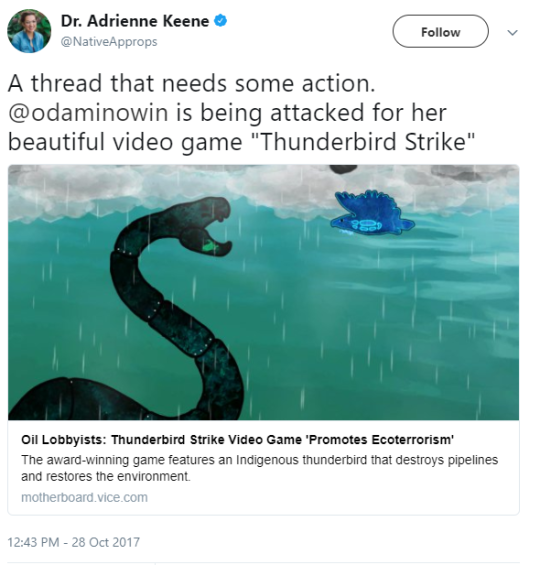
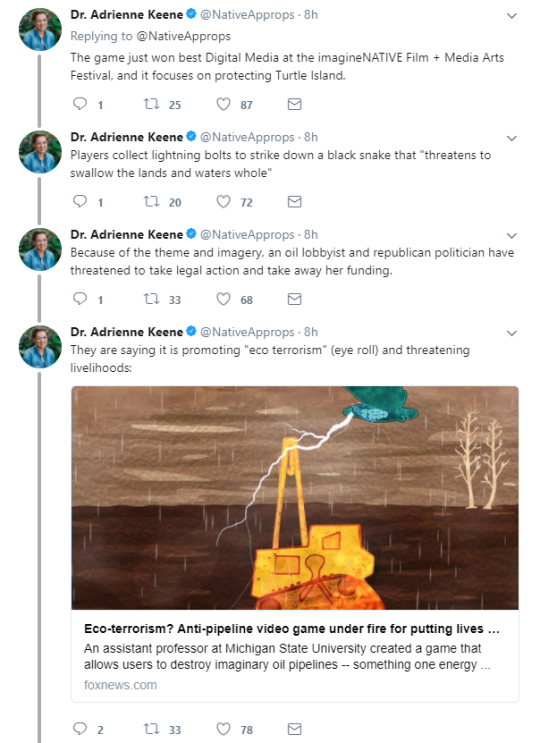
In Thunderbird Strike, a new side-scrolling game that launches at the ImagineNATIVEfestival this week in Toronto, players can control a thunderbird—a symbol in several Indigenous cultures—that destroys as much of the oil industry’s machinery and pipelines as it possibly can. And it’s so satisfying.
The game was created by Elizabeth LaPensée, an Anishinaabe, Métis, and Irish games developer, and assistant professor of media and information at Michigan State University. She told me in an interview that she wanted to create a game where Indigenous players could reclaim some agency around oil pipelines, even if through a video game.
“Especially when we’re talking in the context of pipelines, and the oil industry, there are some wins we can have. But ultimately protectors will be pushed out and the processes are going to move forward. It’s happening with mining and it’s happening with pipelines,” LaPensée told me over the phone.
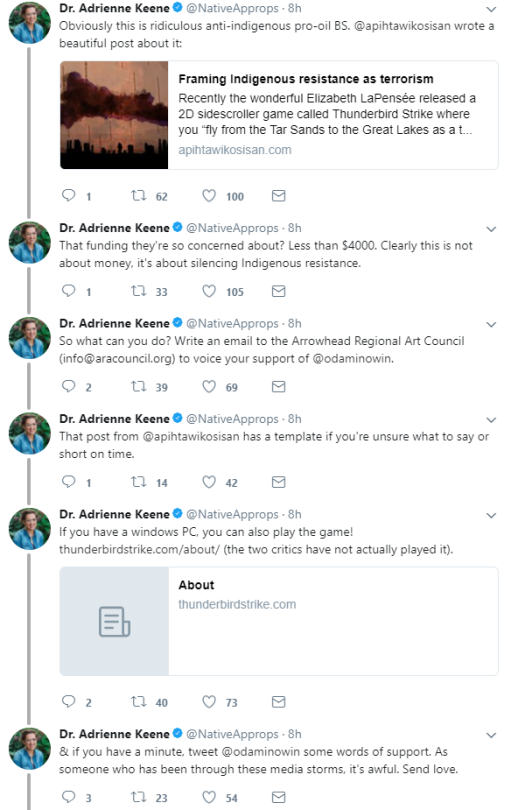
The creator of this game is getting attacked and defamed by oil lobbyists and racists
(and let’s be honest, the venn diagram circle of “oil lobbyists” is just a small circle in the larger circle of “racists”) and could really use support and advocacy:
Sara Jacobsen, 19, grew up eating family dinners beneath a stunning Native American robe.
Not
that she gave it much thought. Until, that is, her senior year of high
school, when she saw a picture of a strikingly similar robe in an art
history class.
The teacher told the class about how the robe was
used in spiritual ceremonies, Sara Jacobsen said. “I started to wonder
why we have it in our house when we’re not Native American.”
She said she asked her dad a few questions about this robe. Her dad, Bruce Jacobsen, called that an understatement.
“I
felt like I was on the wrong side of a protest rally, with terms like
‘cultural appropriation’ and ‘sacred ceremonial robes’ and ‘completely
inappropriate,’ and terms like that,” he said.
“I got defensive
at first, of course,” he said. “I was like, ‘C’mon, Sara! This is more
of the political stuff you all say these days.’”
But Sara didn’t
back down. “I feel like in our country there are so many things that
white people have taken that are not theirs, and I didn’t want to
continue that pattern in our family,” she said.
The robe had been
a centerpiece in the Jacobsen home. Bruce Jacobsen bought it from a
gallery in Pioneer Square in 1986, when he first moved to Seattle. He
had wanted to find a piece of Native art to express his appreciation of
the region.
The Chilkat robe that hung over the Jacobsen dining room table for years. Credit Courtesy of the Jacobsens
“I just thought it was so beautiful, and it was like nothing I had seen before,” Jacobsen said.
The
robe was a Chilkat robe, or blanket, as it’s also known. They are woven
by the Tlingit, Haida and Tsimshian peoples of Alaska and British
Columbia and are traditionally made from mountain goat wool. The tribal
or clan origin of this particular 6-foot-long piece was unclear, but it
dated back to around 1900 and was beautifully preserved down to its long
fringe.
“It’s a completely symmetric pattern of geometric
shapes, and also shapes that come from the culture,” like birds,
Jacobsen said. “And then it’s just perfectly made — you can see no seams
in it at all.”
Jacobsen hung the robe on his dining room wall.
After
more needling from Sara, Jacobsen decided to investigate her claims. He
emailed experts at the Burke Museum, which has a huge collection of
Native American art and artifacts.
“I got this eloquent email
back that said, ‘We’re not gonna tell you what to go do,’ but then they
confirmed what Sara said: It was an important ceremonial piece, that it
was usually owned by an entire clan, that it would be passed down
generation to generation, and that it had a ton of cultural significance
to them.“
Jacobsen
says he was a bit disappointed to learn that his daughter was right
about his beloved Chilkat robe. But he and his wife Gretchen now no
longer thought of the robe as theirs. Bruce Jacobsen asked the curators
at the Burke Museum for suggestions of institutions that would do the
Chilkat robe justice. They told him about the Sealaska Heritage
Institute in Juneau.
When Jacobsen emailed, SHI Executive
Director Rosita Worl couldn’t believe the offer. “I was stunned. I was
shocked. I was in awe. And I was so grateful to the Jacobsen family.”
Worl said the robe has a huge monetary value. But that’s not why it’s precious to local tribes.
“It’s
what we call ‘atoow’: a sacred clan object,” she said. “Our beliefs are
that it is imbued with the spirit of not only the craft itself, but
also of our ancestors. We use [Chilkat robes] in our ceremonies when we
are paying respect to our elders. And also it unites us as a people.”
Since
the Jacobsens returned the robe to the institute, Worl said, master
weavers have been examining it and marveling at the handiwork. Chilkat
robes can take a year to make – and hardly anyone still weaves them.
“Our
master artist, Delores Churchill, said it was absolutely a spectacular
robe. The circles were absolutely perfect. So it does have that
importance to us that it could also be used by our younger weavers to
study the art form itself.”
Worl said private collectors hardly ever return anything to her organization. The federal Native American Graves Protection and Repatriation Act requires
museums and other institutions that receive federal funding to
repatriate significant cultural relics to Native tribes. But no such law
exists for private collectors.
Bruce
and Gretchen Jacobsen hold the Chilkat robe they donated to the
Sealaska Heritage Institute as Joe Zuboff, Deisheetaan, sings and drums
and Brian Katzeek (behind robe) dances during the robe’s homecoming
ceremony Saturday, August 26, 2017. Credit NOBU KOCH / SEALASKA HERITAGE INSTITUTE
Worl
says the institute is lobbying Congress to improve the chances of
getting more artifacts repatriated. “We are working on a better tax
credit system that would benefit collectors so that they could be
compensated,” she said.
Worl hopes stories like this will encourage people to look differently at the Native art and artifacts they possess.
The Sealaska Heritage Institute welcomed home the Chilkat robe in a two-hour ceremony over the weekend. Bruce and Gretchen Jacobsen traveled to Juneau to celebrate the robe’s homecoming.
Really glad that this is treated as hard hitting news, no really, I am
Y’all creepy motherfuckers who tracked down the author of My Immortal down had better at least buy her books. Y’all owe her that much after hunting her down as if her life is a game to you.
And holy shit, there’s going to be a memoir about the author’s time in the foster system, searching for her little brother, and how My Immortal played a part in that: Under the Same Stars. Do y’all know how much guts it takes to talk about the stuff she’s putting in that memoir? How much she has to care about getting this issue – how kids are treated in the foster system, especially Native kids – out in front of people?
She’s Plains Cree and Lenni Lanape and an activist, she digs Lacuna Coil (same), she started writing seriously because she wanted to give her gay best friend non-tragic stories about people like him, she was going to be a physicist before she decided to look for more direct ways to help her community.
Her Gives Light series is a queer m/m YA novel series that’s not tragic? And takes place on a Shoshone reservation?
Y’all, she sounds incredible, and we should support her. She sounds like everything Tumblr tries to support and love. We need to show up for her.
I laughed my ass off about My Immortal many, many times, and have wondered who wrote it, what became of them. It turns out the answer is … pretty damn awesome?








 knitting in the dark