“Despite all of that, I don’t “look” disabled… there are no visual cues that I am plagued by chronic pain and fainting spells.
…I can’t help but mull over my experiences with non-disabled people doubting me as I’m en route to meet the photographer for this shoot. Will Sean be able to grasp the nuances of my disability? More importantly, will he care?”
Since I don’t see this all that often, but part-time wheelchair usage is a thing and these are things I learned as someone who uses a wheelchair part time. (Please add to it if you think of things!)
*Not as many people as you think are watching you get out of your car to walk to where your wheelchair is to get in it.
*Chances are you have only a manual one- this can be hard on your arms. It’s okay to ask for help from someone to push. But it’s just as okay to yell and make a big deal when they push without asking (Then asking them 4 minutes later to push you. Wheelchairs can be emotional things- it’s okay to be emotional.)
*It’s okay to get up from your chair occasional. You don’t have to “pretend” that you can’t get up from your wheelchair. Everyone is different. You don’t owe ANYONE an explanation.
*Don’t be embarrassed about telling family members or friends you need the wheelchair. Chances are they WILL forget. They won’t mean to- but this is new for them and even more part-time for them. It IS okay to insist on bringing the wheelchair. Even on short trips.
* This is an important one I had to learn. IF ITS HARD FOR SOMEONE TO PUSH YOU. Say a hill, or something. DON”T JUST SAY “I feel bad” AND GET UP AND WALK IT. IF ITS HARD FOR THEM TO PUSH YOU. THAT MEANS IT’LL BE JUST AS HARD TO WALK IT. You are in that wheelchair for a reason, don’t feel guilty.
*You are NOT faking. Part-Time wheelchair usage is OKAY to do. You are not exaggerating your symptoms, you are not pretending you are worse than you are. Everyone’s story is different. You do not owe anyone an explanation.
PSA to all you fantasy writers because I have just had a truly frustrating twenty minutes talking to someone about this: it’s okay to put mobility aids in your novel and have them just be ordinary.
Like. Super okay.
I don’t give a shit if it’s high fantasy, low fantasy or somewhere between the lovechild of Tolkein meets My Immortal. It’s okay to use mobility devices in your narrative. It’s okay to use the word “wheelchair”. You don’t have to remake the fucking wheel. It’s already been done for you.
And no, it doesn’t detract from the “realism” of your fictional universe in which you get to set the standard for realism. Please don’t try to use that as a reason for not using these things.
There is no reason to lock the disabled people in your narrative into towers because “that’s the way it was”, least of all in your novel about dragons and mermaids and other made up creatures. There is no historical realism here. You are in charge. You get to decide what that means.
Also:
“Depiction of Chinese philosopher Confucius in a wheelchair, dating to ca. 1680. The artist may have been thinking of methods of transport common in his own day.”
“The earliest records of wheeled furniture are an inscription found on a stone slate in China and a child’s bed depicted in a frieze on a Greek vase, both dating between the 6th and 5th century BCE.[2][3][4][5]The first records of wheeled seats being used for transporting disabled people date to three centuries later in China; the Chinese used early wheelbarrows to move people as well as heavy objects. A distinction between the two functions was not made for another several hundred years, around 525 CE, when images of wheeled chairs made specifically to carry people begin to occur in Chinese art.[5]”
“In 1655,Stephan Farffler, a 22 year old paraplegic watchmaker, built the world’s first self-propelling chair on a three-wheel chassis using a system of cranks and cogwheels.[6][3] However, the device had an appearance of a hand bike more than a wheelchair since the design included hand cranks mounted at the front wheel.[2]
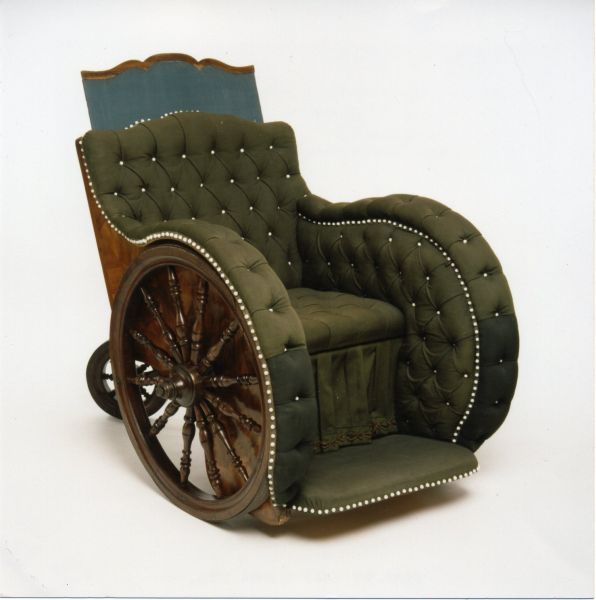
The invalid carriage or Bath chair brought the technology into more common use from around 1760.[7]
In 1887, wheelchairs (“rolling chairs”) were introduced to Atlantic City so invalid tourists could rent them to enjoy the Boardwalk. Soon, many healthy tourists also rented the decorated “rolling chairs” and servants to push them as a show of decadence and treatment they could never experience at home.[8]
In 1933 Harry C. Jennings, Sr. and his disabled friend Herbert Everest, both mechanical engineers, invented the first lightweight, steel, folding, portable wheelchair.[9] Everest had previously broken his back in a mining accident. Everest and Jennings saw the business potential of the invention and went on to become the first mass-market manufacturers of wheelchairs. Their “X-brace” design is still in common use, albeit with updated materials and other improvements. The X-brace idea came to Harry from the men’s folding “camp chairs / stools”, rotated 90 degrees, that Harry and Herbert used in the outdoors and at the mines.[citation needed]
“But Joy, how do I describe this contraption in a fantasy setting that wont make it seem out of place?”
“It was a chair on wheels, which Prince FancyPants McElferson propelled forwards using his arms to direct the motion of the chair.”
“It was a chair on wheels, which Prince EvenFancierPants McElferson used to get about, pushed along by one of his companions or one of his many attending servants.”
“But it’s a high realm magical fantas—”
“It was a floating chair, the hum of magical energy keeping it off the ground casting a faint glow against the cobblestones as {CHARACTER} guided it round with expert ease, gliding back and forth.”
“But it’s a stempunk nov—”
“Unlike other wheelchairs he’d seen before, this one appeared to be self propelling, powered by the gasket of steam at the back, and directed by the use of a rudder like toggle in the front.”
Give. Disabled. Characters. In. Fantasy. Novels. Mobility. Aids.
If you can spend 60 pages telling me the history of your world in innate detail down to the formation of how magical rocks were formed, you can god damn write three lines in passing about a wheelchair.
Signed, your editor who doesn’t have time for this ableist fantasy realm shit.
“You are too young to be disabled,” they say. You age. “You are too young to be disabled,” they say. You age. “You are too young to be disabled,” they say. You have changed. They have not.
You see a flight of stairs. Your friend insists there are only a few. You don’t see an end. You are tired. There are too many stairs. You don’t see an end.
The door has an accessible entrance sticker. It is not accessible. You tell them so. They insist it is. You try to explain. They point to the sticker wordlessly.
You tell people there is no cute for your disability. They whisper. Soon everyone is whispering. You do not know what they are saying but you hear the word ‘yoga’.
You need an ice pack. You get one. You immediately need another. This has been happening all day. Or was it all year? You try to remember and you cannot think of a time you did not need an ice pack.
You stand up from your wheelchair. People gasp. Your disability has magically disappeared. You sit back down. Your disability returns.
You never notice people using canes. You get a cane. Suddenly you notice them. They’re everywhere. The number of canes grows. You chalk it up to your imagination, but you wonder if it really is growing. Soon, everyone will use canes.
You do not see yourself in magazines. You do not see yourself in movies. You do not see yourself on tv. You do not see yourself in books. You start to fear that you do not exist.
A person asks you what your disability is. “I don’t know,” you whisper, “no one knows.” They stare at you confused. You have never known.
You sleep. You are more tired. You don’t sleep. You are more tired. You go out. You are more tired. You stay in. You are more tired. The moon waxes. You are more tired. The moon wanes. You are more tired. You think about whether these things are related. You are more tired.
[disclaimer: you don’t have to identify with all of these in order to reblog (in fact I don’t expect most people will) but please do identify with the cripple punk movement as a whole! or if you’re reblogging for a friend tag that you are and you’re able bodied. Also please tag for unreality and depersonalization if you can! Feel free to add on]
This stupid joke on Cheezburger shows people in wheelchairs at the World Cup who have stood up to cheer with the caption “Miracles Happen Every Day at the World Cup!”
I know this is a joke but it’s part of this trend to call anyone who uses a wheelchair but can also walk, a fake.
Paralysis is really not the only reason someone is in a wheelchair. There are many, very legitimate reasons to use a wheelchair that don’t involve someone not being able to stand. A wheelchair is a mobility tool for people who have trouble with pain, fatigue, balance or joint problems not to mention broken bones or dislocations. Most of these people can stand up and even walk a short way this does not mean they shouldn’t use a wheelchair. People really need to get this. The media (and I know this is not a news article but there have been some) needs to stop convincing the public that anyone who is not paralysed is not disabled.
You CAN NOT tell by looking at someone if the they have an invisible illness. You can not tell if they have heart trouble, if they have Lupus or arthritis or EDS. You can not tell by looking at someone if they are in pain.
Going to a sporting event is massively painful and exhausting. If you are running on very little energy to begin with there is no way you can manage it without assistive devices and why should people have to miss out on things they love because they are disabled? Why should going grocery shopping be something that takes all week to recover from? If walking and standing are something you take for granted then I am happy for you but it is not something I have ever done.
I’ll use myself as an example. I have EDS so my joints are prone to dislocation. Have you ever dislocated something? Have you had a bone shift and pinch a nerve? It’s not fun. My joints hurt all the time and they are unstable. My blood vessels are too stretchy so if I stand still for any length of time I pass out. My balance is terrible and I fall a lot and that causes more damage. I also have Fibromyalgia so all my pain signals are amplified and much of my soft tissue is effected. And just to make things extra difficult I have CFS/ME. I only have the energy to shower once a week most of the time. Moving around the house is often exhausting. Sitting upright can be too much on bad days. Walking around the shops is so, so exhausting. Getting to a sporting event or a concert is a major undertaking.
I look fine. I am a fat woman in her 30s who can walk and stand for short amounts of time. I am not lazy. I am in pain and running on empty and trying not to pass out.
To go to a major event a wheelchair would help stop dislocations (not entirely stop, I dislocate fingers often while driving), it would help keep my pain more managable. It would help reserve what little energy I have so I can make it through the day. I will still need a week to recover. A week of massive pain and migraines and fevers and sleeping 12 hours a night. A week where I can’t shower or cook food or do household tasks.
A wheelchair would help stop me falling over. When you have bad balance it’s hard enough to walk on your own. In a crowd it can be awful. You get bumped all the time but if you can’t correct your balance after it you fall and falling can do so, so much damage.
A wheelchair is often more suited to sitting in than a plastic chair at a sporting event. Hard chairs with no lumbar support can cause pain and muscle strain in your back and neck, they can put pressure on joints to move ways they shouldn’t, they just hurt. Sitting for hours in a chair like that is uncomfortable for anyone but for someone with underlying problems can cause massive pain and dislocations and muscle spasms and migraines.
So don’t judge that person on the scooter or in a wheelchair or parking in a disabled parking space if they have a permit. Just because you can not see any problem with them does not mean they are faking it or rorting the system. One day of joy at an even is not representative of how people live their lives. I go to the Mardi Gras parade each year in Sydney. I get drunk and take a lot of pain killers. I spend the weeks before reserving my energy. I spend many, many weeks afterwards recovering. I know how much I pay to spend the night leaning on a barrier and cheering on the parade. If you don’t see my cane you may not know I’m disabled but that doesn’t stop the pain and the price I pay. Don’t judge my life by what you see that one day. A wheelchair or scooter would be fantastic for such a big day out but they are expensive and I can not afford one.
Invisible illnesses and disabilities are invisible but they are still there! Not everyone is lucky enough to be able to take things like walking and standing and going places for granted. Remember that. Read the spoon theory by Christine Miserandino and stop judging people by what you can see. People could be dealing with all sorts of pain and complications and really struggling to have a day out or just get enough food to get through the week and comments and muttering and ‘looks’ and taunts just make it all so much worse. it’s none of your business.


 knitting in the dark