There’s a lot of talk about the fact that Hawkeye is canonically deaf in the comics (and uses hearing aids), but there’s rarely any mention of how this happened.
I think it’s important to remember Hawkeye didn’t just lose his hearing. He sacrificed it. It happens in the panels from the comic above, final issue of Hawkeye’s first solo limited, published in 1983 (written and penciled by Mark Gruenwald). In this comic, Hawkeye and Mockingbird (who he would marry at the end of the issue) are subjected to a sound that makes them go into a violent, uncontrollable rage. Hawkeye knows there’s a very good chance if he listens to this sound, he will beat Mockingbird to death.
This is a man who watched his father beat his mother. Who lost both his parents when his father forced his mother to drive with him when he was drunk. So when he’s faced with the possibility of becoming like his father, whether it’s of his own choice or not, and turning that kind of violence on a woman he loves, what does he do? He makes the decision to risk his own well being, to sacrifice one of his senses without knowing what the long term consequences will be, to prevent hurting her.
This is part of what makes Hawkeye’s deafness so important. It’s representation, yes, and we always need more of that in media. But it’s also a symbol of who he is, of who he’s willing to be. Yes, Hawkeye is the guy without any “real” powers, the guy who stands with the Avengers because he practiced until he got really, really good with arrows. But he’s also the guy who will put others first, who will do whatever needs to be done no matter the personal cost. Hawkeye’s deafness is a symbol of what makes him a hero, even without the powers.
Because that’s who Hawkeye is—the guy who shows that it doesn’t take a serum or a robot suit to be a hero. And his deafness is a reminder of that.
Tag: meta
One thing I was thinking about today was Alexander Pierce. I feel like one thing that’s been under-discussed in Cap 2 meta (at least, from what I’ve seen on my dash— maybe it’s been talked about elsewhere!) is the privilege of Alexander Pierce, a privilege that is very deliberately communicated onscreen.
Pierce, as a character, is visually distinctive: he’s not just an older white man, but a very specific genre of older white man. His three-piece suits and tortoiseshell glasses suggest a fondness for the styles, at least, of some happier past: the gentlemen’s era (to me located sort of vaguely pre-Philby) when men like him knew how to be graceful with power, because it was something that came naturally to them, something they would never have to demand. His charm, his generally pleasant demeanor are of a piece with this— after all, as he himself tells Steve, he’s the diplomat: the one who keeps his hands clean while Nick Fury does what needs to be done.
Tony does spin out of control and fights his best friend because he’s a drunken mess… except he’s dying. He already gave Pepper his company and is now entrusting the Iron Man suits to the one person he can trust: Rhodey. Tony brawling with Rhodes isn’t just a dispute between friends. Tony was testing Rhodes to see if he was willing and able to use the suit to fight his best friend if need be. In one go, Tony was training, teaching, and evaluating Rhodes’ suitability. Brilliant. War Machine was planned by Tony, who thought he was going to die.
All of which lends new meaning into Tony’s line to Rhodey earlier in the movie: “You gotta trust me. Contrary to popular belief, I know exactly what I’m doing.”
can you talk about steve’s possessive streak :P
YES PLEASE.
Okay, so first of all: in the interest of full disclosure, I really like the idea of possessive Steve. I have no trouble seeing him develop this trait. If you do, that’s cool. Also, this got super rambly.
But. Here’s the thing. Steve Rogers is 1) very protective 2) incredibly hurt.
The Body of Bucky Barnes: A Massage Therapist’s Analysis
(CAVEAT: I have not been a massage therapist for very long. This is literally just me spitballin’—at the same time, this was a really good exercise for me! I like using the assessment part of my brain.)
It’s been tossed around in fandom that Bucky’s muscles have to be pretty f-ed up from having a cybernetic, metal arm grafted onto one side of his body. From the perspective of a massage therapist, that’s 100% accurate—but the issues don’t stop there. At the very least he’s got functional scoliosis and massive compensatory muscle strain, enough adhesions to make Jesus weep, and tons of somato-emotional holding points.
Do you ship Johnlock in the ACD canon? Do you think that ACD intended to write them as in love? Because as my thought process goes, there’s a pretty good chance that he, as a product of his time, was homophobic, maybe not to the point where he wouldn’t befriend a gay man (Wilde) but to the point where he might not intentionally write gay characters. Just a thought.
I absolutely ship them in the ACD canon. I think there’s a lot of suggestion that Holmes and Watson were (very implicitly, of course) queer and in love in the canon, for instance:
- how Holmes and Watson describe men
- and how they distance themselves from attraction
- how Watson speaks about himself and Holmes in relation to bathhouses
- and the significance of bathhouses
- the fact that Holmes and Watson were out of London in April – May 1895 (in The Adventure of the Three Students), possibly the worst time to be queer in London due to Oscar Wilde being on trial and the authorities clamping down on sodomy laws
- the romantic parallel between Dr. Leon Sterndale’s behaviour in The Adventure of the Devil’s Foot and Holmes’ behaviour in The Adventure of the Three Garridebs
- and much of this
- and all of this
Sir Arthur Conan Doyle was way ahead of his time in many ways and loved flying in the face of convention. He has my faith.
Yep! And I cannot recommend the last link given enough, to nekosmuse’s Decoding the ACD subtext site, where they go through each of the canon stories and draw out all the nuggets of nuance. Very good read, although it’s best to read the original story either just before or just after for maximum goodness.
I feel like that’s the thing that’s holding back many young women writers, and many young women in general now—this idea that we don’t put our work out until we believe it’s immaculate, and there’s no such thing as perfection to begin with. Secondly, the lack of a perfected idea never stopped men from speaking out! To be successful I think you really have to shove yourself forward, and I consider myself really lucky that I’ve never held myself back in those ways. To a fault! I’m sort of a pamphleteer for my own work, standing on a street corner ringing a bell, shouting, “Look what I made! Look what I made!”
Elizabeth Gilbert (via robinwasserman)
I feel that Elizabeth Gilbert is right, but I wanted to talk a little bit about bell-ringing, and why women are held back, and how much people resist women shoving themselves forward—how much they resist women doing something that might lead to success.
Compliments are two-edged swords for women: thinking well of yourself is a dangerous activity people will try to stop you engaging in.
I remember vividly being sixteen and having a friend come up to me and compliment my outfit. ‘Thank you!’ I said. ‘Wow,’ she said, and blinked. ‘Normally people say—oh hey, I like *your* thing, but no, it’s cool you just said thanks! It’s great you’re so confident!’ ‘I’m sorry,’ I said. ‘No, I really like your top. I’m sorry.’
And from then on, I remembered to compliment back rather than act like I was so great I could just take a compliment. If possible, I complimented first, just to be safe!
And there’s nothing wrong with complimenting other people. And my friend is and was a lovely person. It wasn’t her fault she said it, or my fault I took it that way. It’s that this is a system that tries to get you coming and going.
THE WORLD: Have high self-esteem generally.
LADY: I’m so cute.
THE WORLD: Uh but don’t be vain!
LADY: I’m so smart.
THE WORLD: Do not be a stuck-up bitch!
LADY: I quite like my…
THE WORLD: Gosh you think HIGHLY of yourself, don’t you?

“Girls are trained to say, ‘I wrote this, but it’s probably really stupid.’ Well, no, you wouldn’t write a novel if you thought it was really stupid. Men are much more comfortable going, ‘I wrote this book because I have a unique perspective that the world needs to hear.’ Girls are taught from the age of seven that if you get a compliment, you don’t go, ‘Thank you’, you go, ‘No, you’re insane.’ “ – Lena Dunham
It’s not that guys don’t get insecure, too. Of course they do: they are human. But it’s true that girls are *taught* insecurity, via a barrage of social pressure… pressure from everybody.
A friend of mine wrote a post a few weeks ago talking about being a woman writer online, and the things you heard from people while… being a woman writer online. Two of those things were: it didn’t sell so she’s a failure, and the other was: it did sell and I liked it but it’s rubbish.
Those two things (she does sell/she doesn’t sell) can’t be true of one writer at one time: obviously she was talking about stuff that happens, across the board, to women writers. Several people, of course, rushed to inform her that she was a bad writer (so she deserves what she gets!) and a bad person (so she deserves what she gets!). Because of course, she had to be whining about how she was treated personally, and she had to be told she deserved it.
Pretty classic method of trying to shut someone up. And never mind that a LOT of women writers, with a lot of different careers, reblogged it: probably they were bad people too, or bad writers too, or whiners, or making everything about sexism, or when they thought it applied to them they were mistaken. (So silly.)
I see this all the time, from people who are openly like ‘Yuck, feminists’ in real life, to people online who are like ‘I am one thousand per cent dedicated to feminism, and I haven’t noticed that a huge amount of my hatred is devoted to women doing it wrong and I love no lady real or fictional as much as I love Bucky Barnes/Tom Hiddleston/Joseph Fink/Derek Hale/a member of One Direction chosen by lottery.’
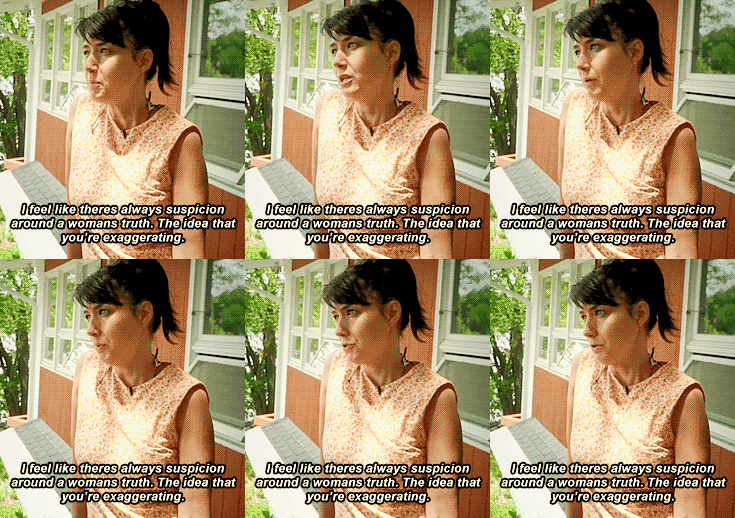
And it has a profound effect on women’s ability to do their jobs. As Elizabeth Gilbert says, not being a bell-ringer for your work is holding you back: but being a bell-ringer for your work is something that comes with the risk of being attacked, feeling lousy… and stopping being a bell-ringer for your work, learning it’s too risky, sacrificing a bit of yourself to preserve the rest.
This training makes women very quiet for a while, because that’s how self-doubt works: you don’t think ‘it’s the world, the world’s all messed up.’ You think: it’s me. You think, I just have to do better. You’re ashamed that you didn’t do better before you spoke up.
But there is no way to do well enough: there is no time there won’t be pushback when you speak up, because the desire behind the pushback, conscious or unconscious, is not for you to do better. It’s for you to stop.
Emily Gould’s talked about the impact an online attack had on her professionally.
‘I felt fear doing events around publication. Not stage fright, fear for my physical safety. Instead of planning celebrations I was arranging with bookstores and my publisher for adequate security at events. I felt worried that the location of my apartment had been revealed in so many profiles. It’s not like I experienced physical trauma or was tortured but I felt under attack. This wasn’t something that “happened on the internet” or something that could have been avoided by “just unplugging.” Talking to readers, doing events, and promoting books online is my job.
I still haven’t sorted out what kind of damage was done.’
http://emilygould.tumblr.com/post/98563959520/just-want-to-say-this-to-have-said-it
And leaving aside individual examples, science has shown the barrage of nasty messages women get for just existing, let alone daring to do something.
‘The study found that female bots received on average 100 malicious private messages a day while the male bots received an average of 3.7. ’
http://www.concurringopinions.com/archives/2009/03/cyber_harassmen.html
So ladies, getting harassed about thirty times more than dudes? And that’s just online… think about what happens in real life, like Joanne Harris having a publisher reject her based on her ‘lack of physical appeal.’
http://joannechocolat.tumblr.com/post/97879457176/are-you-too-fat-to-get-published
One cannot help but think ‘Gosh, if I was receiving thirty times less crap, I might have a better opinion of myself and I might get more done!’
And it’s not just online, and it’s not just publishing, sometimes it’s also your nearest and dearest who have an interest in shutting you up: the people you love and should be able to trust.
Zelda Fitzgerald had her work stolen from her by her husband F. Scott Fitzgerald, who frankly said he was just typing out her diaries sometimes, and she was depressed (who can blame her!) because stories written solely by her got more money when F. Scott Fitzgerald was listed as co-author… or when he was listed as the only author!
http://online.wsj.com/news/articles/SB10001424127887323393304578362314070442492
It’s very reminiscent of the way Walter Keane pretended that he was the one painting his wife Margaret Keane’s paintings, which were a phenomenon in the 1960s.
(She won the court case by having a paint-off.
MARGARET: I painted the paintings. Hey, I’ll paint one right now! In court. Let’s both paint one! Right now. In court.
WALTER: I… uh… brought this note from home to say I’m delicate, so…)
And yet, *would* the paintings have sold like they did if everyone had known they were painted by a lady from the start? I don’t know, but I’d guess probably not.
Which doesn’t make it right. Women deserve credit for their work, and they deserve a fair valuation of their work, and often they do not get either.
http://www.nytimes.com/1999/05/23/magazine/style-an-eye-for-an-eye.html
(THE WORLD: You want the CREDIT?
LADY: Well, I made it…
THE WORLD: But maybe you didn’t! Maybe your husband did it! Maybe your brother Branwell did it!
LADY: And also, work takes time, and I need to eat.
THE WORLD: And now you want to get PAID? Where’s your pride in your work, you money-grubbing ho?
LADY: Oh, *now* I’m meant to be all about the art?)
It is not just one’s husbands who snake women’s work: writing novels at all used to be sneered at as a lady thing, and then suddenly men started doing it and there was serious important literature, and women should stop doing that thing they invented! On a smaller scale but in the same vein, a woman called Victoria Lambert created Doctor Who, but no women have been allowed to write Doctor Who episodes for six years and counting.
It is not, of course, writing but all work done by women that is devalued in various ways: Female scientists’ contributions are overlooked and forgotten, teaching changed from a male-dominated job to a female-dominated job in the 1800s when people realised a) oh no all kids need teaching! and b) oh wait thank god we can just pay the ladies half as much… and it is still a female-dominated and thus underpaid job today, the games industry chases women away savagely (http://elizabethsampat.com/the-truth-about-zoe-quinn/), actresses are not given their own movies to lead (51% of the population, 10.8% of the lead roles in big movies!), women directors are just not given jobs (6% of 2013’s big movies had women directors), women take jobs as film editors instead of directors and then are not given credit for their contribution to films (e.g. Thelma Schoonmaker, who has edited all Martin Scorsese’s movies since 1980), women have 5% of Fortune 100 CEO positions, Taylor Swift gets it in the neck for writing songs about her own love life while Adam Duritz of Counting Crows, to name but one dude, can do the same thing for a decade and nobody cares.
It’s not easy to love yourself or what you do or what you have created. It’s not easy to promote yourself or praise yourself. The whole situation is fixed to make it difficult.
Bell-ringing is so complicated. A writer friend of mine asked for several promotions she knew male authors who sold less well than she had received: she got turned down. So she literally invented a new kind of promotion. They gave it to her in sheer puzzlement.
(It worked, and since then many people have been given that kind of promotion. Mostly dudes. The writer friend who invented it has been criticised a lot for not being a true artiste, and being arrogant. The dudes who got the promotion she invented have almost without exception gone on to win prizes women seldom win, be reviewed in many major publications that feature very few women, and talk about their own genius and get others to talk about it too.)
Dorothy L. Sayers, a badass writer who knew what she was talking about, said it was surprising anyone going through the wringer of sexism ‘retained any rag of sanity or self-respect.’
That’s why bell-ringing is such a complicated thing. It’s why shoving yourself forward is so difficult. ‘Well, just do it anyway’ is good advice, the only advice possible, but it’s also important to acknowledge what gets in the way of doing what we want to do. So that for every time we get pushback or feel ashamed, we remember to celebrate rather than be ashamed.
Despite the pressures of the world, so many women have done and made so many things! Just concentrating on writing, they: invented the novel. Popularised science fiction. Now, they’ve popularised young adult fiction and invented new adult fiction.
So, if you manage to get by and think you’re not so bad most days, that’s a triumph. If you manage to create something despite the voices inside and outside your head telling you not to, that’s amazing. If you make a mistake, own up to it, but know it’s probably not as bad a mistake as everyone is rushing to tell you it was. If you feel shamefaced about something you have done or made, that’s an injustice the world has put in your way—it’s not because you did or made something to be ashamed of. If you can create something, and believe in it and yourself enough to talk about it and think about how to get it out in the world… you have accomplished a series of amazing deeds. You have triumphed against a series of adversities.
That’s something worth bell-ringing about.
(via sarahreesbrennan)
Posts like this are why Sarah is one of my favorite humans and you should read both the whole thing and all the links.
(via seananmcguire)
Okay so I’m tired and sick, but I keep looking at this panel and at the risk of getting Meta, I want to explain why this panel is so important in terms of Tony Stark’s sexuality.
I think everyone needs to talk more about how in love ACD/Granda Holmes and Watson are. I mean, for a time when it was illegal, they were quite obvious about it…. (Don’t even get me started on The Dying Detective or The Three Garidebs)
Oh, honey. I don’t stop talking about that!
The Post Return stories are the most romantic things I’ve ever read. I like to think of them as the second honeymoon stories. Before the Final Problem, the stories were a lot more carefully written. Aside from ridiculously obscene descriptions about Sticky Spearheads, and Holmes’ O face, you had to pick deeper for the coding. After the Return, though? Watson crammed as much romantic imagery into each description as possible. And the events were far more romantic. Holidays on the Cornish Coast, sharing a small seaside cottage for example.
And of course, the most flashing, big arrows pointing ‘code’ in the entire series (A series which includes private couches in bathhouses, a lot of time spent in France, and…. It includes The Blanched Soldier for crying out loud.) is the opening of The Three Students:
It was in the year ‘95 that a combination of events, into which I need not enter, caused Mr. Sherlock Holmes and myself to spend some weeks in one of our great university towns
This is it. This is my favourite piece of evidence pointing to a romantic, sexual relationship between Holmes and Watson. The Three Students takes place at the beginning of April, in 1895. Our great detective and his constant companion are not out of London for a case, and Holmes is rather irritated at not being there. The pair are staying away long enough that they need to rent furnished rooms, rather than staying in a hotel, and judging by the fact that Holmes has none of his own equipment or books with him, they had to pack in a hurry. Almost as if they were fleeing London.
What combination of events would have taken place at the beginning of April, in 1895, so well known to all of London that Watson feels he doesn’t need to remind his readers of what it was? That had queer men running from London for their own safety?


With all the heat Anita Sarkeesian gets for her Tropes series, you’d think it was a new topic, but Gene Siskel & Roger Ebert had a discussion on a similar theme when they were talking about the influx of slasher movies on their show in 1980.
(x)
34 years later and this is STILL relevant
 knitting in the dark