copperbadge:

fyeahleverage:

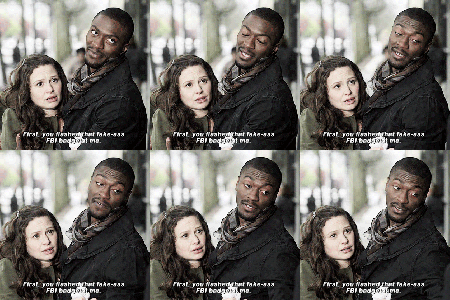
FBI, sir. That young lady is in our custody.

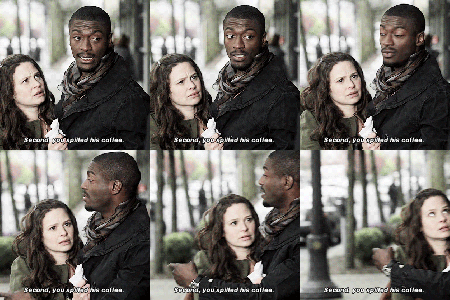
What I like best about this is that we know Eliot doesn’t commit hair-trigger violence over minor things – if someone bumps into him and spills his coffee he’s likely to be annoyed, but he’s not going to automatically break their arms. 

Which means that what’s happening here is Hardison, in bringing up the coffee, is giving Eliot explicit permission to break arms, and Eliot is playing into it. And the only real reason for playing into the coffee schtick is that it will amuse Hardison. 

featherquillpen:

pagerunner:

peroxidepirate:

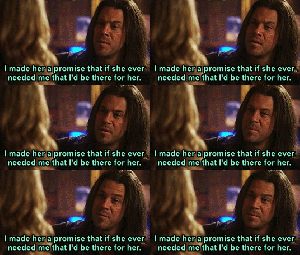
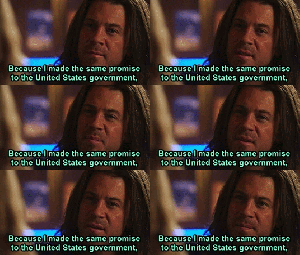
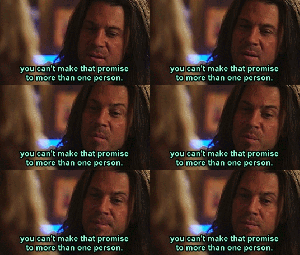
See, this kills me because it’s a pretty fucking fundamental driving force in Eliot Spencer’s character – “you can’t make that promise to more than one person.” And yet he ends the series doing exactly that.

The evil writerly part of my brain wants to know what happens when he can’t be there for Parker and Hardison both at the same moment. Whether it’s a heist gone wrong and he has to choose who to protect, or they’re in conflict with each other and he can’t avoid taking sides – what happens? 

Hardison. (At least for the job gone wrong, and assuming nothing in the job fundamentally supercedes it by putting other’s lives in danger.) Parker would tell him to get Hardison out and he’d do it, because that’s what makes them…them.

And when Hardison demands why, Eliot tells him, “she said to say, there’s never a plan M.”

i feel personally attacked by this headcanon

marguerite26:

drop-deaddream:

“And these are your only two options?”

How many times do you think Peggy has looked at a no-win scenario in her life and said those exact words? 

Growing up she learned she could either be a mother or a wife. Trying to help the war effort she learned she could either be a nurse or work in weapons production. In 1946 she was told she could either become a glorified secretary or find a job outside intelligence.

Peggy Carter spends her entire life finding ways to circumvent the box. She’s looked society in the face, and over and over again she’s challenged it, questioned it, and outsmarted it, even triumphed over it. And it’s because she has the audacity, always, to raise her eyebrow and refuse to be silenced, and because she isn’t ever too afraid to ask the question that matters to her most: and these are your only two options?

This is glorious because, well… I know women like this. We all do. We all know women who look at the shit choices life has given them and say: Are these my only options? I will make my own then. And this is why Peggy is my fav. She is kick ass and brilliant and walks into a room and everyone turns. But also she is a hero that I can relate to, believe in, strive to become. She looks at the world around her and says, I want better, I deserve better and she changes the rules of the game. And while she’s doing it, she’ll inspire you to do the same for yourself.

Now that’s a hero I’ll follow into battle any day, because she’s real and if I watch her closely, she’ll teach me how to lead the next time.

ifeelbetterer:

miwrighting:

kototyph:

leupagus:

killerville:


WOOED THE WORD YOU’RE LOOKING FOR IS WOOED

GUESS WHOSE TAGS ARE TOTALLY GETTING REBLOGGED

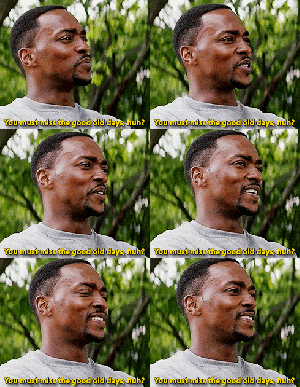
Star-struck Interviewer: “You must miss the good old days.”

Steve Rogers: “I grew up in a tenement slum. Rats, lice, bedbugs, one shared bathroom per floor with a bucket of water to flush, cast iron coal-burning stove for cooking and heat. Oh, and coal deliveries – and milk deliveries, if you could get it – were by horse-drawn cart. One summer I saw a workhorse collapse in the heat, and the driver started beating it with a stick to make it get up. We threw bricks at the guy until he ran away. Me and Bucky and our friends used to steal potatoes or apples from the shops. We’d stick them in tin cans with some hot ashes, tie the cans to some twine, and then swing ‘em around as long as we could to get the ashes really hot. Then we’d eat the potato. And there were the block fights. You don’t know what a block fight was? That’s when the Irish or German kids who lived on one block and the Jewish or Russian kids who lived on the next block would all get together into one big mob of ethnic violence and beat the crap out of each other. One time I tore a post out of a fence and used it on a Dutch kid who’d called Bucky a Mick. Smacked him in the head with the nails.”

Interviewer: “LET’S TALK ABOUT THE INTERNET.”

Steve Rogers: “I love cat pictures.”

(Many biographical details are taken from Streetwise, either from Jack Kirby’s autobiographical story or Nick Cardy’s contribution: http://twomorrows.com/index.php?main_page=product_info&cPath=52&products_id=513 )

it got better

stultiloquentia:

downthepub:

stultiloquentia:

stultiloquentia:

I am reading scholarly works about Jane Austen and having hearteyes about obscure details in the Pemberley chapters of P&P that indicate Mr. Darcy’s sustainable land management praxis.

Okay, let’s talk about Pemberley!

Austen, as a rule, doesn’t spend many paragraphs describing locations. There’s often information to be gleaned from their names (Sense and Sensibility is full of lurking references to sexual scandals and Mansfield Park to slavery), but Longbourn just means “long stream” or “long boundary,” Netherfield means “lower field,” and Rosings’ original owner was a redhead. Meryton, a pun on “merry town,” is kind of fascinating, given the installment of the militia and the threat to stability and serenity they represent. Partying and shenanigans. Possibly a Shakespeare ref.

Longbourn barely gets any description at all. From the get-go, everyone who lives there is obsessed with other places, with getting out (except Mr. Bennet, who never wants to leave his library, never mind the house). Lady Catherine deems it small and mildly uncomfortable, which is in keeping with the theme of confinement, but also it’s Lady Catherine talking. Netherfield can’t tell us much about Bingley, who is only a tenant. Rosings is expensively, ostentatiously modern and gaudily furnished, though it has a handsome park that Lady Catherine and her stifled daughter never set foot in but Elizabeth and Darcy both frequently escape to during their stays.

So it’s notable and wonderful that Austen goes out of her way to describe Pemberley as an old-fashioned, highly successful, working estate. Its practical old Anglo-Saxon name means “Pember’s clearing.” A pember is a man who grows barley. Darcy most likely still does. As Elizabeth and the Gardiners approach and tour the house, they notice and admire its beautiful surrounding woods, and then when they wander outside, the specific word Austen uses is coppice woods. A coppice is a woodland filled with tree species that grow new shoots from their stumps when you chop them down. Darcy probably has oaks on a fifty-year cycle as well as faster-growing species such as hawthorn and hornbeam for firewood, timber and cattle fodder. Coppice forestry is functional and sustainable, and provides habitat for beasts and birds.

Darcy is the anti-John Dashwood (Dashwood, srsly), the brother in Sense and Sensibility who inherits Elinor and Marianne’s childhood estate of Norland, whose wife immediately starts making plans to hack down trees (not even coppice trees, but big, gorgeous, venerable hardwoods) to make way for a folly. Jane Austen hated follies. Also, it ought to be noted that timber was so valuable in Britain at the time that estates often had inheritance clauses that detailed who was and wasn’t allowed to chop down what.

Darcy’s a food producer and land conservator, prefers nature over fussy, ornamental landscape design, his servants and tenants like him, he gives money to the poor… and… he’s a trout fisherman! He shoots, too, as do Bingley and Hurst and Mr. Bennet, but it’s a particular mark in his favour that Austen singles him and Mr. Gardiner out as anglers. It’s a pastime that signifies a taste for contemplation and quietness and appreciation of nature, as blissfully described in The Compleat Angler; or, The Contemplative Man’s Recreation, a hugely popular travel book first published in the 1600s and reprinted often for 18th C libraries. The plot of The Compleat Angler is about the conversion of a hunter (pastime of the ultra-rich) to a fisherman who learns to love the peaceful sport. We receive ample evidence elsewhere that Darcy is a man capable of swift, decisive action and formidable effectiveness. But at Pemberley, Austen takes care to show us how he’s balanced.

Most of the information in this post comes from Margaret Doody’s Jane Austen’s Names

I didn’t know any of this!  I always thought it was a bit odd how her viewing the estate changed her views of the man himself, as if it was about how big the place was.  Instead it was how he cared for the land / people.  Fascinating!  Completely missed that.
It’s literally his character reference! Most women at the time had to marry for financial security, yet marriage was horribly risky, because divorce was almost impossible. If you married someone you didn’t know well, and he turned out to be lazy, irresponsible, or abusive, you were stuck. 

This is why so many Austen heroes are mature, almost frumpy men the heroines have known for years. Local fellows with family ties. They don’t offer breathless romances; the happy endings they offer are happy because they are safe.

Darcy is not a local boy.

Darcy is not a fully formed, baggable Austen hero when he proposes at Hunsford, not just because he’s rude af, but because Lizzy doesn’t know him well enough yet. She has no real way of knowing how he would treat her. Austen sends Lizzy to Pemberley not to dazzle her with Darcy’s wealth, but to provide her with good, hard evidence of his treatment of the people under his protection, including his tenants, his sister, and the intelligent, dignified housekeeper who has known him since he was a toddler.

Character references established, we may proceed with the romance.

(n.b. He doesn’t know her either, until she’s rejected him. He proposes, despite his giant pile of reservations, because he’s so horny for her he can’t stand it (at least, to his credit, he’s turned on by her brains as much as her hot little bod), but only after her refusal does he realize how completely he has failed to understand this woman or make himself worthy of her. He falls in love for real only after she has demanded that he live up to his own high standards. Refreshing, ain’t it?)

savage-america:

But the real reason I had to chime in was that Steve Rogers is my favorite superhero. Why? Because unlike other patriotism-themed characters, Steve Rogers doesn’t represent a genericized America but rather a very specific time and place – 1930’s New York City. We know he was born July 4, 1920 (not kidding about the 4th of July) to a working-class family of Irish Catholic immigrants who lived in New York’s Lower East Side.[1] This biographical detail has political meaning: given the era he was born in and his class and religious/ethnic background, there is no way in hell Steve Rogers didn’t grow up as a Democrat, and a New Deal Democrat at that, complete with a picture of FDR on the wall.

Steve Rogers grew up poor in the Great Depression, the son of a single mother who insisted he stayed in school despite the trend of the time (his father died when he was a child; in some versions, his father is a brave WWI veteran, in others an alcoholic, either or both of which would be appropriate given what happened to WWI veterans in the Great Depression) and then orphaned in his late teens when his mother died of TB.[2] And he came of age in New York City at a time when the New Deal was in full swing, Fiorello LaGuardia was mayor, the American Labor Party was a major force in city politics, labor unions were on the move, the Abraham Lincoln Brigade was organizing to fight fascism in Spain in the name of the Popular Front, and a militant anti-racist movement was growing that equated segregation at home with Nazism abroad that will eventually feed into the “Double V” campaign.

Then he became a fine arts student. To be an artist in New York City in the 1930s was to be surrounded by the “Cultural Front.” We’re talking the WPA Arts and Theater Projects, Diego Rivera painting socialist murals in Rockefeller Center, Orson Welles turning Julius Caesar into an anti-fascist play and running an all-black Macbeth and “The Cradle Will Rock,” Paul Robeson was a major star, and so on. You couldn’t really be an artist and have escaped left-wing politics. And if a poor kid like Steve Rogers was going to college as a fine arts student, odds are very good that he was going to the City College of New York at a time when an 80% Jewish student body is organizing student trade unions, anti-fascist rallies, and the “New York Intellectuals” were busily debating Trotskyism vs. Stalinism vs. Norman Thomas Socialism vs. the New Deal in the dining halls and study carrels.

Steven Attewell: Steve Rogers Isn’t Just Any Hero – Lawyers, Guns & Money

gotta love a well-researched takedown of such lazy, hoary tropes as “Captain America is a monolithic aryan crypto-fascist”

bert-and-ernie-are-gay:

linzeestyle:

ohcaptainmycaptain1918:

on closer inspection, you can see that they used different takes for the individual scenes and the alternate take is somehow even more gut-wrenching

image

Okay but how amazing is this in terms of attention to detail?  Because very, very few people have a photographic memory, and the Winter Soldier – whose brain is essentially electrified pudding at this point – most certainly wouldn’t have total recall, even of a single instant that very clearly shook him, to the point of destroying his conditioning and requiring a full reboot.  This is the kind of detail that no one is going to notice who isn’t obsessively watching the movie over and over (aka, us), but they still did it – and maybe more painful still, the alternate take (Bucky’s memory) is quieter, somehow; it seems to be a take where Chris Evans is taking a quieter approach to the line.  Bucky’s rewriting the memory in his head, trying to work out how he knows “the man on the bridge” – and it isn’t his own name, really, that’s causing his confusion.  It’s Steve’s face, perhaps, but it’s the way he’s saying his name; the way he’s said it all their lives.  And maybe, just maybe, that’s why Bucky’s reworked the memory in his head, shifted it, just a little – made it softer, made it a little more quiet.  Because what has him in knots isn’t just this one, single moment; it’s the way that moment calls up echoes of his old self – the man who heard this voice a thousand times, who called him this, over and over…and, very likely, who said it a little more like in his memories: softer, more intimate.  Bucky’s taken away some of the shock; he’s focused on the part that’s truly confused him, all soft lights and blurred camera and utter impossibility: he’s focused on affection.

the first one is disbelief/incredulity; the second one is just ANGUISH

atbuckybarnes:

You know when someone comes at you over and over and over again, and they can’t hear you; they can’t see. You’re pleading with them, you’re trying to figure out how to get through to them and they just won’t accept it. And at some point, you just give in and you go “that’s right… that’s what you wanted.” 

queencfthestarsdrfoster:

blanca-angelica-loveless:

queencfthestarsdrfoster:

blanca-angelica-loveless:

queencfthestarsdrfoster:

blanca-angelica-loveless:

queencfthestarsdrfoster:

blanca-angelica-loveless:

Okay but Ego was super impressed about hearing that Peter could hold an Infnity Stone, even for a couple minutes, and said he had to be his son, had to be a Celestia to survive that.

Well Jane was possed by one for a few day, so who the Hell is she related too?

Low-key, since she a Peter are basically the same age, I’m gonna headcanon now Ego got busy with some other Earth lady (you can say Ego loves Meredith, but I mean, cheating is a thing, and how much love do we really think that psycopathic planet really had in him). And, also, like, her mom died of cancer in the comics when she was nine, just like with Peter in the movies, I’m just saying. They’re totally half siblings, fight me.

An explanation for why Yondu didn’t go pick her up along with Peter though, is maybe he told Ego he’d only pick up one kid at a time (since Ravagers apparently aren’t even supposed to deal with kids at all), and then while he had Peter, figured out what was happening to Ego’s kids, so obviously didn’t go back to Earth at any point to have gotten her.

This theory is incredibly intriguing. Now I’m trying to remember if we ever learned anything about Jane’s father….

Only, I think, that he was friends with Selvig, and (maybe) a scientist too (in the comics he’s a plumber),

But I dont think its a stretch to imagine Jane’s mom could have thought she’d never see Ego again, and when she ended up with another guy, that guy was around for her and Jane, and became Jane’s father and who she called dad regardless of blood relation.

(Ive been thinking about this theory non-stop since I thought of it last night. Could you imagine how dumb Odin would feel realised he didn’t think a Celestial was worthy of his Son)

Considering how Odin treated his own second son and underestimated him at everything, it’s definitely not something he would have anticipated.

My goodness, does it make sense though. Jane Foster as half Celestial. I’m taking this theory now. That’s incredible. That would also make her and Peter Quill half siblings. Peter Quill would have a sister haha.

Could you imagine after everyone found out and they’re just looking between Peter and Jane like “how?”

But also, I think Jane would be the younger sister, and we know Peter’s all about Classic Family Tropes (Play catch with his dad lmao) so he’d totally be all over Thor when he finds out they used to date, like “Don’t even look at my sister dude, you lost all privilege when you broke her heart!”

“she broke up with me!”

“You abandond her to go planet hopping!”

“Because your girlfriend dad was trying to murder the universe!”

(Nebula and Loki in the back ground like “i hate this family so much”)

@mydaddywasaplanet

And to add some things:

Red skull’s, eyes as he’s disintigrated by the Space Stone: Pretty normal considering who he is.

Clint’s eyes as he’s possesed by the Mind Stone: Solid black, and then settled on an erie blue

Vision, basically the Mind Stone himself: Relatively normal eyes all things considered.

Malekith possesed by the Reality Stone: Brown, weird beatle-like reflectiveness.

Wanda, using the power obtained from the Mind Stone: only the irises change

Natasha, being possesed by the second-hand power of the mind stone: only the irises change

Jane and Peter possessed by the Reality and Power Stones: White sclera turn black, irises turn a glowy-neon.

Lots of different reactions, but Jane’s and Peter’s are the same, soooo,,,,,

Reblogging this again because Tumblr is eating posts I make recently.