atbuckybarnes:

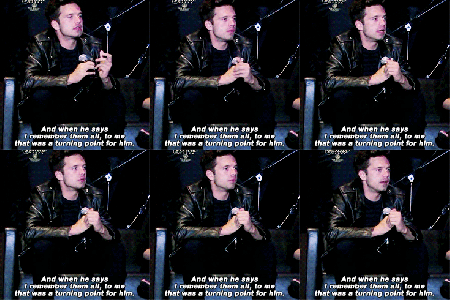
You know when someone comes at you over and over and over again, and they can’t hear you; they can’t see. You’re pleading with them, you’re trying to figure out how to get through to them and they just won’t accept it. And at some point, you just give in and you go “that’s right… that’s what you wanted.” 

timelord-winchester-22b:

fractured-boxofstars:

imgetting2old4diss:

writing-prompt-s:

papered:

writing-prompt-s:

A powerful witch runs away after the villagers try to execute her, couple years later children randomly start disappearing. She’s taking abused children away from their parents and raising them in the woods. But once they grow up and leave, they forget how to get to the witch’s house and their memories of her become blurry.

The town was evil. But the children? They were still pure, there was still good in their hearts, trickling out of their mouth and ears and gentle hands.

She stayed there for years, trying to protect them as much as she can. Even after the villagers had enough of a witch living amongst them, she still took in the lost children.

Every parent’s worst nightmare is their children growing up. The witch was no different.

Her kids, they called her mama once. And now when they passed her as adults, they didn’t even give her a second glance. As far as she figured, they didn’t remember her at all.

(She’d tried talking to Benjamin once, one of her favourites, because he had been a clingy child who couldn’t bear to leave her side. He was thirty when she tried visiting him. When she approached him, he treated her kindly, but the kind of pleasantness you show to strangers and not someone you call your mother.)

The witch was sad, of course. But there was nothing she could do; they had to go, sooner or later.

One of her boys entered her room. “Mama?”

It was Peter, her oldest. He was turning eighteen in a couple of days, and soon it would be his turn to leave.

It hurt her to see him already.

“Yes, love?”

“I am leaving soon,” Peter said. A statement, not a question. “But I don’t want to.”

“You have to, love. None of your siblings wanted to leave,” she answered, simply. “But the hour you turn eighteen, you’ll forget. And you’ll wander off, and then you’ll never find your way back.”

Peter looked sulky. “Isn’t there some way to make me not forget? I don’t want to forget you, ever.”

She almost laughed because of how close she was to crying. Her boy. Her sweet, sweet boy.

“I’m sorry, love.”

He slammed the door behind her when he left. Peter had always been a fiery one.

When she opened the door on the day of Peter’s eighteenth birthday, she expected him to be gone by then.

Instead, her boy was sitting on the bed cross-legged, holding an empty bottle.

He had drunk a potion. An anti-aging potion.

“I found a way, mama,” he said, his eighteen-year-old hands clasping here, firmly. “I don’t want to forget you.”

He left, too, when he got bored of being cooped up in the house with no company. But he visited her every few years, bringing her stories of how he visited children, following in her footsteps.

They called him Peter Pan, the boy who never grows up.

Check out the story tag for more short stories

So cool.

CHIIIIIILLLLLS

OH MY GOD. I am CRYING

lierdumoa:

inqorporeal:

chronicreality:

xzienne:

skary-child:

cruzfucker69:

i hate when the teacher’s like “write about a bad time in your life” like i ain’t tryna get a social worker up my ass, thanks tho fam

This ain’t no joke I had to write a essay about what your scared of so I did it (I was scared of growing up and where my life was going) it was great got a 100 but then I got sent to councilors office and was sent to therapy cause they thought I was suicidal and on the verge of breaking…Apparently they ment like spiders or some shit…

Also like, not everyone finds that at all useful or cathartic.

“Write about some difficulty you’ve experienced personally.”
“Aight fam let me just break down into tears and skip the rest of my classes.”

Yes! I had a psych professor ask us to discuss outloud the hardest thing that ever happened to us literally two days ago and I said “you realize the position you’re putting us in? I feel obligated to lie to not only save my peers the awkwardness but also because I will find no relief in answering honestly but rather anxiety. The hardest thing in my life is having people repeatedly tell me I should find some sort of catharsis in reliving my trauma so someone else can feel pity for me!”

The whole class backed me up because they didn’t want to either! Those kind of exercises are only helpful for people who don’t have any real past/current issues– which is no one btw.

On par with this are those fucking self-assessments where they want to to be optimistic and positive about the future. You’re sitting there drowning in college stress and anxiety so bad you can’t look another human in the eye, fighting depression so that you can eventually achieve a piece of paper that might get you a better job if the economy doesn’t tank itself (guess what, it did), and the most optimistic thing you can think of is that the class ends in 20 minutes.

#why do they do this though ~ @inqorporeal

OH! I KNOW THE ANSWER TO THIS!

There’s a WIRED article that explains the history behind this practice. 

Basically, this guy named Jeffrey Mitchell had a traumatic experience, then after months of PTSD, he told a confidant about the event that traumatized him. Retelling the event to a confidant was so cathartic for Mitchell that his PTSD went away after. He did a bunch of research to see if his personal experience of catharsis and relief could be replicated in other people suffering from PTSD. Years later he published a paper proposing a formalized psychiatric treatment revolving around this idea that expressing a traumatic experience helps relieve it. The paper was so influential that the whole psychiatric community adopted “critical incident stress debriefing” (CISD) as a standard treatment for PTSD.

Unfortunately … it’s bullshit.

Not only does the CISD treatment program Mitchell came up with not help the majority of patients who try it, but it actually makes PTSD worse in the majority of patients who try it.

The WIRED article explains why:

CISD misapprehends how memory works…. Once a memory is formed, we assume that it will stay the same. This, in fact, is why we trust our recollections. They feel like indelible portraits of the past.

None of this is true. In the past decade, scientists have come to realize that our memories are not inert packets of data and they don’t remain constant. 

…the very act of remembering changes the memory itself. New research is showing that every time we recall an event, the structure of that memory in the brain is altered in light of the present moment, warped by our current feelings and knowledge. 

Basically, Mitchell waited until he had some emotional distance before trying to recall the memory, and he had full control of the situation. It was fully his decision. Nobody was pressuring him to talk about it. So he felt safe. Thinking about the memory from a place of safety allowed his brain to re-contextualize the memory as harmless.

Conversely, pressuring a patient to recall a traumatic memory, particularly when it’s still fresh in their minds, makes the patient feel very unsafe. Recalling a bad memory in this unsafe context only serves to re-traumatize the patient. 

[link to the whole article]

strangerdarkerbetter:

autismus-obscurus:

Y’all i have a question.

Is it an autism thing to panic whenever someone yells (due to aggression)? Or is that just a conditioned response?

This seems to be really common amongst autistic people.

I think it may be due to difficulties reading people. We often don’t notice signs that a person is getting angry until they start yelling which can set off sensory sensitivities as well.

I’d also like to add that a high percentage of autistics have been physically, verbally, emotionally and/or sexually abused, and have PTSD that can be triggered badly by people shouting or getting in their space or moving in a way that brings back those memories. Our bodies have a warning system highly tuned to recognise when a situation is flipping from ‘weird & uncomfortable’ to ‘last time this happened I got whipped with a belt so hard I bruised’. Given a lot of us also have memories that are different from the norm, sometimes photographic or eidetic, you can see why we might react poorly to highly charged situations.

askanautistic:

Appreciation for all the Autistics out there who have executive functioning problems/issues with processing, remembering and organising information and as a result often feel like they frustrate others and themselves.

This is me, so much, and why I flunked high school despite testing as gifted. 😦

transyoite:

yungrufio:

megasumpex:

shout out to the kids and adults who have memory problems, who get yelled and screamed at by their families for not remembering things

or over-remembering. remembering things no one else seems to remember but still having blankets of empty in their memory and wondering why they can’t remember chunks of things or why their timelines are all off

oh my god i thought i was alone

allrightcallmefred:

fredscience:

The Doorway Effect: Why your brain won’t let you remember what you were doing before you came in here

I work in a lab, and the way our lab is set up, there are two adjacent rooms, connected by both an outer hallway and an inner doorway. I do most of my work on one side, but every time I walk over to the other side to grab a reagent or a box of tips, I completely forget what I was after. This leads to a lot of me standing with one hand on the freezer door and grumbling, “What the hell was I doing?” It got to where all I had to say was “Every damn time” and my labmate would laugh. Finally, when I explained to our new labmate why I was standing next to his bench with a glazed look in my eyes, he was able to shed some light. “Oh, yeah, that’s a well-documented phenomenon,” he said. “Doorways wipe your memory.”

Being the gung-ho new science blogger that I am, I decided to investigate. And it’s true! Well, doorways don’t literally wipe your memory. But they do encourage your brain to dump whatever it was working on before and get ready to do something new. In one study, participants played a video game in which they had to carry an object either across a room or into a new room. Then they were given a quiz. Participants who passed through a doorway had more trouble remembering what they were doing. It didn’t matter if the video game display was made smaller and less immersive, or if the participants performed the same task in an actual room—the results were similar. Returning to the room where they had begun the task didn’t help: even context didn’t serve to jog folks’ memories.

The researchers wrote that their results are consistent with what they call an “event model” of memory. They say the brain keeps some information ready to go at all times, but it can’t hold on to everything. So it takes advantage of what the researchers called an “event boundary,” like a doorway into a new room, to dump the old info and start over. Apparently my brain doesn’t care that my timer has seconds to go—if I have to go into the other room, I’m doing something new, and can’t remember that my previous task was antibody, idiot, you needed antibody.

Read more at Scientific American, or the original study.

I finally learned why I completely space when I cross to the other side of the lab, and that I’m apparently not alone.