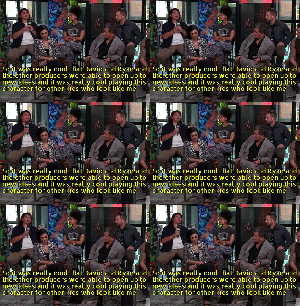
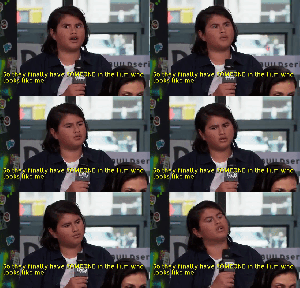
Julian Dennison is out here preaching about the importance of body diversity and representation in the media and I’m honestly so here for it.
“Deadpool is a quirky universe, which is all about being outside of the box, unlike a normal superhero film,” he says, adding that he’s always been confident and comfortable with his body image. “For me, personally, it’s really cool to play someone who other people can finally look at it and see that a bigger person can portray this awesome character.” [x]
Tag: maori
WorldRugby Haka time at the Women’s Rugby World Cup 2017 semi-final
i like how they must have said to the white menbers at some point “yeah becky yall gon do this too get up we all have to learn”
Actually most New Zealanders (white and non white) learn this as children at school and with their friends. Like Kiwi culture’s really a mix of indigenous and non-indigenous elements so there’s not that much cultural segregation as you would have in the states
I’m white as a chicken and mayo sandwich and I learned two or three haka at school. If I’d joined the kapa haka group it would have been more and certainly wouldn’t have been the only white person doing so.
#also if I was the opposite team I would be “WELL WE ARE FUCKED :)”
That is 1000% the point of the Haka. Here’s a really good explanation of it.
I’ve never seen women doing the Haka before and holy shit I’m in love
When I did kapa haka at school, lo these many years ago now (ok about 15), I was taught that it was tikanga in most iwi that women didn’t do the haka (as men don’t do the karanga at pōwhiri). That seems to be changing, which is neat, but it’s very much something that’s up to wahine Māori to change and Pākehā women to follow their lead on, like the varying tikanga on women speaking on the marae.
(but also v agreed that it is incredibly common for Pākehā in NZ to have learned at least some elements of Māori performing arts/kapa haka, if they’re under 40; if a white person in NZ has never done that they’re either an adult immigrant or exclusively attended posh private schools, and even the last might not apply these days. The average non-Māori-speaking NZer understands 80-100 words of te reo. American norms of segregation do not apply.)
There are still some pretty racist towns in New Zealand where they don’t teach any Māori culture even in public schools (mostly rural towns in the South Island). I didn’t learn any Te Reo until I moved to Wellington, and my brother who only just left my old high school had pretty much the same experience.
We’re a lot better than the US, but there’s still more cultural segregation than there should be.
I’m married to someone who grew up in a rural South Island town, so yeah, I know. But ‘rural South Island towns’ only represent about 10% of the NZ population, so this is an exception, not a norm; the experience for the overwhelming majority of Kiwi kids is one where they get at least some exposure to te reo and tikanga Māori as part of the public education system.
(For non-NZers, rural North Island towns are often more Māori than the cities, not less; the majority of the pre-colonisation Māori population lived in the northern half of the North Island.)
That captain looks like a female Dwayne The Rock Johnson and I love her.
My primary school was very big on Maori culture, everybody learned a bit and we also had Maori Club if you wanted to learn more. It was long enough ago that girls Did Not Do The Haka, but one day at practice the boys just weren’t in the mood and were being very low-energy. So our (awesome!) teacher said that we girls should show them how it was meant to be done.
We’d never formally been taught a haka, but of course we’d been there for all the boys’ practice sessions, so we knew it. I swear half of us girls in Maori Club had just been waiting for our chance, and the rest were swept up in the enthusiasm. We roared. We stamped so hard the gym floor vibrated. We got right up in their faces and had them backing away and when we finished there was a breathless pause… and then the teacher just said, “See? Do that.” XD XD XD
it is really cool that there is now an official maori word for autism, created with input from autistic maoris, and it was specifically coined to be nonjudgmental
quote from article:
“In my experience, people with autism tend to have their own timing, spacing, pacing and life-rhythm, so I interpreted autism as ‘takiwatanga’, meaning ‘his or her own time and space’,” [Keri Opai] told government-funded Maori Television.
(source)
I’m not crying, you’re crying.
so a racist got utterly demolished in less than 30 seconds on the New Zealand morning news on Monday and it’s one of the most beautiful things I’ve ever seen
who knew a white guy could be capable of such an iconic response, he knows what’s up and is having none of that shit, every other white guy take notes tbhI love that he said Pakeha
Can someone write what its being said in this?
Male co-host: We have had a whole heap of feedback regarding
Te Tai Tokerau MP Kelvin Davis’s proposal to institute a prison run on Māori
values into New Zealand. He’s looking at potentially establishing this prison
up north. It isn’t Labour policy just yet, it’s just an idea of Kelvin Davis’s.
And this has been really really divisive on our Facebook page this morning. (sarcastically)
Here I think we have the single greatest email, the single greatest message we
have ever had on breakfast.(clears throat deliberately) “’Janice’ says: Good morning. I’m
sick of hearing that Māori need different treatment. If they don’t want to live
in our society, then maybe we should put them all on an island and leave them
to it.”Male co-host: “Janice. That is LITERALLY what happened! That
is the history of our country. Last I checked, Māori WERE on an island, they
were left to it, and then Pākehā (Māori term for white New Zealanders) turned
up and look how that worked out. But thank you very much for that brilliant
insight. Goodness me. Unbelievable. Unbelievable, they actually-“Female co-host: “Actually, you can’t even get angry, you
just actually need to laugh and then screw it up and put it under the desk.
Just when you thought-“Male co-host: (mimicking letter) “’Put them all on an
island, leave them to it.’ Yeah. What a great idea that is Janice.RIP Janice
While I was born here in Bluff, I was raised amongst my mother’s people in Whakarewarewa. I grew up in a village within a hapū, Tūhourangi Ngāti Wāhiao. One of my fondest memories as a child was sitting in the baths with all the kuia who had moko. I was just fascinated, fascinated with lines. I used to stare at them. I just loved moko. Back then a lot of the kuia had moko, and growing up in the pā you used to run around and into everybody’s house, and they fed you, cuddled you, looked after you.
The moko was very common, but only among the kuia.
By Mum’s generation, nobody was being done. That would have been post-war, I suppose. When we had only one kuia left in the pā, I asked my Mum, “Why don’t you get one?”
She said, “Too sore.”
She’d seen it done in the old way as a child; it was a whole lot of blood, and they never flinched or made a sound. My mother was absolutely not having any of that. And by that point I think people thought it was gone, a part of the old world.
But I loved looking at the moko and at the kuia.
I came back to Bluff as a young woman and helped develop the marae; we were quite young to be doing that. There was nothing visibly Māori here, or little to none, back in 1973. There was what they called the Māori house and the Waitaha Hall for functions. After the wharekai was opened, I’d chat with my peers and we’d say we should all get a moko when we turned 40. But no-one was game enough, and it wasn’t the thing to do. It had almost become invisible.
As they started to revive the moko in the past 15, perhaps 20 years, I would see the women and see photographs and think how beautiful it was. A few years ago Mark Kopua, who had come down to do a tā moko wānanga, asked me about my kauae. “Funny you’d say that,” I told him, “because I’ve always wanted one, but now that I have the opportunity I’m a bit scared.”
Three years later I said yes. I’d given myself enough time to get the courage.
I’m thrilled with the revitalisation of the arts. I love seeing the other women and it’s almost like we have a link; an unspoken thing. I don’t know if it’s our moko talking to each other or if it’s the wairua that goes with it.
I think I was fortunate that my parents who raised me understood the beauty behind it; the beauty of the moko. If I think back, there were photos on the wall of two of my kuia with moko kauae – my grandmother’s sisters – from the time I was a baby. And I had a picture of my great-grandmother, and she had one as well.
Mihipeka Wairama of Tūhourangi, painted in 1912 by Charles Goldie, is Hana’s great-grandmother.
Tā moko rising
Kelston Boys’ High School perform a massive haka in honour of the new Maori carving on campus
THIS IS FUCKING SICK
Ooooh – has flatbear seen this??!?!?!?
I’ve seen it floating around but I hadn’t had a chance to watch it! THAT WAS FUCKING AWESOME!