Hello all—
I’m now able to share that my second book is titled Sorcery of Thorns. It’s set to be published in May 2019, and is another YA fantasy unrelated to An Enchantment of Ravens. (For those of you who thought Enchantment was too short, you may be pleased to hear that Sorcery is substantially longer.)
While Sorcery’s premise isn’t technically a secret—there will be a preview in Enchantment’s paperback when it comes out later this month—I’m a little shy about revealing more before the official announcement. For now, the main character is a 6′3 battle librarian named Elisabeth Scrivener, and it’s about magical libraries that contain sentient grimoires who occasionally turn into monsters (which is why battle librarians exist in this setting). Here’s an excerpt:
These weren’t ordinary books the Great Library kept. They whispered on the shelves and shuddered beneath iron chains. Some spat ink and threw tantrums; others sang to themselves in high, clear notes on windless nights, when starlight streamed through the library’s barred windows like shafts of mercury. Others still were so dangerous they had to be stored in the underground vault, packed in salt.
I can’t put to words how excited I am about this book. If you happen to be an Instagram type, there’s a photo of my excited flesh visage holding the title here: https://www.instagram.com/p/BnR0oS3FzVN/
Well, this sounds straight up fantastic and I want to read it yesterday. (Also mentally fan-casting Gwendoline Christie as Elisabeth until further notice.)
That makes me so happy—I modeled Elisabeth’s height after Gwendoline Christie’s, because I love her more than life itself.
Unfortunately I can’t give Sorcery to you yesterday, but if you happen to want it on, say, Friday…
Tag: librarians
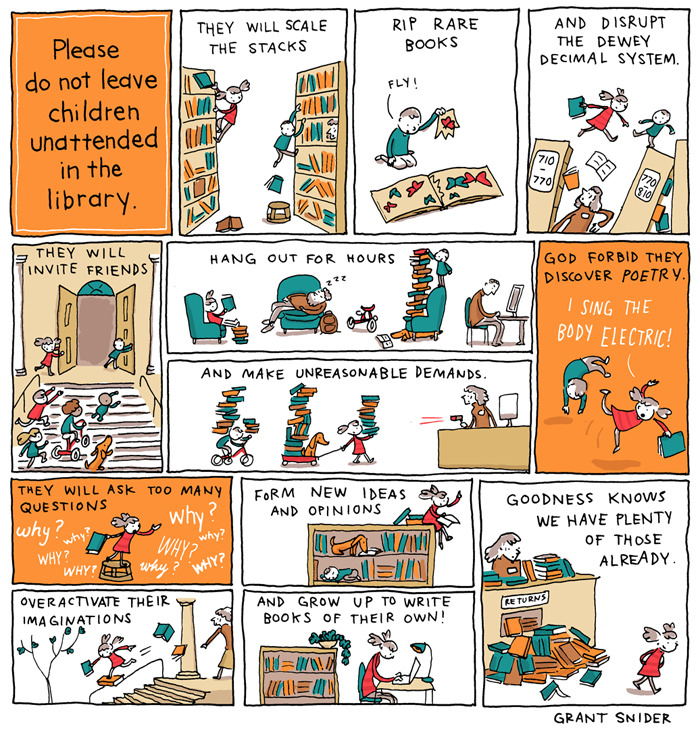
Happy Father’s Day! Please do not leave children unattended in the library.
(New comic for the NY Times Book Review)





Happy National Library Week!
Illustration + words about the @sanfranciscopubliclibrary from Meanwhile in San Francisco by @wendymacnaughton
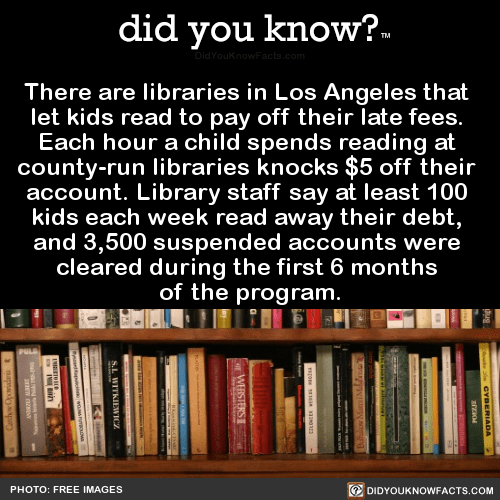
There are libraries in Los Angeles that
let kids read to pay off their late fees.
Each hour a child spends reading at
county-run libraries knocks $5 off their
account. Library staff say at least 100
kids each week read away their debt,
and 3,500 suspended accounts were
cleared during the first 6 months
of the program. Source Source 2
“Welcome,” she said. “Welcome, and thank you for agreeing to be a volunteer with Multnomah County Libraries. We are so grateful for you and your commitment to our community. For the next hour, we’re going to go over some important information that you need to know as a volunteer, no matter what role you play.”
I expected that we were going to learn about things like policies for canceling our shifts, or maybe where to find first aid kits. We probably did talk about those things. But the part that I remember most vividly is the first thing she talked about.
“We’re going to start with the Library Bill of Rights from the American Library Association,” she said, and she projected the text of the document onto the screen. “Everyone who works for libraries, including volunteers, helps to support and uphold the Library Bill of Rights.”
This was new to me. I’d been a regular patron at my local public library for years, graduating from Dr. Seuss to The Babysitters Club series to, most recently, my fixation on books about neo-paganism and queer sex. No one had mentioned this whole Bill of Rights thing. It was a short document with just a few bullet points.
“Libraries support free access to information,” Bess explained. “One of our core values is intellectual freedom. This impacts all of you because when you’re volunteering for the library, we expect you to support the rights of library users to find and read whatever they want, even if you don’t agree with what they’re looking for.”
She continued, “For example, let’s say that a small child came up to you and asked where to find the Stephen King books. You might think those books are too scary for someone that age, or that he shouldn’t be reading that kind of stuff. But that doesn’t matter. No matter what, we help people find the information they want, and we don’t censor their interests. Does that make sense?”
Heads around the room nodded, and I leaned back into the wall, letting her words sink in. It was absolutely, positively the most radical, punk rock thing I had ever heard in my life.
I can read whatever I want. No one can stop me.
I can help other people read what they want. And no one can stop them.
“This is core,” Bess added, “to a functioning democracy. We believe that fighting censorship and providing free, unrestricted access is key to helping citizens participate in the world. And, most importantly, we keep everyone’s information strictly confidential. So, even if you know what books your neighbor is checking out or what they’re looking at on the computer, you don’t share that with anyone.”
As someone who kept carefully guarded notebooks full of very personal thoughts, I was especially excited by the library’s emphasis on privacy. All of this sounded great. I wanted more. I wanted in. I wanted to be a crazy, wild, counterculture librarian-witch who would help anyone read anything from The Anarchist’s Cookbook to Mein Kampf. I would be a bold freedom fighter in the face of censorship. I would defend unfiltered Internet access and anatomically correct picture books. Maybe I was only in the eighth grade, but I was ready to stand up to anyone who tried to threaten the ideal of intellectual freedom. Fuck blink-182. Libraries were the real punk rock.
Neil Gaiman on Libraries and Librarians.
THIS IS WHAT ANARCHY LOOKS LIKE.
Hope for the future.
This kid is incredible.
THIS POST IS BACK ON MY DASH AND I WILL NEVER NOT REBLOG ANARCHIST LIBRARIAN KID.

 knitting in the dark