


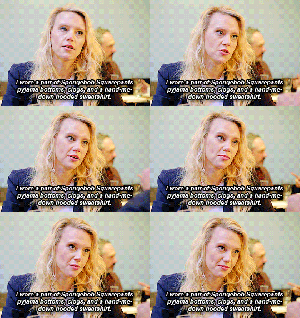






lesbian privilege, as told by kate mckinnon.

theenglishmanwithallthebananas:
activists at barnard college providing “labels”, photographed by susan rennie and published in off our backs: a women’s newsjournal vol. 3 no. 6, february 1973
Black an white photo of two women, one standing, one seated.
Behind them is a hand-written sign reading,
“YEA – It’s a heavy trip. BUT! This is a chance to CHOOSE YOUR OWN LABEL instead of having someone else do it for you:
straight, asexual, lesbian, bisexual, anti-label, dyke separatist, ?, lesbian feminist, anti-sexual or whatever”
i can’t describe the emotions i’m feeling at seeing a 50 year old photograph mention asexuals
i can’t describe the emotions i’m feeling at seeing a 50 year old photograph mention asexuals and include an east asian woman.
I’ve been trying to think of a good term for the “weepy movies about tragic queer people aimed at straight audiences” subgenre, and I think I’ve got it:
dead gays for the straight gaze
eh? eh??
queers die for the straight eye
SO YOOOO who wants to learn why this is a thing because the history is actually really fascinating and ties into some of my favorite shit ever?
Okay, so like, back in the mid-twentieth century, when being queer was still totally a crime everywhere in the United States, queer writers started working in pulp fiction–starting with Vin Packer (she is awesome)–and writing pulps to tell our stories.
So one day over lunch, her editor asks her, “Hey, Vin, what’s the story you most want to write?”
And she goes, “Well, I’d like to write a love story about lesbians because I’m, you know, gay.”
He says, “Hey, that’s awesome, I will publish it. One thing, though, the homosexuality has to end badly and the main character has to realize she was never gay in the first place. We can’t seem to support homosexuality. I don’t actually think that’s cool, but the government will literally seize our book shipments and destroy them on the basis of the books being ‘obscene’ if you don’t, so if we want this story actually out there, and not burning in a bonfire somewhere, it’s what you gotta do.”
So Vin goes home and writes Spring Fire, the book that launched the entire lesbian pulp genre. And while one character ends up in an insane asylum and the other ends up realizing she never loved her at all, it’s massively successful, and queer women everywhere snap it up and celebrate quietly in their closets across the nation because HOLY SHIT THERE’S A BOOK ABOUT ME? I’M NOT ALONE and it starts a huge new genre.
But: every publisher is subject to those same government censorship rules, so every story has to end unhappily for the queer characters, or else the book will never see the light of day. So, even though lesbian pulp helps solidify the queer civil rights movement, it’s having to do so subversively or else it’ll end up on the chopping block.
So blah blah blah, this goes on for about twenty years, until finally in the seventies the censorship laws get relaxed, and people can actually start queer publishing houses! Yay! But the lesbian pulps, in the form they’d been known previously, basically start dying out.
MEANWHILE, OVER IN JAPAN! Yuri, or the “girls love” genre in manga, starts to emerge in the 1970s, and even starts dealing with trans characters in the stories. But, because of the same social mores that helped limit American lesbian pulp, the stories in Japan similarly must end in tragedy or else bad shit will go down for the authors and their books. Once more: tragic ends are the only way to see these stories published rather than destroyed.
The very first really successful yuri story has a younger, naive girl falling into a relationship with an older, more sophisticated girl, but the older girl ends up dying in the end, and subsequent artists/writers repeated the formula until it started getting subverted in the 1990s–again, twenty years later.
And to begin with cinema followed basically the same path as both lesbian pulps and yuri: when homosexuality is completely unacceptable in society, characters die or their stories otherwise end in tragedy, just to get the movies made, and a few come along to subvert that as things evolve.
But unlike the books and manga before them, even though queer people have become sightly more openly accepted, movies are stuck in a loop. See, pulps and yuri are considered pretty disposable, so they were allowed to evolve basically unfettered by concerns of being artistic or important enough to justify their existence, but film is considered art, and especially in snooty film critic circles, tragedy=art.
Since we, in the Western world, put films given Oscar nods on a pedestal, and Oscar nods go to critical darlings rather than boisterous blockbusters (the film equivalent of pulps, basically), and critics loooove their tragedy porn, filmmakers create queer stories that are tragic and ~beautiful~ that win awards that then inspire more queer stories that are tragic and ~beautiful~ until the market is oversaturated with this bullshit.
The Crying Game? Critical darling, tragic trans character.
Philadelphia? Critical darling, tragic gay character.
Brokeback Mountain? Critical darling, tragic queer (? not totally sure if they’d consider themselves gay or bi, tbh?) characters.
And so on and so on VOILA, we now have a whole genre of tragedy porn for straight people, that started out as validation for us and sometimes even manages to slip some more through the cracks occasionally, but got co-opted by pretentious ~literary~ types. While tragic ends made these stories more acceptable to begin with, and in the mid-to-late nineties that started getting subverted a little bit (Chasing Amy, But I’m a Cheerleader), eventually that became the point, as more straight audiences started consuming these narratives and got all attached to the feels they got from the ~beauty of our pain~.
Queer history is crucial




this wins over other pro-gay commercials because you had no idea he was gay and then you can’t tell which one is his husband
they are showing them as people
not as gays and straights
fuckin love this commercial
can we just talk abotu the fact that the husbands arent even bringing the drinks over theyre just standing there next to the drinks and chatting
fuckin useless husbands
they are showing anyone can be useless. Even gay people
they are saying that it doesn’t matter if you are gay or straight. You can still be a useless personthis post got better
Useless 👏 person 👏 representation 👏 matters 👏
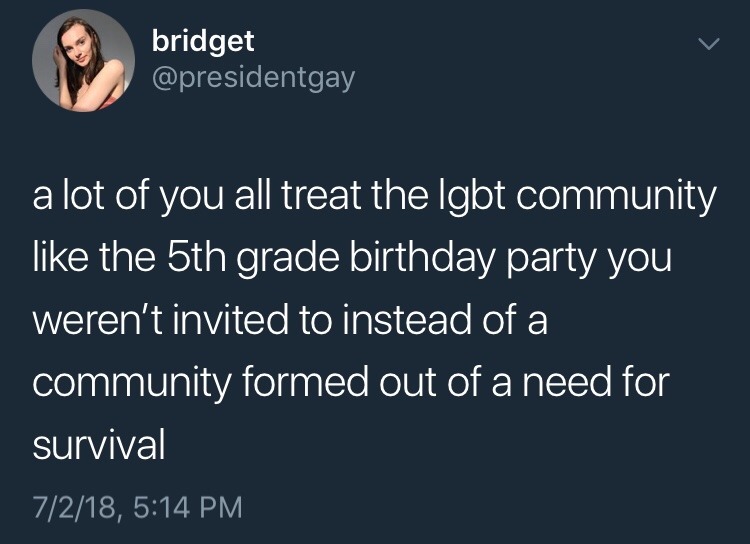
“the Bible says homosexuality is a sin” well the Bible also has a lot of sexism, rape, incest, violence and a lot of contradictory messages in general because it was written by people and people have agendas
I don’t really think that God even has the time to care about if people are gay like if he’s got a whole world to run there are more important things anyway
And if God is love, he’s not just loving me if I am what he wants; he’s loving me as the person he made me to be, which is a queer person
You can’t say “I love you, and I made you gay but I’m sending you to hell you awful sinner” my dude that doesn’t make sense it’s not like hell has a low population is it
The god I believe in loves queer people because that’s how he made us
the bible doesn’t condemn homosexuality anyway. It’s content taken out of context and misinterpreted over hundreds of years of translations, re-translations, and mis-translations.
Hell, in Kenneth Davis’s Don’t Know Much About The Bible, there’s a passage that absolutely blows my mind and proves just how much we can misinterpret with simple translation mistakes:
“In researching the world’s oldest city, for instance, I learned that Joshua’s Jericho is one of the oldest human settlements. It also lies on a major earthquake zone. Could that simple fact of geology have had anything to do with those famous walls tumbling down? Then I discovered that Moses and the tribes of Israel never crossed the Red Sea but escaped from Pharaoh and his chariots across the Sea of Reeds, an uncertain designation which might be one of several Egyptian lakes or a marshy section of the Nile Delta. This mistranslation crept into the Greek Septuagint version and was uncovered by modern scholars with access to old Hebrew manuscripts.”
The bible is one long-ass game of telephone, whispered around the world in dozens if not hundreds of languages, for thousands of years. I have a hard time knowing what my grandpa is talking about, when he starts going on about the technology or practices of his youth, and that was only about 80 years ago, in the same country and in the same language as me. So why every Joe on the streets thinks they can take one or two verses, completely out of context and probably mis-translated several times to boot, and use it to spout propaganda and hatred for an entire group of people will forever be beyond me.
You’re all valid, and frankly, if there is a ‘loving God,’ then that God will be happy to see you happy. Seriously.
I needed that. Thank you.
The Bible wasn’t faxed down from the sky, people, it’s been compiled and formulated for hundreds of years until it became what it is today. And yes, misinterpreted by whoever with whatever agenda-of-the-day.
And hypocrites always stick to the word and not the spirit of any religion: to love, to help, to respect, to protect, and to strive to make the world a better place.
Yup, Jesus never said ANYTHING against LGBT people. All he said was don’t be greedy, don’t be lustful and don’t be wrathful. The fact that LGBTphobes took those instructions out of context to justify their LGBTphobia is pretty telling!
Hey, your friendly neighborhood Jew here!
You guys know that verse in Leviticus that homophobes like to trot out? Well, I’m here to tell you:
They don’t read Hebrew and they don’t know shit.
And now here’s something you probably won’t hear from any of those Fine Christian Folks ™ anytime soon, either:
We do read Hebrew and we still don’t know shit.
Here’s the thing. The most “accurate” word-for-word translation of that verse would say “a man shall not lie with another man; it is forbidden.”
Here’s the issue.
The grammar surrounding “men” in that sentence isn’t correct, and the word I’ve translated as “forbidden” is “toevah,” a word so fucking old we literally don’t know what it meant anymore.
The strange sentence construction suggests that “lie with another man” uses a feminine construction you wouldn’t normally find in a sentence that’s entirely about men, and while “toevah” means “forbidden,” it’s not actually clear what is forbidden. Here’s an incomplete list of possibilities:
Pederasty (adult male/adolescent male sex) is full-stop forbidden, a man sleeping with a male prostitute is full-stop forbidden, a man sleeping with a man as part of any kind of sex magic or fertility ritual is forbidden.
And my rabbi’s personal interpretation, based on the sentence construction: a man shouldn’t sleep with another man in a woman’s bed. (So basically: don’t cheat on your wife with a dude, which is probably treated separately from “don’t commit adultery” because adultery would come with the risk of an illegitimate child.)
You’ll notice none of these involve “ew, you disgusting gays.”
Unless you accept a word-for-word literal translation with zero consideration for the social mores and other tribes surrounding Israel contemporary with the writing of Torah, nothing about this commandment has anything to do with our modern understanding of queer people having committed relationships. Once you start taking the rituals and practices of Israel’s contemporaries into account, it suddenly becomes clear why these prohibitions would have been put into place (sex magic was common in the cult of Ba’al, for example, while pederasty was practically a requirement in Greece).
If you’re just a person out there loving other people of the same gender as you? The Torah says nothing against you. But do you know what our literary tradition does say?
It puts you in the company of Naomi and Ruth.
Ruth is considered the first convert, and her vow to her mother-in-law Naomi (after Ruth’s husband’s death) forms the basis of our modern marriage vows. “Where you go, I shall go, and where you lodge, I shall lodge; your people shall be my people, and your G-d my G-d; and where you die I shall die, and there shall I be buried.” Ruth remarries as prescribed by law at the time, but even when a child is born of that new union, nobody calls it “Ruth’s and Boaz’s child”–they all say a child has been born to Ruth and Naomi.
You are in the company of a woman whose name we invoke in our prayers and whose life we celebrate. I wear her words around my shoulders on my tallit, my sacred prayer shawl. Since we consider that everything in the Tanakh is intended for learning and study, what might we take from this story, but that a queer person can be virtuous and beloved of G-d?
Slow clap for Jews spitting truth.
Yesssssss
phenomenal
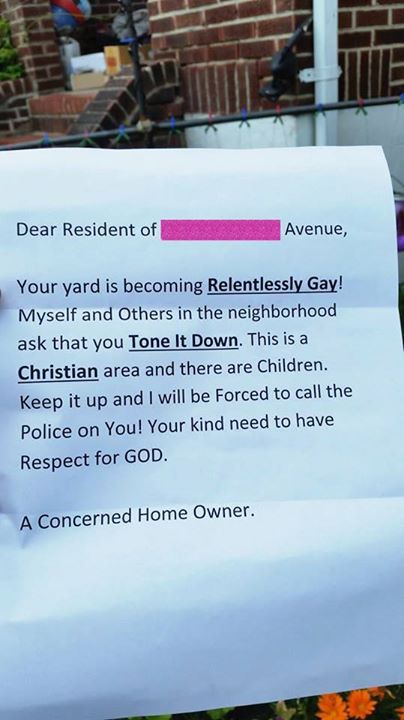
RELENTLESSLY GAY
I have goals for when I get a yard.
*types ‘where to buy glitter cannon’ into google*








 knitting in the dark