naamahdarling:

inaneenglish:

zetablarian:

mashmoments:

writerofthought:

To all the young Millenials about to watch M*A*S*H for the first time, do not be turned off by Max Klinger being a guy in a dress.

For those of you unaware, the character tries several schemes to get out of the army on the grounds of being mentally unfit for service, most notably being a man who wears a dress, which no one buys. It’s played off as a joke but everyone loves him and treats him very respectfully unless it’s a character you’re not supposed to sympathise with.

You might want to call bull on the fact that they’re getting a cheap joke at a man in a dress. But, this man in a dress had a gender identity crisis ON SCREEN (although they couldn’t call it that) and also helped pave the way to allow transgender people into the armed forces.

No, seriously. A congressman who was a fan of the show brought up how Max Klinger cross dressing never was an issue at this M*A*S*H unit and it allowed transgender people to serve in the armed forces!

I’m a trans(masc) millenial and the biggest thing I feel was made fun of was how much some people were bothered by Klinger’s clothes, not the fact that he’s wearing them.

Klinger learns a lot about fashion and sewing and seems to develop a genuine passion for it over time.

There’s even one time when he develops a psychosomantic (spelling?) rash during a short time when he has to wear his uniform. Even after it is clear that he’s not gonna get to go home by wearing dresses, he continues – suggesting either a persistent act of defiance to make him feel better, or a real appreciation of the clothes… or both!

He’s clearly coded as straight, is accepted by his peers, and his character arc and development is barely focused on his clothes (rather it focuses on what he wants to do with his life; his dream future).

For a show made in the 70’s depicting the 50’s, M*A*S*H was a show before its time – with feminist messages and anti-war messages, as well as speking out against homophobia and racism – and Klinger was a groundbreaking character.

This is especially true, I think, if you watch the episodes sans the laugh track. Without the canned laughter, Klinger’s costuming comes off as especially sincere.

Klinger is a good man and a great character and everyone in the camp respects him (and if they don’t, it’s not because of his attire).

This is weirdly timely for me because I recently started re-watching MASH. It’s one of my all time favorite shows but this time around I was really struggling with how Klinger is depicted. This put my doubts to rest. I mean, his crossdressing isn’t handled perfectly, but it’s definitely a step in the right direction.

Is there a place where episodes can be streamed without a laugh track? I despise them but I recall really enjoying M*A*S*H when I was young and would like to revisit it sans annoyance.

I have no idea if it’s possible to stream them. The best legal way is probably to buy the dvd box set, which allows you to toggle the laugh track off. (Just check the item description to make sure the version you buy has this option.) Less legal is to torrent the series. There are torrents out there without the laugh track. That’s what we did, but the box set is very much on our ‘to buy’ list for the future. We just completed a complete rewatch, which neither myself or my partner had ever done before, and it’s an amazing thing. The way Klinger was handled was one of my favourite things (along with Margaret’s evolution).

Help This Graduate Study: LGBTQIA Fiction Community Survey

sapphicbookclub:

queeksonline:

Do you like to read? Do you like to read books featuring women who happen to like other women? Do you enjoy good karma points from the universe? If so, help this CMU grad student with her LGBTQIA Readers Survey! It takes less than 10 minutes and answers are anonymous. 

The survey can be found here. Must be 18+ to participate: https://www.surveymonkey.com/r/ReaderSurveyCMU 

More info from the graduate student running the study: 

“I’m Hope, a graduate student in the Master of Science in Administration program at Central Michigan University. My capstone thesis study, underway now, examines the LGBTQIA fiction market and its readers – especially for women who love women. The data collected will provide useful information and help us understand how authors and publishers can make better LGBTQIA content for readers.

My target participation goal is approximately 400, and I’m hoping to capture a healthy portion of responses from outside the USA. The results of this study are only useful if it accurately captures the needs and interests of the LGBTQIA fiction community. I’m happy to share a summary of the study once it’s finished – please contact me at my academic email for more information or questions: croni1h@cmich.edu.

Thanks for your time and support of this project! Your voices and your stories matter!

I’ve been asked to spread this among my followers because whom best to get the statistics from than wlw readers themselves! The survey is really short so do it if you have a few minutes free.

youmattered:

trezbelivt:

youmattered:

Having separate flags is good bcos it’s good to have a symbol for your particular identity to embrace but it also important to remember the rainbow flag unites us all. All LGBT+ people can use it. I feel like it’s somehow become assumed by a lot of younger lgbt+ people that it’s only fr gay men, which it isn’t and never has been

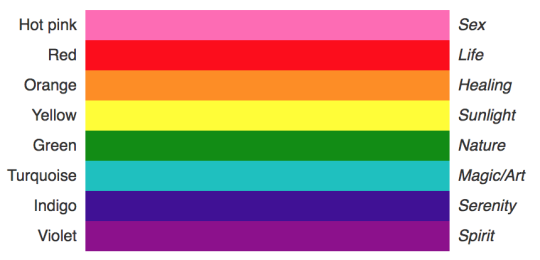
The rainbow flag when originally created by Gilbert Baker in 1978 actually contained 8 stripes that were assigned values and specific meanings that were meant to show what unites us and what we value as a community, 

It took 30 people to hand dye AND hand stitch the first 2 pride flags- 30 people of various identities came together to create the first symbol of pride. Hot pink was removed due to fabric shortages and turquoise was mixed with indigo to have the darker blue we have today.

Having individual flags is great to show your identity but I think we shouldn’t forget that the rainbow flag isn’t reserved for gay men, it was created to show what we all have in common regardless of identity. 

Thank you for the ONLY good addition to my post

My aunt used to write horoscopes for the newspaper as a part time job. She had a friend in college who a)always read that newspapers horoscope and b)didn’t know my aunt wrote it. So whenever the friend had a shitty episode my aunt would make her horoscope as positive as possible to cheer her up. Long story short they recently got married and are both my aunts now.

batmanisagatewaydrug:

what do mean “long story short” give me this entire sappy gay romance novel right now 

redstarthecat:

blu-iv:

latinxstan:

maeamian:

paladin-protector:

dynastylnoire:

maeamian:

maeamian:

maeamian:

BTW, the high five was invented in 1977 which means your parents probably didn’t grow up with it.

For real though Glenn Burke, inventor of the high five was a gay black player in the 70s, and the Dodgers tried to get him to marry a beard and their manager got mad when he befriended the manager’s gay son before being traded to the Athletics, probably for being gay. In Oakland, the rumors of homosexuality followed him and manager Billy Martin started using homophobic slurs in the clubhouse and homophobic behavior from other players lead to an early retirement for the promising young star at 27.  After retiring from baseball he introduced the high five to the Castro district of San Franscio where the high five became a symbol of gay pride and identification. ESPN wrote a long form piece about it which I recommend reading, it’s got some homophobic slurs in it although not presented positively.

A few appendices:

Although he was unceremoniously drummed out of Major League Baseball, Burke became the star shortstop for the local Gay Softball League, and even dominated in the Gay Softball World Series, as well as medaling in the 100 and 200 meter sprints in the inaugural 1982 Gay Games. Unfortunately, Burke also picked up a cocaine habit and had his leg and foot crushed in an accident. He spent much of his final years homeless in the Castro, and died from AIDS complications in 1995, but he was in the first class of inductees to the Gay and Lesbian Sports Hall of Fame, and his High School retired his jersey number.

The Dodgers Manager in question was Tony Lasorda, whose son “Spunky” died of AIDS complications in 1992 although Lasorda maintains that it was cancer. Likewise, despite the High Five becoming a symbol of the 1980 Dodgers team, Lasorda maintained and continues to this day to maintain to not know its origin. It’s possible that this isn’t a deliberate slight to Burke, but given his homophobia in other matters that’s a hard benefit of the doubt to give.

The Athletics have, in the years since, attempted to make up for some of the wrongs they committed in this story. When Glenn revealed publicly that he was living with AIDS, the As moved in and helped him financially. Burke was honored publicly at Pride Night at the park in 2015 and his brother was invited to throw the first pitch.

Burke was happy to see the high five catch on, spilling out of sports and into the small joys of every day life. He died believing that the high five was his legacy. Next time you high five your friend, remember that the high five came from Glenn Burke.

Npr has a dope story on it

What? Cool! Maybe I can find some of his baseball cards?

You can! Not super expensively even!

I’m so glad high fives are gay culture

So high fives are gay 🙂

*slams fist on table* GAY HIGH FIVES GAY HIGH FIVES

Author Spotlight: Lisa Jenn Bigelow

sapphicbookclub:

In today’s guest post you get to learn a bit about Lisa Jenn Bigelow, the author of middle grade f/f novels
Starting From Here and newly released Drum Roll, Please, and about her experience growing up and becoming a writer.


Drum Roll, Please: How an F/F Tween Novel Was Born, Grew Up, and Came Out of the Closet By Lisa Jenn Bigelow

image

1995

Senior year of high school. After two years of questioning, I’d decided I was gay. Probably. Aside from a trip to the mall with a skater boy, I’d never dated. Everything felt hypothetical.

I’d scoured libraries and bookstores for queer books. (This was before I had Internet access.) Those I found were mostly about gay men, mostly about AIDS. Nothing for teens. There was a lesbian bookstore downtown. I’d read about it in the paper, seen its rainbow flag flying. I mustered the nerve to go in. There, I found a flyer for an LGBTQ teen support group. The group had its own library, packed into a Styrofoam picnic cooler. There was Annie on My Mind, by Nancy Garden. Tales from the Closet, by Ivan Velez, Jr. Queer YA existed after all.

I wish I’d discovered these books earlier, before I started to question myself. I wish there had been more of them. I wish they’d all had happy, or at least hopeful, endings. My life today is still shaped by those early years of feeling alone, afraid, and inferior. I was fortunate to feel confident of my parents’ and closest friends’ support, whenever I came out. But school was a homophobic environment. The local paper regularly printed homophobic letters to the editor.

Day after day, the headlines debated whether gay people deserved the same rights as straight people. President Clinton passed “Don’t Ask, Don’t Tell” and the Defense of Marriage Act. Homosexuality was technically a crime in many states.

I didn’t think I’d ever be allowed to marry. I didn’t think I could ever have children. But those books in the cooler were a ray of hope.

Keep reading