my favourite thing about hercule poirot is that once he solved the murder he just makes everyone involved sit in a circle and dig shit about everyone before telling who’s the killer he’s like “i know we’re here because someone is dead but lemme tell you susan is the illegitimate child of paul and bethany is in love with her step brother. this had absolutly nothing to do with the killing but i thought yall should know tbh. now about the murder”
Poirot the king of #receipts
You have to read this in his voice, especially “I thought yall should know tbh.”
the asl sign for “transgender“ is basically the same as the sign for ”beautiful“ but signed at the chest instead of in front of the face.
so that’s cool.
this is my imperfect not-a-fluent-signer understanding but:
(based on a presentation by a deaf trans guy i was at in 2005 where he was promoting that sign)
it seems like that sign was invented and implemented by trans people over the last 10-ish years. before that the predominant vocabulary was “sex change” and then some deaf trans people were like “yo fuck that” and came up with the current sign, which starts off with the sign for “myself,” then motion that indicates both change and coming together, and ends with the closed hand held against the sternum.
and in the process it also mimics the sign for “beautiful”
and because of spatial grammar, things closer to the front of your body in ASL are generally more vital, more emphatic, more immediate, more present.
so it’s actually a case where the word coherently indicates “beauty” and “self transformation” and contains hints of the complete thought of “my self transforming, through a coming together of disparate factors, into something more real, immediate, and vital than I was before.”
so yeah. that’s just fuckin’ awesome.
and that’s just the way to express that concept now.
My name is Calfe & Im too young to know yet what do with my Toung!
So till my Mom say “Dont Do That!” Ill stick it out And lik this cat.
My little Calfe, Im proud of yu– yur living like the Big Cows do. Yur doing just what Mom have said– for yu lik cat, and cat
lik bred.
Bad meme execution. 0/5 stars.
These poems are supposed to be imitative of 17th/18th century middle English poetry (pre-dating dictionaries and formalized spelling conventions) not early 2000s chatspeak, not babytalk.
These poems are also supposed to be in iambic diameter, giving them a pleasing songlike rhythm. The above has inconsistent syllabic structure from line to line.
These attributes are clearly illustrated in the prime:
So tired of people on this website and their flagrant disregard for syllabic structure.
No respect for the craft.
1. first of all, how dare you. i would never, N E V E R, put forth a cow poem with inconsistent syllabic structure. these may not be my finest work, but the iambic dimeter is IMPECCABLE. check my scansion again and come back to me. I guess “know what do yet” is not ideal, but it falls within the constraints of the form. i’m genuinely appalled by this. i have SEEN inconsistent scansion in this meme, i do NOT approve of it and i have NOT done it. how dare you. HOW DAR EYOU!!!
Secondly: it is not absurd to suppose that the linguistic constraints of a Cow Poem would depend on the figure to whom Cow speaks. In the original (and perfect) “i lik the bred,” the narrative cow, like a Chaucerian non-characterized narrator, directs her speech to an imagined and unspecific listener; not to “the men,” who are characters within the poem, but to some more general audience. (See the Canterbury Tales prologue for an example of this voice in action.)
Later, poem_for_your_sprog has Cow address contemporaries like “dog.” You will notice that the voice of Cow varies slightly, in speaking to Dog, from her voice in the original “I lik the bred.” WHY, then, can we not extrapolate that Calfe – who is, after all, a narrator of limited capacity, being only a Baby Cow with a Baby Cow’s simplicity – would have its own variant voice? And why, too, would Cow not speak differently to her own Calfe than she does to an animal peer, or to reverent imaginary auditors? These are experiments within an emerging form – flawed experiments, certainly, but not mistakes ipso facto. Again: HOW DARE YOU!!!!!!!!
my name is Cow, and as yu see, its worth yor tiyme to studye me. but if yu dont like what yu red,
take 2 deep breths
and lik the bred.
I am willing to concede on second reading that the syllabic structure is passable, and in that regard I’ve wrongly impugned the integrity of your work, however I maintain that your Frankenstinian amalgam of fake middle English with fake modern American baby talk is thoroughly unconvincing as either middle English or as modern American baby talk.
It’s an aesthetic failure, IMH(inh)O*
You’ve created the linguistic equivalent of a spork — vitiating two perfectly serviceable tools by attempting to fuse them.
Writing ‘till mothere says / do not do that,’ would have conveyed roughly the same idea without feeling quite so awkwardly anachronistic.
My name is Rave, and I can see you’re bent on pa- tronizing me! ”Anachronistic” frankly seems a misplaced word to use of memes. But since you want to start that fight, let’s step outside and do this right.
Dude: if you want to not get wrecked you’d better get your facts correct.
Like, “Mothere,” friend, is not a word that Geoffrey Chau- cer ever heard.*
Chadwick talking about his accent in Black Panther. CNET interview.
I love that actors think this deeply about their characters, and it matters so much, both for the performance, and for the people comsuming the media. Representation matters.
He stopped in front of the mirror and sighed. His penis was just a little too large to be fashionable, and his balls were just a little lopsided. Most days it didn’t bother him, but today he pushed at his genitals, trying to make them look more normal, like the men in magazines. It was hopeless. He dropped his junk in resigned frustration. There were worse things than having too large of a penis, he thought.
Judaism is not a religion of blind obedience. Indeed, astonishingly in a religion of 613 commandments, there is no Hebrew word that means “to obey”. When Hebrew was revived as a living language in the nineteenth century, and there was need for a verb meaning “to obey,” it had to be borrowed from the Aramaic: le-tsayet. Instead of a word meaning “to obey,” the Torah uses the verb shema, untranslatable into English because it means [1] to listen, [2] to hear, [3] to understand, [4] to internalise, and [5] to respond. Written into the very structure of Hebraic consciousness is the idea that our highest duty is to seek to understand the will of God, not just to obey blindly.
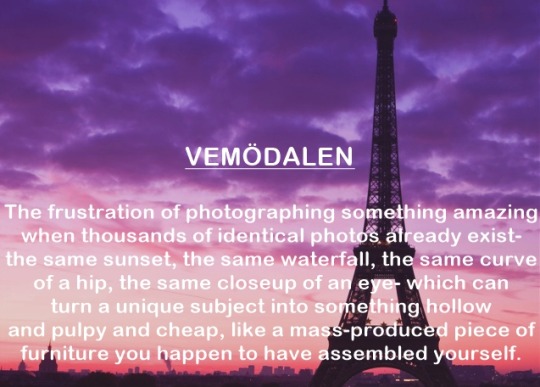
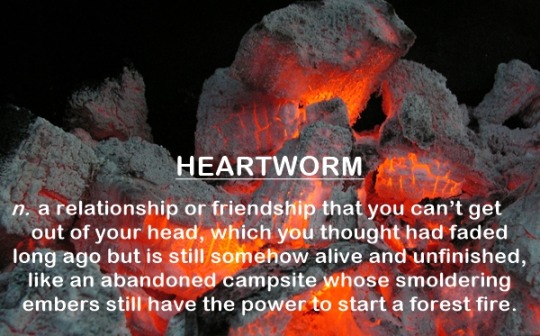
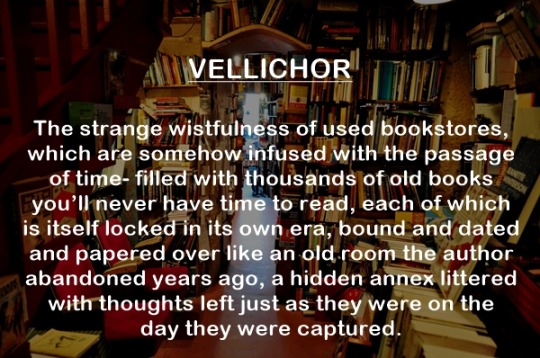
People often ask whether they should use Koenig’s made up words in real life.
He says yes, because all words are made up in the beginning.
He also quotes lexicographer Erin McKean: “Anybody who’s read a children’s book knows that love makes things real. If you love a word, use it—that makes it real. Being in the dictionary is an arbitrary distinction; it doesn’t make a word any more real than any other way. If you love a word, it becomes real.”



 knitting in the dark
