“The problem with people quantifying that richness is that they completely forget it is infinite compared to the broadest of humanity’s finite capacities. A similar problem happens when people try to quantify personhood. The richness I experience of the world is not merely a more limited version of other people’s experiences. My experiences have their own richness that other people may not be able to see.”
Holy shit. I have ALWAYS thought the people around me were being unconscionably intrusive and power-playing in their starter conversations and they told me I was antisocial and oblivious to culture norms. Turns out, maybe I’m just from a different culture.
Huh. This is really interesting.
I’m disabled, and it’s really uncomfortable to field that question about work in a social setting. (”Why no, random person at the yarn store, I don’t want to tell you about that, or about the nature of my disability”.)
I like his
“So how do you spend your time?”
question better.
A formative experience in my early twenties was when I was in a mixed group of people and we were instructed to pair off and get to know each other. My partner and I looked at each other glumly. I was a young white girl who had arrived from another country and was painfully lost and alone. He was a magisterial black British man in his forties with a greying beard and interesting clothing. He looked at me with the expression of a socially awkward introvert being asked to do a group exercise, so I tried to Hlep.
“So um what do you do,” I started, and then I saw this most complicated and weary and sad expression on his face and just yelped “WAIT no I’m sorry I’m SO sorry I didn’t actually want to ask that! I meant! AH! What do you love!!!”
“Ugh,” he said. “Well, I really love pottery.”
“I ALSO LOVE POTTERY,” I yelped like a Hleping chat-robot.
“I am assisting my disabled elderly father in his dying process, and I am not currently employed,” he said.
“I have just immigrated and I am not currently employed,” I said, gratefully. “What kind of pottery do you like.”
“The kind that is rough on one side and shiny on the other,” he said.
“ME TOO,” i said.
The leader came over, “how are you getting on?”
And we both barked, in the identical tones of introverts being asked how they are getting on, “WE LIKE POTTERY.
We took two pottery classes together, made some rough/shiny objects and never spoke again.because he did not believe in the internet, and at the time I did not believe in phones.
But I think about him, and that exchange, all the time. I didn’t even want to know what he “did.” I just felt like it was what adults say. And if I hadn’t recovered the question I wouldn’t have known Hermes and made a bunch of really fucked up pots with him
See, I know I ask the wrong questions at times, and I know some of that is due to WhitenessTM, but some of it is because I’m an Autistic person trying hard to Do Conversation by trying to remember what neurotypical people talk about and HOW they talk about it, which is heavily informed by media, because how else do you learn anything? Basically I’m nearly 37 and I know I fuck up about 60% of the time but I’m trying to be a person and not be racist and ableist. And I’ll never stop trying, because social interactions do not come with a script, so every new conversation with a friend or an acquaintance or a person at a store is like stepping into deep water and trying to remember how my limbs work so I don’t drown. I apologise in advance if my flailing injures you; it’s a constant battle, but I’m never going to NOT try to do better.
activists at barnard college providing “labels”, photographed by susan rennie and published in off our backs: a women’s newsjournal vol. 3 no. 6, february 1973
Black an white photo of two women, one standing, one seated.
Behind them is a hand-written sign reading,
“YEA – It’s a heavy trip. BUT! This is a chance to CHOOSE YOUR OWN LABEL instead of having someone else do it for you:
BUTCH/FEMME: Butch-femme relationships, as I experienced them, were complex erotic statements, not phony heterosexual replicas. They were filled with a deeply Lesbian language of stance, dress, gesture, loving, courage, and autonomy. – Joan Nestle, 1981]
A conversation on the fluidity of terms, and how to understand and have a productive conversation with a shifting generational gap in trans terminology.
Thiiiiiiiis
Also goes for encounters with trans people regardless of their age. We come from different places, different cultures, different sub-cultures. We don’t all have the same framework for what language best describes who we are.
The enforcement of appropriate terminology is agist, racist, colonialist, classist, ableist, US-centrust and Eurocentrist and all together undermines community solidarity.
So don’t give them back to our oppressors by telling other queer folks we can’t use those words for ourselves ❤
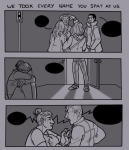
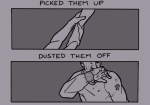
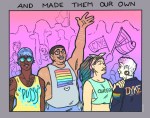
[Image description: a six-panel comic.
Panel 1: the text “we took every name you spat on us” and several people cornering someone.
Panel 2: a person curled up in on the floor in a room, while someone in the doorway yells at them.
Panel 3: someone yelling at and grabbing another person.
Panel 4: the text “picked them up” with someone helping someone else get up.
Panel 5: the text “dusted them off” with someone cleaning up their injuries”
Panel 6: the text “and made them our own” with four people: one wearing a shirt saying “pussy”, one wearing a rainbow tank top, one wearing a shirt labeled “queer”, and one wearing a jacket with a rainbow and the word “dyke”. It is the only panel in color.
General approximation of how my Russian ear heard this scene the first time (and it was perfect):
DESIRE!1!!1!!!
zh-rusty!
twzwelve!
intelligence seRRRRvice
f’yornace
nyain
kind-quality (also sounds like “benign” with odd ukrainian accent)
RTVUVRN TO MADALAND
wahn
thunderstorm wagon
EITHER “soldier” with honey-cute uwu pronunciation (he softens the “L” like a german would, but in russian softened consonants are used for baby-talk) OR, if broken in two words, “want some salt?”











 knitting in the dark