So don’t give them back to our oppressors by telling other queer folks we can’t use those words for ourselves ❤
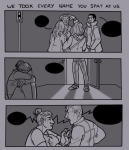
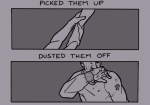
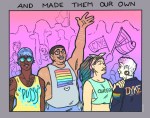
[Image description: a six-panel comic.
Panel 1: the text “we took every name you spat on us” and several people cornering someone.
Panel 2: a person curled up in on the floor in a room, while someone in the doorway yells at them.
Panel 3: someone yelling at and grabbing another person.
Panel 4: the text “picked them up” with someone helping someone else get up.
Panel 5: the text “dusted them off” with someone cleaning up their injuries”
Panel 6: the text “and made them our own” with four people: one wearing a shirt saying “pussy”, one wearing a rainbow tank top, one wearing a shirt labeled “queer”, and one wearing a jacket with a rainbow and the word “dyke”. It is the only panel in color.
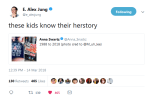
“Queer history doesn’t exist in high school textbooks. It’s hidden in fading library books, dusty archives, and oral histories forgotten with time.
But one Instagram account is bringing important LGBTQ moments out of the shadows.
@lgbt_history meticulously documents the queer community’s past, bringing stories of queer people to light through historical photos and incredibly in-depth captions.
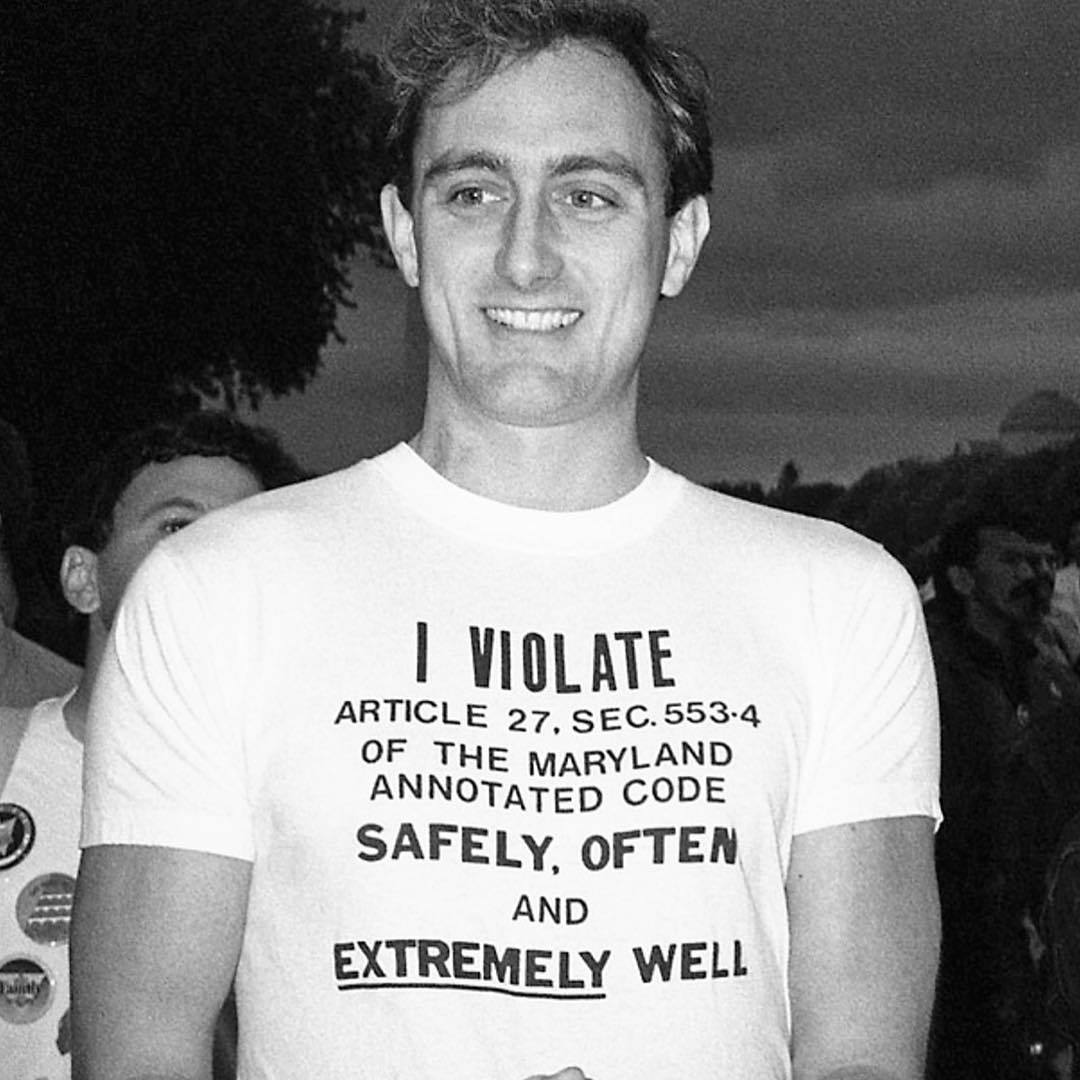
Sections 553 and 554 of Article 27 of the Maryland Code prohibited sodomy (punishable with a sentence of “not less than one year nor more than ten years”), oral sex, and “any other unnatural or perverted sexual practice with any other person.”
“uwu but if there was a cure for autism nobody would force you to-
Bullshit. Yes the fuck they would.
Want to get hired? Oh, you have autism? Well, we can’t hire you unless you get cured.
Want to get paid? Oh, we’re legally allowed to pay you less because you’re autistic. We can pay you a reasonable amount when you get cured!
Need accommodations? Why don’t you just get cured instead?
You know, you wouldn’t need all this therapy and assistance if you just got cured. You should just get cured!
We don’t need special care programs for autism! There’s a cure available! Just get it!
This isn’t covered by your healthcare because autism is a pre-existing condition, sorry!
My child was autistic and we didn’t want him to be, so we cured him! He didn’t want or ask for it, but we did!
Look, autism can’t be cured. But if it could, that cure would would absolutely not be a choice. It would just be disguised as optional.
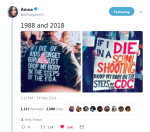
Look at the danger already for people of colour, disabled people, women, nonbinary people, transpeople, etc. if they are labelled noncompliant by medical or benefits services. Tell me not consenting to be ‘cured’ wouldn’t land you in it. Tell me that they wouldn’t make being ‘cured’ conditional for lighter sentencing in the court system, the way some courts still, in 2018, make sterilisation an ‘option’ for people charged with repeat offences. Tell me they wouldn’t exclude uncured autistic people from public housing, education and support services. Tell me again, and then go and look at history. See if you can convince yourself it won’t happen again, when we have Nazis marching in the streets and eugenicists running for election who openly call for murder of disabled people because they’re a drain on resources. Tell me that if there was a cure, it wouldn’t become a genocide.
I don’t know how universally relevant this is (I guess no part of queer history ever is) but I wonder how many trans people know the history of T&T groups.
Like, in the 90′s and 00′s in the Netherlands almost every trans related groups was a T&T ‘Transsexual and Transvestites’ group and that seemed to also be a quite common thing in other north-west European countries for as far as I can see. Maybe beyond Europe too? I’m not sure.
People who called themselves transsexual and transvestites at the time felt that they had many experiences in common that made organising together valuable and many agreed that there was a large grey area of overlapping identities. With very little information available, a lot of trans women identified as transvestites first, before identifying at trans women (in that period often using the term Male-to-Female transsexual and transwoman without the space between the words).
Then, in about 2007-2012, things changed. Transgender became more popular than transsexual and crossdresser largely replaced transvestite. In those early days, the term transgender was often understood to include crossdressers. The transgender umbrella is from that time:
Back then, the word transgender was seen by many as the umbrella term that would unite all the struggles against gender roles. But that grouping together was far from uncontroversial and a lot of heated debates took place over how broad or narrow the transgender umbrella term should be. Some feared too wide an umbrella would take attention away from transsexuals, others feared it would be confusing, some groups that had previously only had transwomen and transvestites did not appreciate the new presence of transmen and transmasculine people in their transgender community, some felt that it was very important to distinguish binary-identified transsexuals from all sorts of weird non-binary identities.
Those who took part in the debates probably remember the specific standpoints in more detail. For me, I just remember how in 2008-2012 all the T&T groups started changing their names to ‘transgender groups’ and then slowly but surely focussing more on only those transgender people that wanted some kind of transition, physical or social. Eventually, transvestites (or crossdressers, as the common term was by then) disappeared entirely from the transgender groups and a lot of transgender people forgot about the earlier wider meaning of transgender as an umbrella term.
Within that same period, there started to be a LOT of new and fairly positive media attention for transgender issues, specificallytransition related atttention. The media was no participant at all in the ‘what does transgender mean’ question but the questions they did ask were ‘are you on hormones yet?’ and ‘did you have the surgery’? Since that was a lot better than ‘so are you mentally ill because you want to be a woman?’ a lot of people who fitted the hormones + surgery narrative eagerly accepted this ‘positive visibility’ and did not question the narrow focus. This further cemented the view that transgender meant transition.
And the transgender activists? Well, let’s just say many of them, knee deep in a struggle against terrible health care and cruel human rights violations, leaped at the opportunity to seize the momentum and finally make some changes and many didn’t really give much thought to the slow disappearance of transvestites from the newly named ‘transgender’ community.
So where are we now, in 2018?
The transgender community seems to have largely forgotten about their T&T history. The terms transvestite and crossdresser both seem to be in decline, as are the communities that meet around those identities. Younger people who don’t fit the gender binary but also do not desire social or physical transition, are now more likely to identify themselves as some kind of genderqueer and nonbinary or just ‘not into labels’ or just to wear whatever they want and rock it. Some of them find their way back under the transgender umbrella after all. Which I guess is some kind of a happy ending.
But then theres the question of recognizing our legacy. I don’t think a lot of these young people realise that, had they been born 20 years earlier, many of them would probably have found a home in the transvestite community. I don’t think a lot of young transgender people recognize older transvestites as their elders, who paved the way for them. I often get the impression that they view the dwindling groups of 50+, 60+, 70+ transvestites with an element of disdain, as people who held on to a regressive binary identity, instead of as like – their badass grandfather-mothers who build parts of trans history.
I encourage everyone to think of the above next time you see someone shitting on crossdressers. We’re stronger together than we are divided.










 knitting in the dark