Matthew Hodson:
“
20 years ago, 2 years after the arrival of combination therapy that effectively treated #HIV, the Bay Area Reporter, San Francisco’s LGBT newspaper ran ‘No Obits’ as its headline.
It was the first edition not to report an AIDS death in almost 15 years.”
This year, on the 31 March, we lost Gilbert Baker, gay artist and creator of the gay pride flag. Today we would celebrate his 66th birthday. Let’s remember him as the wonderful person he was.
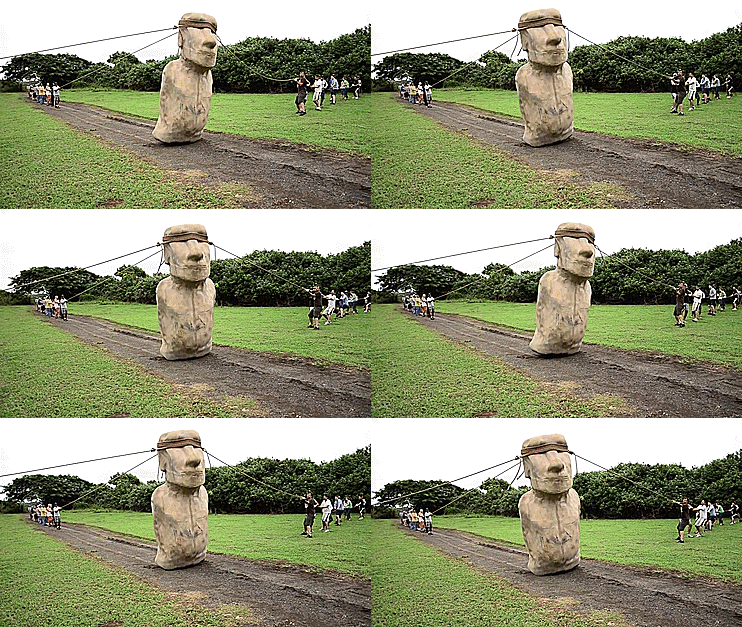
What’s really wild is that the native people literally told the Europeans “they walked” when asked how the statues were moved. The Europeans were like “lol these backwards heathens and their fairy tales guess it’s gonna always be a mystery!”
Maori told Europeans that kiore were native rats and no one believed them until DNA tests proved it
Roopkund Lake AKA “Skeleton Lake” in the Himalayas in India is eerie because it was discovered with hundreds of skeletal remains and for the life of them researchers couldn’t figure out what it was that killed them. For decades the “mystery” went unsolved.
Until they finally payed closer attention to local songs and legend that all essentially said “Yah the Goddess Nanda Devi got mad and sent huge heave stones down to kill them”. That was consistent with huge contusions found all on their neck and shoulders and the weather patterns of the area, which are prone to huge & inevitably deadly goddamn hailstones. https://www.facebook.com/atlasobscura/videos/10154065247212728/
Literally these legends were past down for over a thousand years and it still took researched 50 to “figure out” the “mystery”. 🙄
Adding to this, the Inuit communities in Nunavut KNEW where both the wrecks of the HMS Erebus and HMS Terror were literally the entire time but Europeans/white people didn’t even bother consulting them about either ship until like…last year.
“Inuit traditional knowledge was critical to the discovery of both ships, she pointed out, offering the Canadian government a powerful demonstration of what can be achieved when Inuit voices are included in the process.
In contrast, the tragic fate of the 129 men on the Franklin expedition hints at the high cost of marginalising those who best know the area and its history.
“If Inuit had been consulted 200 years ago and asked for their traditional knowledge – this is our backyard – those two wrecks would have been found, lives would have been saved. I’m confident of that,” she said. “But they believed their civilization was superior and that was their undoing.”
“Oh yeah, I heard a lot of stories about Terror, the ships, but I guess Parks Canada don’t listen to people,” Kogvik said. “They just ignore Inuit stories about the Terror ship.”
Schimnowski said the crew had also heard stories about people on the land seeing the silhouette of a masted ship at sunset.
“The community knew about this for many, many years. It’s hard for people to stop and actually listen … especially people from the South.”
Indigenous Australians have had stories about giant kangaroos and wombats for thousands of years, and European settlers just kinda assumed they were myths. Cut to more recently when evidence of megafauna was discovered, giant versions of Australian animals that died out 41 000 years ago.
Similarly, scientists have been stumped about how native Palm trees got to a valley in the middle of Australia, and it wasn’t until a few years ago that someone did DNA testing and concluded that seeds had been carried there from the north around 30 000 years ago… aaand someone pointed out that Indigenous people have had stories about gods from the north carrying the seeds to a valley in the central desert.
it’s literally the oldest accurate oral history of the world.
Now consider this: most people consider the start of recorded history to be with the Sumerians and the Early Dynastic period of the Egyptians. So around 3500 BCE, or five and a half thousand years ago
These highly accurate Aboriginal oral histories originate from twenty thousand years ago at least
Ain’t it amazing what white people consider history and what they don’t?
I always said disservice is done to oral traditions and myth when you take them literally. Ancient people were not stupid.
PSA to all you fantasy writers because I have just had a truly frustrating twenty minutes talking to someone about this: it’s okay to put mobility aids in your novel and have them just be ordinary.
Like. Super okay.
I don’t give a shit if it’s high fantasy, low fantasy or somewhere between the lovechild of Tolkein meets My Immortal. It’s okay to use mobility devices in your narrative. It’s okay to use the word “wheelchair”. You don’t have to remake the fucking wheel. It’s already been done for you.
And no, it doesn’t detract from the “realism” of your fictional universe in which you get to set the standard for realism. Please don’t try to use that as a reason for not using these things.
There is no reason to lock the disabled people in your narrative into towers because “that’s the way it was”, least of all in your novel about dragons and mermaids and other made up creatures. There is no historical realism here. You are in charge. You get to decide what that means.
Also:
“Depiction of Chinese philosopher Confucius in a wheelchair, dating to ca. 1680. The artist may have been thinking of methods of transport common in his own day.”
“The earliest records of wheeled furniture are an inscription found on a stone slate in China and a child’s bed depicted in a frieze on a Greek vase, both dating between the 6th and 5th century BCE.[2][3][4][5]The first records of wheeled seats being used for transporting disabled people date to three centuries later in China; the Chinese used early wheelbarrows to move people as well as heavy objects. A distinction between the two functions was not made for another several hundred years, around 525 CE, when images of wheeled chairs made specifically to carry people begin to occur in Chinese art.[5]”
“In 1655,Stephan Farffler, a 22 year old paraplegic watchmaker, built the world’s first self-propelling chair on a three-wheel chassis using a system of cranks and cogwheels.[6][3] However, the device had an appearance of a hand bike more than a wheelchair since the design included hand cranks mounted at the front wheel.[2]
The invalid carriage or Bath chair brought the technology into more common use from around 1760.[7]
In 1887, wheelchairs (“rolling chairs”) were introduced to Atlantic City so invalid tourists could rent them to enjoy the Boardwalk. Soon, many healthy tourists also rented the decorated “rolling chairs” and servants to push them as a show of decadence and treatment they could never experience at home.[8]
In 1933 Harry C. Jennings, Sr. and his disabled friend Herbert Everest, both mechanical engineers, invented the first lightweight, steel, folding, portable wheelchair.[9] Everest had previously broken his back in a mining accident. Everest and Jennings saw the business potential of the invention and went on to become the first mass-market manufacturers of wheelchairs. Their “X-brace” design is still in common use, albeit with updated materials and other improvements. The X-brace idea came to Harry from the men’s folding “camp chairs / stools”, rotated 90 degrees, that Harry and Herbert used in the outdoors and at the mines.[citation needed]
“But Joy, how do I describe this contraption in a fantasy setting that wont make it seem out of place?”
“It was a chair on wheels, which Prince FancyPants McElferson propelled forwards using his arms to direct the motion of the chair.”
“It was a chair on wheels, which Prince EvenFancierPants McElferson used to get about, pushed along by one of his companions or one of his many attending servants.”
“But it’s a high realm magical fantas—”
“It was a floating chair, the hum of magical energy keeping it off the ground casting a faint glow against the cobblestones as {CHARACTER} guided it round with expert ease, gliding back and forth.”
“But it’s a stempunk nov—”
“Unlike other wheelchairs he’d seen before, this one appeared to be self propelling, powered by the gasket of steam at the back, and directed by the use of a rudder like toggle in the front.”
Give. Disabled. Characters. In. Fantasy. Novels. Mobility. Aids.
If you can spend 60 pages telling me the history of your world in innate detail down to the formation of how magical rocks were formed, you can god damn write three lines in passing about a wheelchair.
Signed, your editor who doesn’t have time for this ableist fantasy realm shit.
A conversation on the fluidity of terms, and how to understand and have a productive conversation with a shifting generational gap in trans terminology.
Thiiiiiiiis
Also goes for encounters with trans people regardless of their age. We come from different places, different cultures, different sub-cultures. We don’t all have the same framework for what language best describes who we are.
The enforcement of appropriate terminology is agist, racist, colonialist, classist, ableist, US-centrust and Eurocentrist and all together undermines community solidarity.
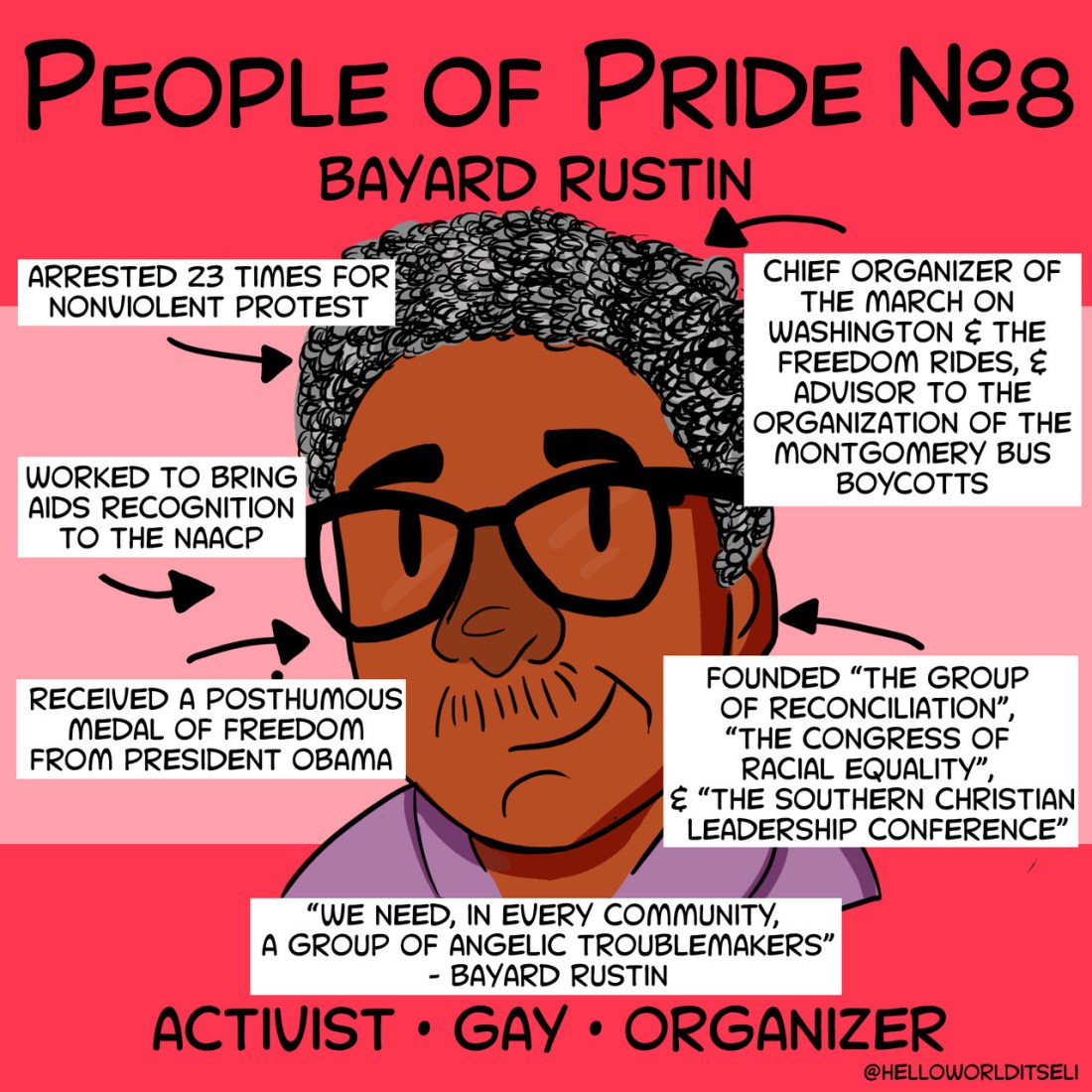
Bayard Rustin was the black, gay, non-violent activist responsible for organizing the March on Washington. His pioneering contributions to the fight for economic, racial, & LGBT+ equality are immeasurable, there is so much more to say than there is room to say it. Bayard Rustin is a name lost in history books that should have never been forgotten, I encourage you to read more about who he was, what he loved, and what he conquered here:
Every day in June, I will be posting an illustration that highlights an LGBT+ activist who I believe everyone should know. This series will be in no way comprehensive, & will include a multitude of identities, races, sexualities, and genders.





















 knitting in the dark