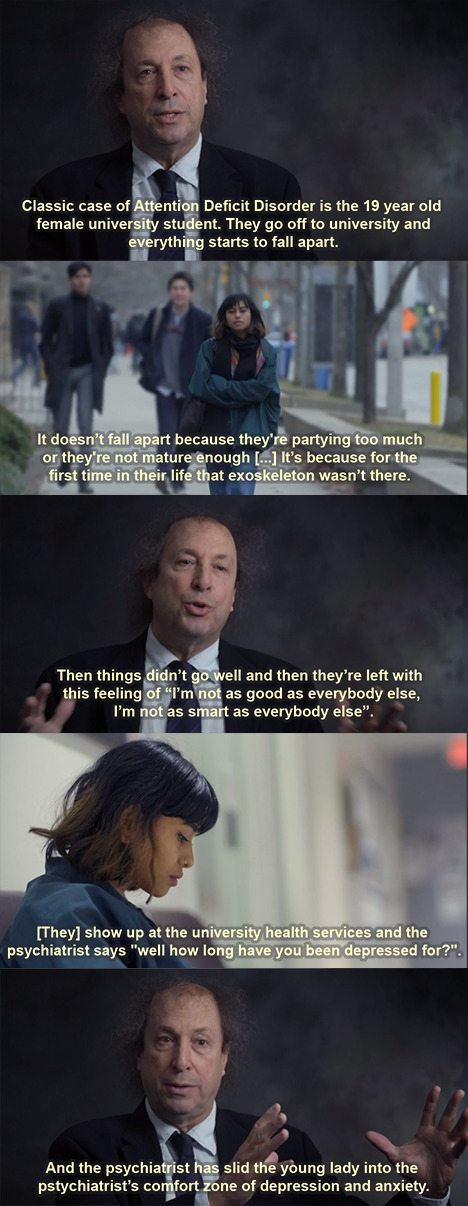
CBC made a good documentary on adult ADHD and part of it really caught me off guard because i swear they repeated verbatim my life story for the past 3 years
I don’t know how universally relevant this is (I guess no part of queer history ever is) but I wonder how many trans people know the history of T&T groups.
Like, in the 90′s and 00′s in the Netherlands almost every trans related groups was a T&T ‘Transsexual and Transvestites’ group and that seemed to also be a quite common thing in other north-west European countries for as far as I can see. Maybe beyond Europe too? I’m not sure.
People who called themselves transsexual and transvestites at the time felt that they had many experiences in common that made organising together valuable and many agreed that there was a large grey area of overlapping identities. With very little information available, a lot of trans women identified as transvestites first, before identifying at trans women (in that period often using the term Male-to-Female transsexual and transwoman without the space between the words).
Then, in about 2007-2012, things changed. Transgender became more popular than transsexual and crossdresser largely replaced transvestite. In those early days, the term transgender was often understood to include crossdressers. The transgender umbrella is from that time:
Back then, the word transgender was seen by many as the umbrella term that would unite all the struggles against gender roles. But that grouping together was far from uncontroversial and a lot of heated debates took place over how broad or narrow the transgender umbrella term should be. Some feared too wide an umbrella would take attention away from transsexuals, others feared it would be confusing, some groups that had previously only had transwomen and transvestites did not appreciate the new presence of transmen and transmasculine people in their transgender community, some felt that it was very important to distinguish binary-identified transsexuals from all sorts of weird non-binary identities.
Those who took part in the debates probably remember the specific standpoints in more detail. For me, I just remember how in 2008-2012 all the T&T groups started changing their names to ‘transgender groups’ and then slowly but surely focussing more on only those transgender people that wanted some kind of transition, physical or social. Eventually, transvestites (or crossdressers, as the common term was by then) disappeared entirely from the transgender groups and a lot of transgender people forgot about the earlier wider meaning of transgender as an umbrella term.
Within that same period, there started to be a LOT of new and fairly positive media attention for transgender issues, specificallytransition related atttention. The media was no participant at all in the ‘what does transgender mean’ question but the questions they did ask were ‘are you on hormones yet?’ and ‘did you have the surgery’? Since that was a lot better than ‘so are you mentally ill because you want to be a woman?’ a lot of people who fitted the hormones + surgery narrative eagerly accepted this ‘positive visibility’ and did not question the narrow focus. This further cemented the view that transgender meant transition.
And the transgender activists? Well, let’s just say many of them, knee deep in a struggle against terrible health care and cruel human rights violations, leaped at the opportunity to seize the momentum and finally make some changes and many didn’t really give much thought to the slow disappearance of transvestites from the newly named ‘transgender’ community.
So where are we now, in 2018?
The transgender community seems to have largely forgotten about their T&T history. The terms transvestite and crossdresser both seem to be in decline, as are the communities that meet around those identities. Younger people who don’t fit the gender binary but also do not desire social or physical transition, are now more likely to identify themselves as some kind of genderqueer and nonbinary or just ‘not into labels’ or just to wear whatever they want and rock it. Some of them find their way back under the transgender umbrella after all. Which I guess is some kind of a happy ending.
But then theres the question of recognizing our legacy. I don’t think a lot of these young people realise that, had they been born 20 years earlier, many of them would probably have found a home in the transvestite community. I don’t think a lot of young transgender people recognize older transvestites as their elders, who paved the way for them. I often get the impression that they view the dwindling groups of 50+, 60+, 70+ transvestites with an element of disdain, as people who held on to a regressive binary identity, instead of as like – their badass grandfather-mothers who build parts of trans history.
I encourage everyone to think of the above next time you see someone shitting on crossdressers. We’re stronger together than we are divided.
i’m just gonna leave this here as a reminder that “hitting bottom” doesn’t mean “staying on bottom for the rest of your life and dying as a piece of crap”
I will never, ever, not reblog this.
*huggles RDJ* Anyone on here who loves him, someone posted an amazing story about him when he was younger. I wish knew where the link was so I could share it. Instead, it’s just cut and pasted below. If I find the link, I’ll replace it with that.
I will also say that I have read this several times now and it still makes me cry.
“True story: His Name is Robert Downey Jr.” by Dana Reinhardt
I’m willing to go out on a limb here and guess that most stories of kindness do not begin with drug addicted celebrity bad boys.
Mine does.
His name is Robert Downey Jr.
You’ve probably heard of him. You may or may not be a fan, but I am, and I was in the early 90’s when this story takes place.
It was at a garden party for the ACLU of Southern California. My stepmother was the executive director, which is why I was in attendance without having to pay the $150 fee. It’s not that I don’t support the ACLU, it’s that I was barely twenty and had no money to speak of.
I was escorting my grandmother. There isn’t enough room in this essay to explain to you everything she was, I would need volumes, so for the sake of brevity I will tell you that she was beautiful even in her eighties, vain as the day is long, and whip smart, though her particular sort of intelligence did not encompass recognizing young celebrities.
I pointed out Robert Downey Jr. to her when he arrived, in a gorgeous cream-colored linen suit, with Sarah Jessica Parker on his arm. My grandmother shrugged, far more interested in piling her paper plate with various unidentifiable cheeses cut into cubes. He wasn’t Carey Grant or Gregory Peck. What did she care?
The afternoon’s main honoree was Ron Kovic, whose story of his time in the Vietnam War that had left him confined to a wheelchair had recently been immortalized in the Oliver Stone film Born on the Fourth of July.
I mention the wheelchair because it played an unwitting role in what happened next.
We made our way to our folding chairs in the garden with our paper plates and cubed cheeses and we watched my stepmother give one of her eloquent speeches and a plea for donations, and there must have been a few other people who spoke but I can’t remember who, and then Ron Kovic took the podium, and he was mesmerizing, and when it was all over we stood up to leave, and my grandmother tripped.
We’d been sitting in the front row (nepotism has its privileges) and when she tripped she fell smack into the wheelchair ramp that provided Ron Kovic with access to the stage. I didn’t know that wheelchair ramps have sharp edges, but they do, at least this one did, and it sliced her shin right open.
The volume of blood was staggering.
I’d like to be able to tell you that I raced into action; that I quickly took control of the situation, tending to my grandmother and calling for the ambulance that was so obviously needed, but I didn’t. I sat down and put my head between my knees because I thought I was going to faint. Did I mention the blood?
Luckily, somebody did take control of the situation, and that person was Robert Downey Jr.
He ordered someone to call an ambulance. Another to bring a glass of water. Another to fetch a blanket. He took off his gorgeous linen jacket and he rolled up his sleeves and he grabbed hold of my grandmother’s leg, and then he took that jacket that I’d assumed he’d taken off only to it keep out of the way, and he tied it around her wound. I watched the cream colored linen turn scarlet with her blood.
He told her not to worry. He told her it would be alright. He knew, instinctively, how to speak to her, how to distract her, how to play to her vanity. He held onto her calf and he whistled. He told her how stunning her legs were.
She said to him, to my humiliation: “My granddaughter tells me you’re a famous actor but I’ve never heard of you.”
He stayed with her until the ambulance came and then he walked alongside the stretcher holding her hand and telling her she was breaking his heart by leaving the party so early, just as they were getting to know each other. He waved to her as they closed the doors. “Don’t forget to call me, Silvia,” he said. “We’ll do lunch.”
He was a movie star, after all.
Believe it or not, I hurried into the ambulance without saying a word. I was too embarrassed and too shy to thank him.
We all have things we wish we’d said. Moments we’d like to return to and do differently. Rarely do we get that chance to make up for those times that words failed us. But I did. Many years later.
I should mention here that when Robert Downey Jr. was in prison for being a drug addict (which strikes me as absurd and cruel, but that’s the topic for a different essay), I thought of writing to him. Of reminding him of that day when he was humanity personified. When he was the best of what we each can be. When he was the kindest of strangers.
But I didn’t.
Some fifteen years after that garden party, ten years after my grandmother had died and five since he’d been released from prison, I saw him in a restaurant.
I grew up in Los Angeles where celebrity sightings are commonplace and where I was raised to respect people’s privacy and never bother someone while they’re out having a meal, but on this day I decided to abandon the code of the native Angeleno, and my own shyness, and I approached his table.
I said to him, “I don’t have any idea if you remember this…” and I told him the story.
He remembered.
“I just wanted to thank you,” I said. “And I wanted to tell you that it was simply the kindest act I’ve ever witnessed.”
He stood up and he took both of my hands in his and he looked into my eyes and he said, “You have absolutely no idea how much I needed to hear that today.”
Ramadan is super close!!! – and I’m so excited. Every year I get tonnes of questions from my non-muslim friends and even muslim friends who want to know better. So I’m compiling it all here in this post.
~ I’ve been fasting each year for more than ten years and I’ve been a student of Islamic studies more than 13 years. So yeah I know what I’m talking about.~
What is Ramadan?
It’s the ninth month in the Islamic calendar and a pillar of Islam. It has extreme significant importance to Muslims as it is the month in which the Quran was first revealed. A very holy month in which Shaytan ( the devil) is said to be locked in chains and each good deed and prayer blesses a Muslim 70 times more than any normal month of the year.
Muslims all around the world spend each day fasting from dawn till dusk. We celebrate the end of this blessed month – the first three day of the next month, Shawal – in a celebration known as Eid-ul-Fitr. It’s a really big deal for us.
How do you know when Ramadan is? Does it have a fixed date? When is Ramadan this year?
Ramadan does not have a fixed date! It depends on physical sighting of the moon or the Saudi Arabian declaration of Ramadan ( which is then again, by sighting of the moon but some countries avoid the hassle and follow that. Or if it’s a non-Muslim majority.)
The moon cycle is different for many parts of the world, hence the beginning and end of Ramadan is different – usually no more than one day – for each country.
Ramadan 2k18 is estimated to begin on 15th May! -confetti burst-
So all you do is just abstain from food and drink from dawn till dusk in Ramadan?
No! We also abstain from eating, drinking, smoking and having sex from dawn till dusk. After breaking fast most Sunni Muslims also attend series of special prayers in congregations called ‘Tarawih’ which are specific to Ramadan only. Some Muslims segregated themselves for a few days in mosques of their homes – not engaging in talking or listening to music etc – and spend the time secluded in prayer. This is not specific to Ramadan but most Muslims prefer it during this Ramadan. This practice is called ‘I’ttekaaf’.
In Ramadan the Muslim community gets together, we break the fast together as family and friends. Some hold feasts at the end of Ramadan. Nearing the end of Ramadan and throughout Ramadan able affording Muslims give money to the poor and destitute from their property, money, jewellery. This practice is called Zakat. It is not an option, every able Muslim must give Zakat in Ramadan.
Not even water?
Yes, not even water. Nothing can go into your stomach or out of it during fast. Yes, you read that right. Voluntarily vomiting breaks the fast! ( I take ten minutes brushing my teeth during the fast…careful to not let water into my throat.)
If you’re sick, do you still have to fast?
It depends on the sickness itself. You may not fast if your sickness becomes worse with fasting – however if you are a well-off Muslim – you are to feed a poor person three meals for one day for each fast you miss for your sickness/any other reason from which you recover.
If it’s a mild sickness, take a break from fasting until you get better but you are required to complete your fasting after Ramadan.
Children smaller than ages 13-15 are not allowed to fast. If you are travelling a hard and long journey, you are not required to fast. If you are pregnant, breastfeeding – you are not required to fast but you are to make up the days you missed after Ramadan is over. And you can’t fast at all when you’re menstruating. Menstruating breaks your fast.
Do medical injections, drips, eye drops, nose drops break a fast?
It’s important not to swallow any of the nose drops etc. Otherwise it’s a-okay to use. Injections and drips as long as they aren’t of glucose/nourishing stuff are permitted during fasting.
Fasting is such a good way of losing weight lol. You all must get real skinny after Ramadan!
HAH. Listen, Muslims gain more weight during Ramadan than any other month. That’s because we party after dusk and we eat a lot of fatty stuff to keep us going throughout the day. And a lot of Muslim countries have special non-alcoholic sugary drinks that we drink so. Much. After breaking the fast.
Also that’s really fucking disrespectful, we don’t fast to diet, we fast as a religious duty and to practice patience and steadfastness. The whole Muslim community comes together during this month.
How can I be behave as a Non-Muslim during Ramadan?
Be respectful!
Don’t make a big deal out of eating infront of us – most of us have been fasting for ages.
Tag tumblr content like food, porn etc as #nsfr ( not safe for Ramadan)
Don’t call Eid, ‘The Muslim Christmas’ just…don’t.
Remember that Ramadan is for all Muslims. That includes minority Muslim sects ( wahabis don’t interact ), LGBT Muslims, Muslims suffering in war zones, disabled Muslims, new converts. Ramadan is for all of us.
Please, consider donating to the people of Syria, Palestine and the Rohingya Muslims this Ramadan. They are as much as part of this Ummah as we.
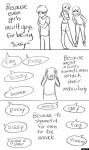
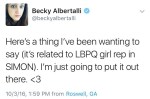
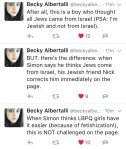
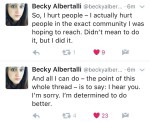
Other than that this was a genuinely great book, after reading it I immediately passed it on to my best friend, a gay man, and I’m super psyched about the film??
Also: Becky’s new book, Leah on the Offbeat, is about Simon’s friend Leah realising she’s bi so maybe she’s gonna help Simon unlearn some of his misconceptions and prejudices? Keep an eye out – the book releases in late April 🙂
Actually just on that, Becky has said that Leah has known since she was 11 that she was bi!
it is really cool that there is now an official maori word for autism, created with input from autistic maoris, and it was specifically coined to be nonjudgmental
quote from article:
“In my experience, people with autism tend to have their own timing, spacing, pacing and life-rhythm, so I interpreted autism as ‘takiwatanga’, meaning ‘his or her own time and space’,” [Keri Opai] told government-funded Maori Television.










 knitting in the dark