My future is already here, they desperately needed guacamole this morning. (Don’t worry, I didn’t give them any, they got freeze-dried chicken treats instead.)
@copperbadge too exotic for their little tums? Reminds me of the time Kit-Kat insisted she have some of my Brinjal pickle. I literally got bitchslapped for it.
I think the avo would be all right, but the spices in the guac mix (including onion powder) aren’t good for them (the salt’s not great either but the effect of that as a one-off would be negligible). That has not stopped them from COMPLAINING LOUDLY about their lack of guacamole.
Avocado actually is mildly toxic to cats.
Most of our cats will just sniff something they were demanding to see, with an offended expression of “How DARE you show me this thing that I don’t want?”. Especially if it’s a can of veggies. They HEARD the can opener, but fish did not appear!
Avocado is basically poisonous to everything EXCEPT humans. Do not give it to your pets! Also bad – onions/garlic/chives, macadamia nuts, artificial sweetners like xylitol, grapes and sultanas, anything from the lily family (even just brushing up against these can be toxic), and certain essential oils (don’t use an oil burner while cat owning, the effects are cumulative and can be fatal), alcohol, apple and stonefruit pips (cyanide), and, of course, chocolate. It’s also best not to give cats dairy. There are special formulated cat milks if you want to give them a treat.
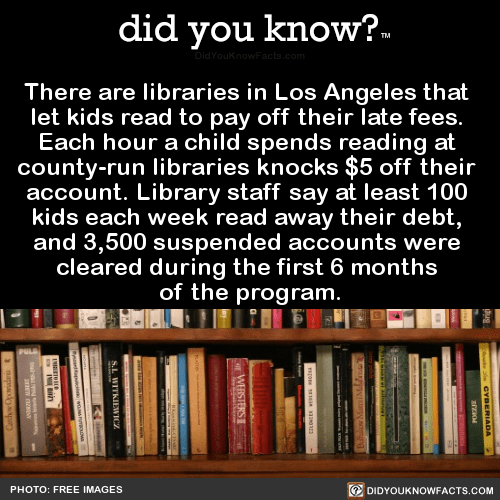
There are libraries in Los Angeles that
let kids read to pay off their late fees.
Each hour a child spends reading at
county-run libraries knocks $5 off their
account. Library staff say at least 100
kids each week read away their debt,
and 3,500 suspended accounts were
cleared during the first 6 months
of the program. SourceSource 2
The belief that someone might be faking it means they don’t deserve help is one of the greatest social ills put upon us as a society.
Let me explain:
With every charity there will be at least 5% of people (more or less depending) that look like they don’t deserve to benefit from the charity due to their clothes, phone, ability to walk, looking cis or het, looking white or any outwards sign of privilege that they might seem to show.
In actuality, about 0.01% of these people either do not qualify for the charity in question or actually have the privilege that they look like they have.
An example:
You are at a food bank. Mrs. White come up in a shiny Escalade with 4 kids all piled in the back. She comes in to get food for her, her husband, and her 4 kids. Immediately after they leave, you hear one of the other volunteers criticizing the fact that these “obviously well off individuals” are coming in for food.
In reality: Mrs. White’s husband was in a car accident that cost him his ability to walk for long periods of time, the car, and his ability to work. The insurance company paid for the escalade (a dream car of the husband’s) and disability allows them to keep the house, but Mrs. White is barely able to work part time to take care of her husband and the kids. They rely on the donations at the food bank to get by.
Another example:
You see a pair of people walking in the pride parade that look cis and het and are being affectionate at Pride. You hear someone snarl about invaders.
In reality: They are both trans or Bi and this is their first Pride being out.
Another example:
A person on the internet talks about their experience with Autism and how it means they have a hard time working. They’re self-diagnosed.They’ve gotten jeering comments about how they’re faking it and making it hard for real Auties.
In Reality: They’re autistic but can’t afford a professional diagnosis because they have a hard time working and they showed atypical traits as a kid.
I could go on and on.
I’ve heard it all. From just about anyone. But mostly? Mostly I hear it from people who think that if you don’t fit the stereotype you don’t deserve help. That you must be in the very lowest place you can be before you get help. But that’s simply not how it should be.
We should reach kids before they’re on the verge of death, someone before they’re on the street, a person before they’re grasping at the end of their rope. And if we were able to do this, maybe more people would feel comfortable asking before they had no other option than to beg for the scraps that society can leave them.
Society’s greatest illness isn’t those who fake need, but those who think that that tiny bit of people who don’t need the help asking for it is worth forsaking everyone else who does.
it’s also because Leonard COHEN (!) was Jewish and this is a quintessentially Jewish line, and changing it to that level of Annoying Certainty is stripping it of its Jewish meaning and imbuing it with that particularly American smug evangelical Christian attitude that makes me tired, so very tired
THAT IS EXACTLY WHY
I don’t think I’ve heard any cover artist sing my favorite verses
You say I took the name in vain
I don’t even know the name
But if I did, well really, what’s it to you?
There’s a blaze of light
In every word
It doesn’t matter which you heard
The holy or the broken Hallelujah
I did my best, it wasn’t much
I couldn’t feel, so I tried to touch
I’ve told the truth, I didn’t come to fool you
And even though
It all went wrong
I’ll stand before the Lord of Song
With nothing on my tongue but Hallelujah
um woah
I will always hit the reblog button so hard for Hallelujah but ESPECIALLY mentions of the elusive final verses which are just about my favorite lyrics ever. Why do people always omit the best part of the song??
In Yiddish
In Hebrew
In Ladino
Yeah, I wonder why the verses that reference specific Jewish mystical and chassidic concepts that aren’t readily understood by American “I love Jews, you know, Jesus was Jewish!” Christians never get any airtime. Funny that.
You say I took the name in vain I don’t even know the name But if I did, well really, what’s it to you? There’s a blaze of light In every word It doesn’t matter which you heard The holy or the broken Hallelujah
These are specifically about Chassidic Jewish theories of the holy language, how each letter and combination of letters in Hebrew contains the essence of the divine spark and if used correctly, can unlock or uncover the divine spark in the mundane material word. And of course, there are secret names of God which, when spoken by any ordinary human would kill them, but if you are worthy and holy and righteous can be used to perform miracles or even to behold the glory of God face-to-face. The words themselves have power. Orthodox Jews often won’t even pronounce the word “hallelujah” in it’s entirety in conversation, because the “yah” sound at the end is a True Name of God (there are hundreds, supposedly) and thus too holy to say outside of prayer.
None of this is to mention how David’s sin in sleeping with Batshevah (the subject of much of the song, with a brief deviation to Shimshon and Delilah) is considered the turning point in the Tanach that ultimately dooms the Davidic line at the cosmological level and thus dooms Jewish sovereignty and independence altogether. From a Christian perspective this led to Jesus, the King of Kings, and that’s all very well and good for them, but for the Jews, the Davidic line never returned and is the central tragedy of the total arc of the Torah. Like, our Bible doesn’t have a happy ending? And that’s what this song is about? There’s no Grace – you just have to sit with the sin and its consequence.
Of course, Cohen is referencing all of this ironically, and personalizing these very high-level religious concepts. Like the point of this song is that Cohen, the songwriter, is identifying with David, the psalmist, and identifying his own sins with David’s. The ache that you hear in this song is that the two thousand year exile that resulted from one wrong night of passion and Cohen feels that the pain he has caused to his lover is of equally monumental infamy. Basically, in a certain light, the whole of Psalms is a vain effort for David to atone for his sin and I think Cohen was writing this song in wonderment that David could eternally praise the God who would not forgive him and would force him and his people into exile. But he ultimately gets how you have to surrender to the inexorable force of God in the face of your own inadequacies and how to surrender is to worship and to worship is to praise – hence, Hallelujah. You can either do the right thing and worship God from the start, or you can fuck up, be punished, and thus be forced to beg for His forgiveness. It’s the terrible inevitability of praise that’s driving him mad.
Like honestly, I identify with this song so strongly as an off-the-derech Jew, I sometimes wonder what Christians can possibly hear in this song, as it speaks so specifically to the sadomasochistic relationship that a lapsed Jew has with their God. It’s such a different song from a Christian theological perspective it’s almost unrecognizable, man. This song continues to be a wonder of postmodern Jewish theology and sexuality from start to finish. Don’t let anyone give you any “Judeo-Christian” narishkeit. This is a Jewish song.
(Sorry about the wild tangent it’s just 2AM and I love this song so dang much, you guys.)
holy shit. woah.
This.
I … I am finding myself having some very powerful and inarticulate Feels about @dduane reblogging this whole thing with the tag #Young Wizards meta.
As a somewhat lapsed Catholic I feel every fucking word of this
……
That feeling when a post is by Jewish people, about Jewish people, about a song about being Jewish being appropriated by Christians, and someone comes onto the post and says “as a Catholic….”
I still think Moana deserved an Oscar for this part
To me, the moral of Moana is that only women can help other women heal from male violence.
The movie starts with the idea that the male god who wronged Te Fiti must be the one to heal her. This seems to make a certain sort of intuitive sense in that I think we all believe that if you do something wrong you should try to make it right. But how does he try to right it? Through more violence. Of course that failed.
It was only when another woman, Moana, saw past the “demon of earth and fire” that the traumatized Te Fiti had become (what a good metaphor for trauma, right?) and met her with love instead of violence that she was able to heal. Note that they do the forehead press before Moana restores the heart, while Te Fiti is still Te Kā. Moana doesn’t wait for her beautiful island goddess to appear in all her green splendor before greeting and treating her as someone deserving of love.
Moana is only able to restore the heart because Te Kā reveals her vulnerability and allows Moana to touch her there. Maui and his male violence could only ever have resulted in more ruin.
This is a touching anaylisis but it’s extremely racist as
not only have you completely ignored the whole point of Maui’s character, but
have managed to incriminate a man of color on a tumblr wide scale.
First of all, Maui’s character does not represent male
violence—it represent human greed. Maui did not take the heart because he is a
man, and Te-Fiti is a woman. He took it because the humans asked him to. The humans asked Maui to do everything for them,
not caring how greedy or selfish their requests were and in the end it was Maui
who suffered for it. Maui is supposed to show the flaw of humanity.
This has nothing to do with sexism, it has everything to do
with the fact that Maui gave and gave to the humans who could never stop being
greedy. Moana giving the heart back wasn’t supposed to be her “making up” for
the male violence that Maui represents. It was her making up for the greed she
and her people represent. It was touching however because yes it was an
important moment between two women, but you missed the point and you’ve come off
racist and very disrespectful to a culture at that.
Yes, Moana is an empowering movie for women, especially
women of color. But the last thing this is about is Maui being an abuser/rapist
or whatever. That is not the point of Maui’s character.
And to assume so is racist. You are a white woman completely
dehumanizing a man of color and ruining his image because of how you see him. And other white girls here
on tumblr have happily picked up that image and interpretation and rolled with
it. Maui’s character is now seen as an abuser or as someone who is violently
because of white girls here on tumblr—which it doesn’t surprise me. (an in a
historical context this is even MORE racist because white women would always
make Maui’s people out to be savages and abusers etc., simply because of the
color of their skin and their culture so yea, this is bad).
You can see the morality of the movie however you want, but
do not be disrespectful toward a character and in this case a culture.
@i-want-cheese Please don’t write this off as another “butthurt comment” or
“male guilt”, because this is really messed up. I see how you’re brushing off
some other people’s comments and I honestly hope that you don’t see mine the
same way because this is an issue I think you need to face/realize. You are
being racist and brushing it off isn’t going to change that.
the
@visibilityofcolor THANK YOU FOR THIS. As a Polynesian woman, reading that post and other replies painting Maui and even Tui as aggressive and violent men had me feeling some type of way, especially since White people have always regarded Polynesian men in such a manner.
I’ve thought about replying because I’m tired of seeing these kind of “Moana is a feminist movie” posts collect hundreds of notes despite the fact that these posts always conveniently fail to mention Pasifika people, but it always stressed me out, so thank you.
As an aside, Maui taking Te Fiti’s heart and Moana restoring it was symbolic of environmental preservation. Because the people who inspired Moana–Pasifika people, not just Polynesian–are always affected first when the environment is threatened. Our way of life is greatly influenced by the ocean and we believe that if you take care of the ocean, she will take care of you.
You’re very welcome.
This is insight for me as well (as I wasn’t aware that the movie also came fro the culture of the Pasifika people), and does give a very important perspective. I do agree with you, this movie is about environmental restoration, not some white fem bullshit.
I tried over and over again to explain to I-want-cheese about how she was being racist, but she responded by blocking me and other poc who called her out (even other polynesian people). People to this day are still trying to explain that she is being racist and culturally insensitive but she ignores us.
I’ve made a few posts about this, hoping that people realize how problematic it is to agree with i-want-cheese. Explaining to her racist white ass that this was problematic was like explaining to a bird. She wouldn’t listen and neither would have of her racist friends.
Sorry you’ve had to see this on your dash every so often, but I’m glad my portion of the post is starting to get around. (reblogged to the wrong blog at first lols)
Also i-want-cheese is a transphobe and means trans women when she says male violence. All around bad post i-want-cheese and bless you ppl for giving us more cultural context for this.
Honestly, I was touched by
i-want-cheese’s post the first time I read it, but I admit, I had a hard time imagining Maui as essentially… a rapist… I never once imagined him as anything but someone who endlessly tried to please everyone, striving constantly to create a perfect impression of himself (much like many men of color I’ve met in my life). As a white person I also admit I have no context for Polynesian culture outside of what very, very little I researched after seeing this movie, but I recognize solid character writing, and Maui was just as much of a victim in this movie as
Te Fiti
was. I’ll always reblog this when it hits my dash.
What’s more the point falls apart when you identify the fact that the films frames no one as an antagonist. Tamatoa would meet this point traditionally since he’s a ‘bad guy’ but doesn’t play a big enough role in the film for it to really count. The three characters who fit the role of a typical antagonist (those who oppose the goals of the protagonist (the person who’s actions push the narrative forward)) would be Chief Tui on the Island, Maui in the opening scene, and Te Kā for the majority of the film. Even Maui after he steals Moana’s boat. However, each of them is misrepresented in some way. Tui just wants to ensure the safety of his people long into the future. Maui wants to be loved. Te Kā wants what was stolen. And ultimately each becomes resolved. There are no bad people in Moana, just conflicting motivations. And even in the case of
Te Kā, I don’t think her actions were voluntary.
Which I ultimately believe is the basis for the story outside of Moana’s know yourself. Moana is about the inter connectivity and complexity of growing up. Its about learning that the people who you think fit into simple archetypes don’t. Be it your parents, you heroes, or a literal God. There is complexity to everything.
The use of Antagonist as a trope in film is used as a representation of a child’s perception of evil. But the film allows for nuance to be discovered as the film continues. And through Moana and the kindness and freedom she represents, each ‘antagonist’ is able to move on from their struggle and find their own piece.
So its absolutely unfair to label anything that happens in the film as a metaphor or symbol of male violence, because nothing that takes place in purely violence. Or something that isn’t resolved through complex characterisation. Maui didn’t take the heart knowing what it would do. He wanted to help the people who revered him and gave him the only validation he could get. But when we did realise it the error of his ways and found that validation within himself, he did everything in his power to make up for that mistake.
Most adult children of toxic parents grow up feeling tremendous confusion about what love means and how it’s supposed to feel. Their parents did extremely unloving things to them in the name of love. They came to understand love as something chaotic, dramatic, confusing, and often painful—something they had to give up their own dreams and desires for.
Obviously, that’s not what love is all about. Loving behaviour doesn’t grind you down, keep you off balance, or create feelings of self-hatred. Love doesn’t hurt, it feels good. Loving behaviour nourishes your emotional well-being. When someone is being loving to you, you feel accepted, cared for, valued, and respected. Genuine love creates feelings of warmth, pleasure, safety, stability, and inner peace.
Susan Forward, “Toxic Parents: Overcoming Their Hurtful Legacy and Reclaiming Your Life” (via heavyweightheart)
ever notice that the mean voice in ur head that insults u is awful confident for something thats literally never done anything in its life except be mean to you… like… one of us is pathetic and its not me buddy… get a hobby… yikes
Hopefully this works, I’ve never tried to share a google drive link before so I’m not sure if I did it right. Anyway if you weren’t aware since the start of January I have been working on a magazine for my senior project that is meant for autistic people and by autistic people. I have received a lot of contributions from other autistic people on my blog in the form of submissions to sections like the positivity section for example, art for the art section, and articles. Most of the magazine was done via submissions from other autistic people. Except for the school advice section which I wrote based on my own experience, and the autistic celebrity and autistic character sections which I wrote myself after doing research. Last week I turned it in at the end of my final class (and I got an A on the magazine by the way 😊).






 knitting in the dark