fandomsandfeminism:

imawhore4thor:

fandomsandfeminism:

etaleah:

cephalotodd:

rick riordan off the shits

This made me want to go out and buy some Rick Riordan books immediately. Hell, I might actually do that. Anybody have recommendations? @fandomsandfeminism what’s a good place to start for someone who has never read him before?

Easiest place to start is with Percy Jackson and the Olympians #1: The Lightning Thief. Fair warning though, the books start off kinda corny but get better as they go.

If you don’t want to work through the first 5 books (which is the first series), you could probably get away with reading wikipedia summaries and jumping right into Heroes of Olympus #1 The Lost Hero. 

His Magnus Chase series is fantastic.

Probably my favorite. I suppose you could read it in isolation, but have the Percy Jackson background makes those times when we see Annabeth and Percy so much cooler.

queeranarchism:

challahchic:

A conversation on the fluidity of terms, and how to understand and have a productive conversation with a shifting generational gap in trans terminology.

Thiiiiiiiis

Also goes for encounters with trans people regardless of their age. We come from different places, different cultures, different sub-cultures. We don’t all have the same framework for what language best describes who we are.

The enforcement of appropriate terminology is agist, racist, colonialist, classist, ableist, US-centrust and Eurocentrist and all together undermines community solidarity.

dodgylogic:

insufficient-earth-skills:

moon-boob:

fecundism:

prissygrrrl:

fecundism:

fecundism:

ive been reading a book that basically explains how so-called “brain differences” between the genders is the result of gendered socialization and not the cause of it. i honestly expected the book to be very cis-centric but its actually the opposite, the author stresses that testimony from trans ppl is actually indispensable because we’ve, in a sense, “lived both experiences”

more cis feminists should have this mindset

one of the first examples that she uses to introduce her point about how perception by others can shape a person’s performance actually uses a trans woman. it explains that as a certain trans woman became to be seen as a woman more and more frequently, the ppl arond her eventually started viewing her as being ill equipped for tasks that they did not bother her about pre-transition. eventually she even found herself underperforming in these tasks herself.

whats the name of the book

Delusions of Gender by Cordelia Fine

Here’s a pdf, babes ❤

I knew it was this book before I’d finished reading the first two lines. Honestly this book is indispensible if you want to debunk any gender determinism people claim is science. I can’t recommend it enough.

She’s written a new one! It won the Royal Society prize for science book of the year, and it’s called Testosterone Rex, and it is excellent.

(Bonus: it’s making old white men really really mad.)

(Bonus bonus: I am myself a neuroscientist, and the old white men mentioned above – who are not – could not have missed the point harder if they’d actively tried. Which. Maybe?)

jedusaur:

Ursula K. Le Guin in 1976: “‘He’ is the generic pronoun, damn it, in English.”

Ursula K. Le Guin in 1988: “Until the sixteenth century the English generic singular pronoun was they/them/their, as it still is in English and American colloquial speech. It should be restored to the written language, and let the pedants and pundits squeak and gibber in the streets.”

(from this fascinating 1988 annotation of a 1976 essay on pronouns in her classic 1969 novel, Left Hand of Darkness)

Free to Be…You and Me

autismserenity:

This was one of my favorite books as a kid. I checked it out of the library about a billion times. 

If you’ve never read it, then you probably don’t know about The Story of Baby X!

1974. Thirty-three years ago. This anthology included a story. About a kid being raised without an assigned gender. As a positive thing. 

I didn’t know I was genderqueer at the time, or that that was a thing, or… anything. But it had a huge influence on me. It made it very easy to imagine raising a kid by using gender-neutral pronouns, and waiting to hear a gender, and/or pronouns, from the kid themself. 

And here it is. 


Once upon a time a baby named X was born. It was named X so that no one could tell whether it was a boy or a girl.

Before it was born, scientists created an Official Instruction Manual that would help the families raise baby X.

Many families were interviewed to find the perfect parents for baby X. Families with grandparents named Milton or Agatha, families with aunts who wanted to knit blue shirts and pink dresses, families with other children who wanted a little brother or sister. All of these families didn’t want a baby X, they wanted a baby girl or boy. 

Finally, scientists found the Jones family The Jones family wanted to raise a healthy, happy baby, no matter what kind. They wanted, most of all, to raise a baby X.

The Jones promised to take turns holding X, feeding X, and singing X to sleep.

They promised to never hire any babysitters, because babysitters might try to peek at baby X’s secret.

The day the Joneses brought home their baby, everyone asked, ”Is it a boy or a girl?” To which Mr. Jones replied proudly, ”It’s an X!”

No one knew what to say. They couldn’t say, “look at her cute dimples” or “look at his husky biceps!” And just saying “kitchy-coo” didn’t seem right either.

The neighbors were unsure, and the relatives were embarrassed. “People will think there is something wrong with it!”

And the Joneses didn’t understand this. “What could be wrong with a perfectly healthy and happy baby?” they sat and wondered.

Suddenly everything changed for the Joneses: The cousins who sent a tiny helmet did not come and visit anymore. The neighbors who sent pink, flowered dresses pulled their shades when the Joneses passed their house.

The Official Instruction Manual had warned the new parents this would happen, so they didn’t worry too much. Besides, they were having too much fun raising baby X.

Mr. & Mrs. Jones had to be very careful. Because if they kept bouncing baby X up in the air and saying how strong and active X is, they’d be treating baby X more like a boy. But, if they cuddle and kiss baby X and tell it how sweet and dainty X is, they’d be treating baby X more like a girl rather than an X.

So they consulted the Official Instruction Manual, and the scientists prescribed, “Plenty of bouncing and plenty of cuddling. X ought to be strong, sweet, and active. Forget about dainty altogether.” [Continued below the cut]

Keep reading

I knew this story, not from the original book, but from when I studied childcare way back when. So, it’s out there, being taught to early childhood educators, in Australia, at least.
Free to Be…You and Me
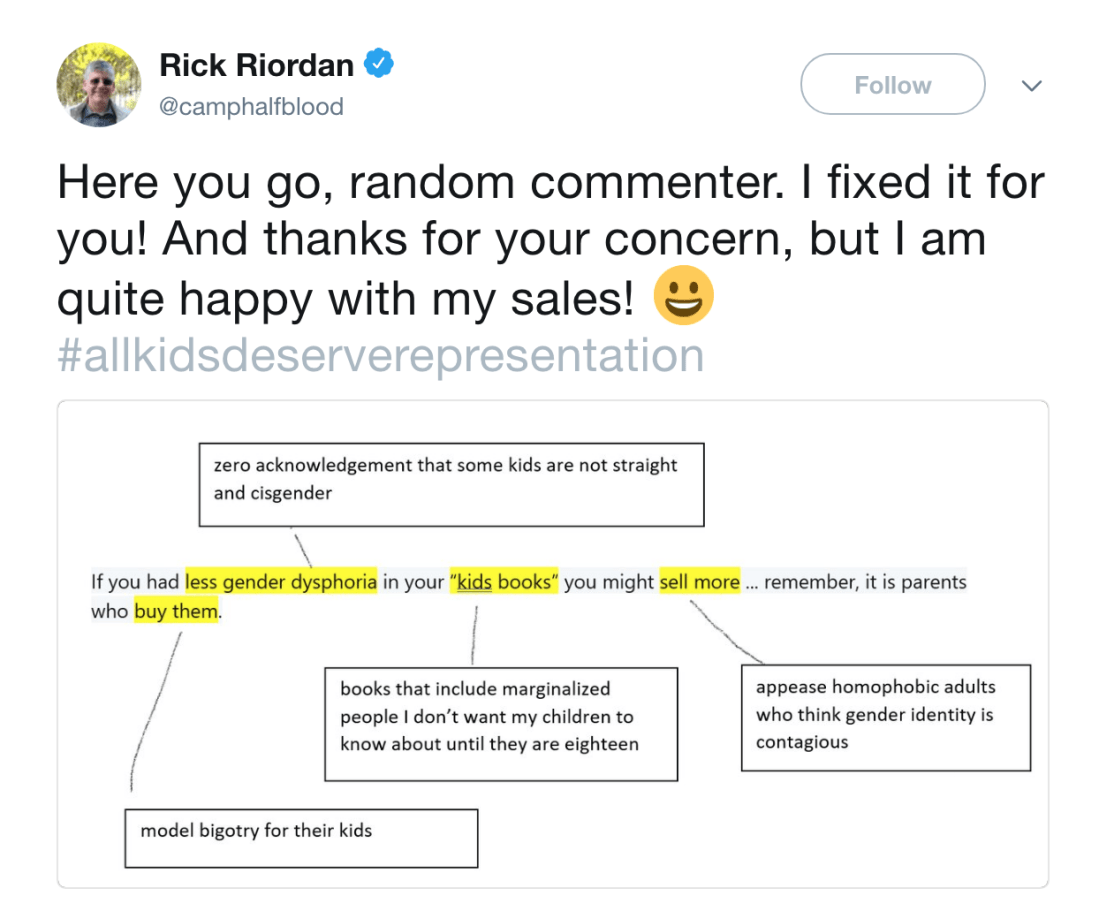
someone: are you a boy or a girl
The Doctor: i’m a time lord
someone: but what’s your gender
The Doctor: alien
someone: yeah but what’s in your pants
The Doctor: ALL OF TIME AND SPACE

kyraneko:

profeminist:

yugiohnineinthesky:

Ok but can we talk about how emo, as a genre, defied gender roles in a big way? Like, everything about the culture, from the guys wearing makeup and womens’ skinny jeans, to the way they got unabashedly emotional in spite of the “men aren’t supposed to cry” narrative they’d obviously been socialized with, was just this complete “fuck you” to the idea that there’s a certain way to be a “man”. 

And a lot of their detractors called them “girly” or “gay”. And they didn’t give a fuck! Fall Out Boy has a whole song entitled “Gay Is Not A Synonym for Shitty”, which referenced a famous Pete Wentz quote, where he basically said that if you thought his band sucked, to just say it sucked, and not be a “homophobic asshole” about it. 

And, then, geez, My Chemical Romance took it a step further, and Gerard Way outright kissed one of his bandmates at concerts purely to infuriate homophobes who were at his shows.

 A lot of these bands were openly for LGBT rights, for womens’ rights. I remember one instance where some band MCR was touring with asked women to flash their tits in exchange for backstage passes. And Gerard was so horrified by this, and told his female fans to “spit in the faces” of misogynists in the rock scene. 

Like, god, these bands were so progressive. And they still are. Right after the Pulse tragedy, Brendon Urie literally danced around in a pride flag and told his queer fans what they meant to him. Pete Wentz said that “Uma Thurman” was meant to show his female fans that they could be “badass”, too. And Gerard pretty much admitted in an interview to somewhat identifying with the label “nonbinary”. 

That’s the most lasting impact that emo is going to have. Showing fans of all genders that there’s nothing wrong with being whoever the fuck you are, that there’s no specific way to be a man or woman. And, god, I just fucking love that. 

Gifset source

“So every day during my set, when I’m playing my own shows, I talk about people that are transgender. I talk about it a lot because everyday basically I say: …”

– Gerard Way, Soundwave, Melbourne, 2015

Source

I feel like disco and emo should team up and that should be the next big music thing, sort of a defiant apocalyptic dance party, because disco did this sort of thing too, the rejection of straight white male heteronormativity, and that was basically why it was killed, so, like, emo plus defiant zombie disco would be the perfect thing to play in the Mango Menace era.