This post may be triggering. I’m about to talk about being fat, and my eating disorder, and an exchange I had with a new therapist at my treatment center. It’s an assumption that has become so common place it hardly phases me anymore. But it should. It needs to. Because it’s an example that even within a treatment facility with a weight set point mind set and a health at every size governing philosophy, when the staff see me, and see my body, and my size, there’s an assumption that I either have binge eating disorder or compulsive eating disorder.
I’ll share the interaction, and then why it’s so important. I sat down to an orientation for a new group I’m joining. The therapist and I have met in passing, but have had no direct interaction before this. She asked how my recovery was going. I told her I’ve had a lot of set backs over the last six months, but I’m four weeks in to eating AND sleeping, which is a huge accomplishment. I’m really starting to feel true hunger and my dietitian is thrilled that I’m actually eating. And the therapist said, “Oh, so, you mean feeling hunger and eating in a good way?”
And I just stared at her for a moment. I’ve gone for so long not knowing what actual hunger felt like, doing anything and everything to busy myself the moment my body twinged in that direction, suddenly becoming desperately busy and oh look, it’s too late now, I’ll just eat at the next meal, or perhaps the next…
When I first entered treatment, I was nauseated all the time. The amount of food on my meal plan felt impossible. Every meal was a nearly unbearable experience. My meal plan’s been raised multiple times since then. Now, I wake up hungry and cranky until I feed my body. It’s still hard to eat. But I’m doing it. Every day. So many things have changed.
But not that I’m fat.
Every now and then, I get to forgot that I’m fat for a little while. It’s usually not long before I’m reminded, before an assumption, or a seemingly innocuous question brings it back to the forefront. Right. I exist in a large body. There are a lot of assumptions that go along with that.
And my answer was a laugh, and a clear explanation, because I’ve had to do it so many times before, ticking off each thing on my fingers. “Oh! I have a restrictive eating disorder. My behaviors are restricting, purging, starvation, diet cycling, and using exercise as a way to punish my body. My meal plan is a minimum I have to eat each day, going over that is great but I can’t go below. And I have restrictions on water, because I have a history of water loading.”
"Oh!“ was her reply.
I followed immediately with the example I always use, preempting the inevitable bingeing question. “When I started here, I thought I binged. I was like, ‘I totally binge. I’ll eat an ENTIRE cheeseburger!’ And the staff was like ’…That’s not a binge.’”
And she stepped in and finished the sentence with, “…right, that’s a portion.”
And suddenly we were back on the same page. She had adjusted her internal diagnostic criteria of me, and what I struggle with, and the rest of the orientation went great. I’m excited about the group, and I think she’ll be a great facilitator. I do feel a bit heartsick though that she didn’t take a moment to look at my file, or speak to my current treatment team before our orientation. It would have saved me from that moment, where I have to explain, again, that while yes, I’m fat, the disorder that I’ve been struggling with for over 30 years is restrictive, based in control, anxiety, and trauma, as well as genetics and a solid dose of disordered modeling. The reactive eating I’ve done, what feels like bingeing to me, falls squarely in the realm of a portion, or at its most extreme, a large meal.
Now there’s some great stuff over at www.youreatopia.com and @bigfatscience & @everythingeatingdisordered if you’d like to understand how you can not lose weight, and even gain weight, while being in a restrictive state. This is especially true while diet cycling, which has been my path in between ED behaviors for the past 15-ish years. To quote @heavyweightheart “It turns out human bodies are a little more complicated than lawn mowers.” We’re not just fuel-in, energy-out robots. There are all kinds of processes that occur making us very different than, say, a car’s engine. And each of us has unique needs.
And here’s where we veer into the why: Why these underlying assumptions matter so very much, why they must be examined and challenged, and why there needs to be more open and honest dialogue around the reality of eating disorders occurring in individuals of all body sizes.
I went to my neurologist recently to discuss the increase in my migraines in both frequency and severity. I told him in clear and blunt language that I’m in the early stages of eating disorder treatment for a restrictive eating disorder and on exercise restriction. He asked why. Not kindly, or with compassion. But very bluntly. “Why?” And I explained.
He then went on to bring up weight loss three times and walking an hour a day four times in the remaining time of the appointment. Did he say these things over and over because he thought this was what was best for my overall health, taking into consideration the serious damage I’ve done to multiple organ systems with my decades of starvation and purging? No. He said these things because of the theoretical damage that could occur based on correlation between these issues and obesity. My blood pressure, pulse, blood sugar, and other metabolic measures of health look pretty damn good for someone with as many health issues as I have, none of which are weight related, but many of which are ED related.
It’s so ingrained.
You’re fat. Get healthy. Lose weight. Exercise. My psychiatrist put it really well. She said, “If you had gone in for a well check, checking in and making sure you’re eating a variety of food and getting some exercise makes sense when discussing migraines. But it’s like you went in and said, ‘I’ve been through hell. And I’m still there.’ And his response was, ‘Let’s get some walks in!’ He didn’t actually listen to you, or hear you.”
I was asked recently whether I thought there was any point when inpatient treatment would have been appropriate. And I said yes. When I was 19, and passing out daily in class, and my movement teacher told me I couldn’t return until I’d seen the doctor. They diagnosed me as hypoglycemic. I was at a “normal” BMI, the smallest I’d ever been, but still not underweight. I had never missed a period, and the fact that I worked out 2-8 hours a day showed how really dedicated I was to my health. I used the diagnosis as an excuse to become a vegetarian and cut even more food out of my diet, and learned how to eat just enough to not pass out in class. 19 years after that, I finally sought treatment.
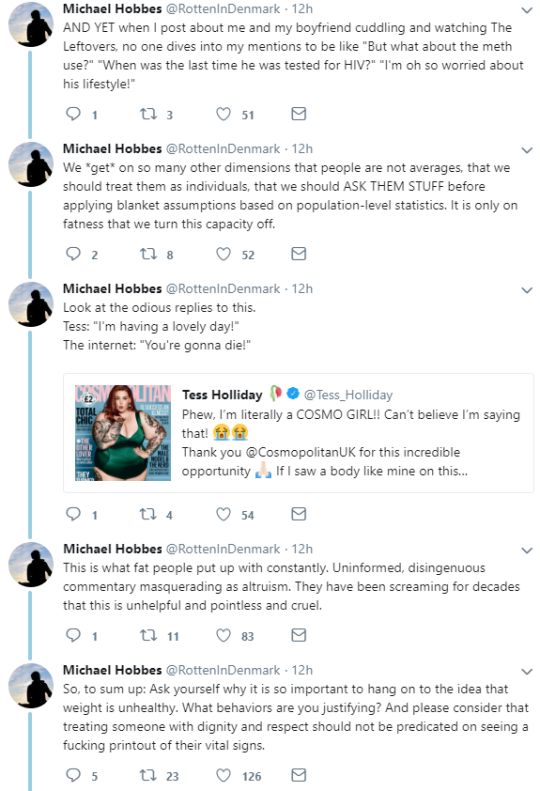
We say it over and over and over. Eating disorders impact all manner of people. Eating disorders are mental health disorders first, and cause a myriad of health issues, further psychological issues, and relationship and social issues. And not everyone who has them is underweight. Yes, the pictures of skeletal women are the most shocking, attention grabbing, and likely to get people to raise both money and awareness, which ED treatment desperately needs. But the cost is that the rest of us, those in average size bodies, and yes, those of us in fat bodies, are receiving extremely dangerous messages, repeatedly, about our bodies, and our health.
I’m not referring to our theoretical some day health, that health that my neurologist is so focused on. I’m talking about our health right now.
My biggest wake up call in treatment was when my dietitian sat me down, looked at me seriously, and said, “We need to talk about your weight.” I flinched, sure that she was going to say that I’d gained a huge amount of weight adding in more food, that I was messing up my meal plan, that I was failing at recovery.
Instead, she said, “You’re losing weight alarmingly fast. You have to start eating again. Everyday. Your full meal plan. All that long term damage you thought you wouldn’t have to worry about?” She pulled out some charts and showed me some very scary things. “You’ve been doing this for 30 years. It’s now. The long term damage is happening now.” I was shocked. Wasn’t I supposed to lose weight? Wasn’t I supposed to shrink away into nothingness? Or at the very least, into a “normal” BMI?
My restriction, dieting, and exercise addiction were supported and even recommended to me by my doctors. And what’s so scary is that when I tell doctors outside my treatment team I’m in recovery, and on exercise restriction, it’s still being recommended. My dietitian was horrified. My therapist was furious. My psychiatrist gently but firmly suggested I find a different neurologist.
It’s hard enough to confront that what you’re doing is hurting yourself. It’s excruciating to confront that your eating disorder also hurts the people you love, and who love you. There’s no break from recovery. There’s no day off. And when you’re fat, you also deal with a daily onslaught from every direction suggesting, prodding, lecturing, even screaming at you that you are invalid in your body. That you are not worthy as a human being until you reach a certain weight. And that your well being is dependent on you losing weight.
We live in a culture where being thin is so closely aligned with being healthy, that that goal is worth anything. It’s worth a doctor telling me to actively do things that will harm me. He’s not the first. He’s just the most recent this month. Not this year. Not this season. This month. It causes assumptions so deeply ingrained that even amazing, supportive therapists at the front line of this work still catch themselves making a judgment based on the size of the body of the person sitting in front of them.
I’m having to unlearn a lifetime of information while it’s still being forcefully given to me by doctors, friends, biological family, the media, random strangers on social media, random strangers on the street, and every single packaged food loudly proclaiming it has less fat, less calories, and more all natural ingredients!!! I have had to narrow my focus. I listen to my treatment team. I do my own research. I trust the chosen few who are supporting me with everything they have.
I’m fat, and I have a restrictive eating disorder. These things can, and do, exist in the same body, at the same time. If you take anything away from reading this, know that I am not the only person who exists in a large body who has a serious eating disorder. And it may not be the kind you think.







 knitting in the dark