fun fact my cat & i are both blind so we accidentally run into each other sometimes, but bc im much louder than he is, when we get close to each other he chirps to warn me he’s there
“getting dressed, undressed, tying your shoes you can’t do that and my daughter can do that and she’s four! and i can’t even do that like ‘baby can you tie daddy’s shoes?’ and you can’t even do your zipper or anything.
you just feel pretty helpless.
and any room that had a round knob i’d get locked into it! because a lever i can like use my elbow to get it down but i’m like…get me out of this room!”
– jeremy renner on the hardest thing about living with two broken arms
People sometimes ask, “Is it okay for me to say I’m disabled?” What do they mean? A variety of things, I think:
• They have some condition that’s in the ballpark of disability, but they have struggled personally over whether they themselves want to identify as disabled.
• They view themselves as disabled in some way, but worry that other disabled people won’t accept that, or that they will be accused of “appropriating” disability identity and culture.
• They think that if they refer to themselves as “disabled”, their friends and families will be sad or disapprove, or worse … believe they are faking in order to gain some kind of advantage or benefit.
• They are focused on one of the more narrow, specific definitions of “disabled,” such as qualifying for Social Security Disability, being entitled to a “handicapped parking” permit, or being covered under the Americans with Disabilities Act.
• They take the word “disabled” very literally, to mean unable to do anything. From this point of view it can seem both inaccurate, (everybody can do SOMETHING), and discouraging … as if calling yourself disabled is not only descriptive, but predictive.
I’ve thought about it a lot, and here is the definition of disability that makes the most sense to me. It’s a personal definition, not a legal or bureaucratic one:
If you have a physical or mental condition that you have to think about and plan around every day, then you are disabled.
This definition encompasses any physical, mental, cognitive, and sensory impairments. I personally don’t include temporary impairments, impairments that are seamlessly adapted, (like glasses for nearsightedness), or ordinary variations in personality, talent, and physical makeup.
I’m watching a livestream of President [Obama]’s ADA address in which he remembers his father-in-law, who had MS, and wonders what more he would have been able to achieve and experience in his life if he had
-been able to use a powerchair sooner
-not been hesitant to go places and do things due to his fear of getting in people’s way by being slow, or burdening his family members in certain situations
this is one of those nuances that nondisabled people, even if they broadly say all the right things, almost never get? Like, President Obama was reminiscing about how his father-in-law always went to events early so he could take his seat before everyone else came in, to avoid getting in their way – but he wasn’t saying this to like, show that as an example of how everyone should think/act about their disability – he was saying, this is a thought pattern that ultimately needlessly limited the life of a wonderful man. Essentially he was saying that ableism, internal and external, makes people’s lives smaller, and being accommodated makes people’s lives bigger, owning their disabilities and having pride makes people’s lives bigger.
so many people just say “look at the heroic lengths this person went to in order to get around the barriers imposed on them as a person with a disability. that is so inspirational.” and I was worried that’s where this speech was going but no, the message was “look at the lengths this person went to in order to get around these barriers. he never should have had to do that. Let’s make a world that doesn’t do this to people.”
[Brooke Winters tweeted: “As a disabled person I don’t want to be told I can do anything if I put my mind to it. I want to know that what I can do is good enough.”]
I really needed to hear this. I just had someone say “don’t let your disability hold you back from doing somethings”. That’s not how it works. That’s not how it ever has worked.
I just want to take everyone who has ever said something like this, grab their shoulders, stare directly into their eyes for an uncomfortable length of time, and ask them in a low voice if they know what “disability” means.
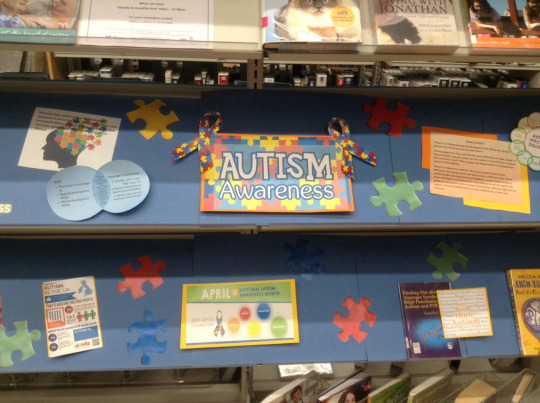
I’m at my local library and they’ve made a display for autism awareness month. This is a well meant effort, but…
As you can see, they’ve gone with the “autism speaks” motif. This is somewhat distressing for me, especially since I usually come here to de-stress. I’m going to write a letter for the library about why this is offensive to me as an autistic person, but I don’t want them to think it’s just me wigging out about it, so if you all would be so kind I’d appreciate it if you could reblog this post and add your own thoughts on autism speaks and the symbols of their organisation. I’m going to print off as many responses as I can and hand them over to the library along with the letter.
Thanks so much for your time, and I hope you all have a good autism awareness month
QUICK ADDITION TO THE POST
If you want to add your comments but feel uncomfortable posting them publicly, please please feel free to message them on anon. You should not be silenced because you are shy or self conscious. I will absolutely add every anonymous comment to the letter
Hey, thought I’d give an update for those of you wondering how this shook out. After the library didn’t contact me for a few days I decided to head down there to see what was going on and:
they’ve changed the display! I have to say, I wasn’t sure what the expect. I thought if they did anything it would just to be to change the colour and hopefully the puzzle pieces, but they actually changed the books and info that they have on there too, Including:
A notice explicitly debunking autism as an illness, and advocating how autism is different for everyone and always requires individual support
Books written by autistic people
Books about helping your kids with the challenges they might face, rather than guides for coping with having an autistic child
Even THIS book
Which I thought had a very suspect title turned out to have this passage inside:
You can even see that they’ve decided to promote the NAS, a society dedicated to helping autistic people live the lives of their choosing.
I’m very happy with the changes that have been made here. And I think it’s a good reminder that just because someone gets something wrong, doesn’t mean that they’re bad people. The important thing is being willing to listen and learn, and the staff at this library have done just that.
This feels to me like a good way to start autistic pride month. And remember, if you want to support people with autism this season – or throughout the rest of the year – be sure that you are speaking with us, not for us or over us.
This is so wonderful!! There’s a lot of good info there and I’m sure it’ll help a lot of people learn more about what autism really is.
I think you and the community have really made a positive difference here ❤
I’m literally crying this makes me so happy! This is amazing!
Im happy-crying too! bless you and that library!
[Image 1: A library display primarily using blue and puzzle piece motives.
Image 2: A library display with a red sign saying: “Autism Awareness Month”. The shelves are mint-coloured. There are no more puzzle pieces.
Image 3: A note reading:
“What is Autism?
Autism is a lifelong developmental disability that affects how people see the world and interact with others.
Autistic people see, hear and feel the world differently than other people. If you are autistic, you are autistic for life; autism is not an illness or a disease and cannot be ‘cured’. Often people feel being autistic is a fundamental aspect of their identity.
Autism is a spectrum disorder. All autistic people share certain difficulties, but being autistic will affect them in different ways. Some autistic people also have learning disabilities, mental health issues or other conditions, meaning people need different levels of support. All people on the autism spectrum learn and develop. With the right sort of support, all can be helped to live a more fulfilling life of their choosing.”
Image 4: A book titled “The reason I jump” by Naoki Higashida.
Image 5: A book titled “I’m not naughty – I’m autistic: Jodi’s journey” by Jean Shaw.
Image 6: A book titled “Sleep well on the autism spectrum” by Kenneth J. Aikten.
Image 7: A book titled: “Girls on the autism spectrum: overcoming the challenges and celebrating the gifts”.
Image 8: A book titled: “My child has autism, now what? 10 steps to get you started”.
Image 9: A page of the above book reading:
“Rules of thumb to live by
I know there is a lot to learn, but here are a few rules of thumb to guide you:
1. If something doesn’t work, try something else.
2. The only expert in autism is a person with autism.
3. Every child with autism is different – what works for one may not work for another.
4. You may not know autism, but you know your child and that is enough.”]
It can be difficult when you’re disabled to consciously prioritise yourself.
To admit that you’re having a bad day and that you need to step away from everything that isn’t essential to your day-to-day survival.
Often, your subconscious can handle rationalising why you’re pushing off tasks.
The world won’t end if you live off Pot Noodle for a few days or the kitchen isn’t clean or you don’t shower over the weekend.
But right this second, in this political climate, it’s very easy to feel as if the world might end if you’re not marching or phoning people or engaging with incredibly heavy subject-matter constantly.
And everyone always tacks on “if you’re able”.
“Everyone should be doing this! But, like, I mean those who are able. Don’t feel bad if you can’t. But also, here’s a list of ways to engage with it anyway if it’s difficult for you. No pressure, but this person did it and they hate phone calls!”
But what about those of us who are nebulously able?
Who could maybe push ourselves, but at the expense of the essential day-to-day stuff, like our jobs or studies or basic self-care?
So here’s a reminder to everyone who is nebulously able: doing shit like this is for good days.
And it’s not even the first thing to do on a good day because you have to put the hoarding for bad days first.
Wait for a good day.
Make sure you’ve caught up on basics like shopping and cleaning and all of those things that shouldn’t have gotten so far down your list.
Make sure that engaging with these kinds of topics isn’t going to drain you of spoons that you need for the near future.


 knitting in the dark