stolligaseptember:

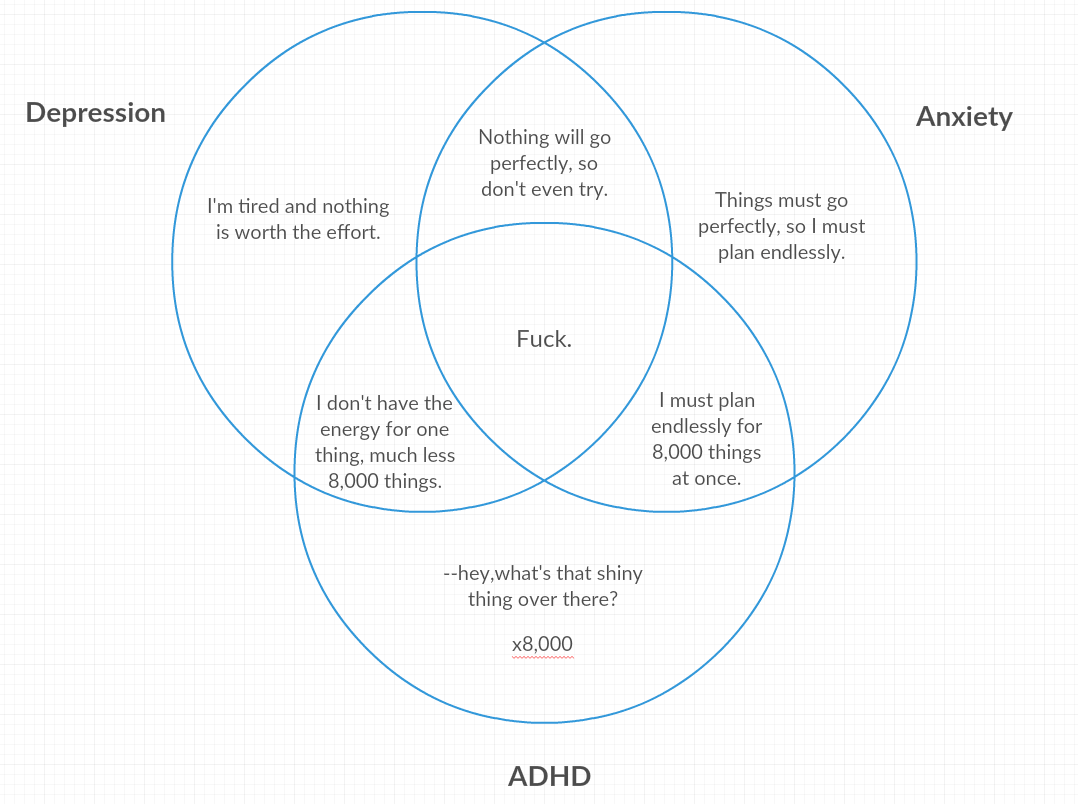
do you ever tire of how, like, dramatic anxiety is?? it’s like. bitch. bitch. it’s not that serious. we’ll live. it’ll probably be a pain in the ass, but we’ll live. so stop making me feel like i’m actively dying.

I have been saying for years that neurotypical people have NO IDEA HOW BORING anxiety and depression are. It’s not so much, ‘OMG, the world is ending, how will I cope????’ but ‘Seriously? Again? Bitch, I GOT SHIT TO DO. Outside. You know, the place I’m having a panic attack at thinking about going. FFS, GET IT TOGETHER.’

cricketcat9:

queenstravelingdarling:

colachampagnedad:

tkdontslay:

this-is-life-actually:

this is so great. fuck toxic masculinity. we need something like this stateside (x) | follow @this-is-life-actually

i love this so much

for all my quiet & reserved men going thru it i love u all

This!!!! Spread this message around. Crying is good!!!!

Crying is not female thing, crying is a human thing, and an animal thing, and, I dunno, maybe an alien thing too. Have a cry if you feel like it, dudes!

Tarot for Sad People

alethiomancer:

I get sad. There are other more clinical and specific names for how sad I get, but ultimately, I feel sad. Tarot is such an important part of my life that just like a best friend, I turn to it when I am sad.

This is the story of how I reach for tarot in my sadness. My hope is that it will illustrate the usefulness of tarot as a tool. Not just a tool, a friend.

I am offering Tarot for Sad People in my Etsy shop for $3. Despite the low price, I’m also giving it away for free. Right here.

Tarot for Sad People

I value the work I do – and writing something while sad is definitely work – and I want to make sure that everyone who might need this gets to see it. So please download this PDF. And if you’re able and feeling it, then you can buy it as well on Etsy, maybe even give it as a gift.

Much love,
xoxoxoxox
Alie

Tarot for Sad People

domesticwitch:

thewinterotter:

auspisstice:

auspisstice:

science side of tumblr why do all of us mentally ill ppl like storms so much

@revelationed said:
Rain/moving water has negative ions which cause a biochemical reaction that reduces stress. It’s the same reason people feel more at peace on beaches or by waterfalls. We spend most of our lives surrounded by positive ions created by electronics and recirculated air. A study by Columbia University showed that negative ions can have the same affect as antidepressants.

thank u science side of tumblr

ARE YOU SHITTING ME RIGHT NOW

All the more reason for me to start practicing weather magick. ☔⚡

This is all new to me! Thank you Tumblr.

clintscoffeepot:

clintscoffeepot:

“Depression turns you into a series of nouns, without the adjectives and without the verbs. You don’t remember where you misplaced your descriptions, your actions … You become: bed, shower, socks, coffee, keys, obligations.”— A Series of Nouns

Real talk, I know a lot of you followed me for this post and I gotta say that I’m so grateful because through this one little post I’ve managed to meet so many people that struggle with depression like I do, so many supportive, loving people and I guess I just wanted to say thank you.

I made this post—just kind of threw it together, really— right after getting out of a particularly difficult therapy session. The Hawkeye comics have gotten me through a lot of dark times and I feel such a connection with Clint. I’m just grateful that you were able to feel the same, and I’m sorry for why you were able to feel it, because that means you’ve been through this to some extent and that sucks. It really does.

I guess the other thing I really wanted to say was that the adjectives and verbs come back, I promise you they do. Take those nouns and own them for now, because before you know it, you become “hell yeah imma go to bed because i can”, and "a shower will make me feel better” and “these are my favorite socks”, and “fuck yeah i love coffee”, and “where the hell are my keys?” and those obligations? They’re always gonna be there but sometimes they’re not as bad as you’d think, sometimes they actually are fucking amazing.

You, me, and Clint, we’ll all get better together. So don’t think those words are gone forever, you’re more than just a series of nouns.

iamshadow21:

cameoamalthea:

greenjudy:

pyrrhicgoddess:

thgchoir:

no offense but this is literally the most neurotypical thing i have ever seen

Uhhhh… no.
This is what they teach you in therapy to deal with BPD and general depression.
When I got out of the hospital after hurting myself a second time, I got put into intensive outpatient program for people being released from mental hospitals as a way to monitor and help transition them into getting them efficient long-term care.
This is something they stressed, especially for people with general depression. When you want to stay at home and hide in your bed, forcing yourself to do the opposite is what is helpful. For me, who struggles with self harm- “I want to really slice my arm up. The opposite would be to put lotion on my skin (or whatever would be better, like drawing on my skin) the opposite is the better decision.” It doesn’t always work because of course mental health isn’t that easy, but this is part of what’s called mindfulness (they say this all the time in therapy)

Being mindful of these is what puts you on the path to recovery. If you’re mindful, you are able to live in that moment and try your best to remember these better options.

I swear to god, I don’t get why some people on this website straight up reject good recovery help like this because either they a)have never been in therapy so don’t understand in context how to use these coping tactics. Or b)want to insist that all therapists and psych doctors are neurotypical and have zero idea what they are talking about. (Just so ya know, they teach this in DBT, the therapy used to help BPD. The psychologist who came up with DBT actually had BPD, so….a neurotypical women didn’t come up with this.)

I have clinical OCD and for me, exposure therapy–a version of “do the opposite”–has been fundamental. I’ve had huge improvement in the last year, but I’m 100% clear that if I hadn’t done my best to follow this protocol I’d be fucked. I have a lot of empathy for that moment when you’re just too tired to fight and you check the stove or you wash your hands or go back to the office at midnight to make sure the door is locked. But the kind of therapeutic approach outlined above has been crucial for me. 

It’s hard to do. I’ve weathered panic attacks trying to follow this protocol. But I’ve gotten remarkable results. I was afraid to touch the surfaces in my house, okay? I was afraid to touch my own feet, afraid to touch my parrot–deliberately exposing myself to “contamination” has helped me heal. I can’t speak for people with other issues, but this has helped my anxiety and OCD. 

I feel that tumblr, in an effort to be accepting of mental illness, has become anti-recovery. Having a mental illness does not make you a bad person. There is nothing morally wrong with having a mental illness anymore than more than there’s something morally wrong with having the flu. However, if you’re “ill” physically or mentally, something is wrong in the sense that you are unwell and to alleviate that you should try to get better. While there is not “cure” for mental illness, there are ways to get better.

There was a post on tumblr where someone with ADHD posted about how much you can get done when you focus and was attacked for posting about being “nuerotypical” – when she was posting about the relief she got from being on an medication to treat her illness. 

I saw another post going around tumblr that said something along the line of “you control your thoughts, why not choose to have happy thoughts” which again was shot down as “nuerotypical” but while you don’t have control over what thoughts come into your mind, you absolutely can and should choose to have happy thoughts. In DBT we call this “positive self talk”.

I’m in DBT to help treat PTSD stemming from child abuse. The abuse and abandonment I experienced destroyed my self esteem and created a lot of anxiety over upsetting other people. DBT has taught me to recognize when my thoughts are distorting realty ‘no one likes you’ and answer back ‘plenty of people like you, you don’t need everyone to like you, especially if the relationship doesn’t make you happy’, to respond to the thought ‘I’m so worthless’ with ‘you’re really great and have accomplished something’ 

And it’s not easy to challenge your thoughts, it’s a skill that’s learned and it’s hard to force yourself to think something that doesn’t seem authentic or even seems wrong to think – it’s hard to be encouraging towards yourself when you hate yourself – but you force yourself to be aware of your thoughts and push back when you fall into unhealthy patterns 

That isn’t “so neurotypical” that’s recovery. 

Not shaming mental illness doesn’t mean shaming RECOVERY.

Pro-Recovery isn’t anti-disability. 

Do not shame healthy behaviors as “neurotypical”.

Learning healthy behaviors and taking steps to treat mental illness and disorders including taking medication if that’s what works for you is important. You shouldn’t be ashamed if you have mental illness, but you shouldn’t say ‘well I’m not neurotypical therefor I can’t do anything to get better’ – while there is no cure for mental illness, there is a lot you can do to get better, to function better, to manage your mental illness and be safer, happier, and healthier for it. 

I’m sort of on the fence here, because sure, there are things I can do as someone with depression/anxiety/PTSD to get myself out of negative patterns of behaviour and thought. These things are hard, almost always harder than just defaulting to how I feel and think without challenging them, but that doesn’t mean I shouldn’t try.

BUT.

I am also an autistic person who probably also has inattentive type ADHD, and ignoring my body and mind telling me “okay, I need to leave now, I need to shut down for a while, I need to recharge, I need to get out of this environment” and pushing into areas of sensory and social discomfort CONSTANTLY is a great way for me to end up in meltdown, shutdown, and maybe even end up with a “hangover” for days where all I can do is sleep and watch TV. I was constantly told, as an undiagnosed autistic person, that these sensory and social limits didn’t exist, that “everyone else” was just fine, so these messages were fake and that I was just “shy” and “high strung” and needed to push myself. Scared in social situations? Do public speaking! and so on, and so forth. Neurotypical standards of what was resonable to “push through” resulted in periods of being housebound, temporarily nonverbal, and so anxious and depressed I couldn’t do anything. It absolutely tanked my self-worth. It made me disregard these warning signals my autistic brain gave me that could have helped me avoid burnout. Learning how to notice and respect these warning signals has been an incredibly difficult process, because ignoring them was reinforced so often, for the first twenty-five years of my life.

So, lists like this have their place, but for neurodiverse people, they are only useful if they have the self-knowledge about what is useful and what is going to be harmful. This is something I didn’t have until very recently, and something I still struggle with. It’s lists and advice like this that made me continuously force myself into situations that harmed me, and made me ruthlessly repress stimming and selfcare that may have helped me. Those stimming and selfcare behaviours didn’t conform with the list/advice, you see. They were particular to my neurotype, and were things I had to discover/rediscover for myself, because no professional or well-meaning non-professional ever knew they were needed, BECAUSE NONE OF THEM WERE MY NEUROTYPE.

So, yes, challenge negative behaviour and thought patterns.

And yes, it’s the most neurotypical thing I’ve ever seen.

Listen to your body and your mind and take care of your SELF. Because there is no ‘one size fits all’ for mental health.


Also, I have Feelings about ‘forgiveness’ being the advised ‘good’ thing for betrayal. This anchors in heavily with the way people treat victims/survivors of abuse.

You don’t get to decide that someone else who’s been abused in any way should ‘forgive’.

You never have to ‘be the better person’ and forgive those who hurt you.

You never have to listen to those who tell you if you don’t forgive your abuser, you’ll be living with that abuse for the rest of your life.

You never have to look at your abuse and say, “Actually, I feel okay with my past and what you did to me and have love and acceptance in my heart for it all, and forgive what you did.”

It is absolutely fine for you to live your life without forgiving.

But gosh, you think, won’t it make me a toxic, bitter ball of hatred, unable to process trauma and move on? That’s what all those well-meaning people tell me.

No.

Actually, what happens is you work out that your abuser is irrelevant. Gradually, you won’t think about them every minute, or every hour, or every day. Eventually, you’ll go longer and longer, until you barely think of them at all, and your life will be as full as anyone else’s of things that are not the abuse or abuser.

That’s where I’m at. And I never had to forgive my abuser to get there.

cameoamalthea:

greenjudy:

pyrrhicgoddess:

thgchoir:

no offense but this is literally the most neurotypical thing i have ever seen

Uhhhh… no.
This is what they teach you in therapy to deal with BPD and general depression.
When I got out of the hospital after hurting myself a second time, I got put into intensive outpatient program for people being released from mental hospitals as a way to monitor and help transition them into getting them efficient long-term care.
This is something they stressed, especially for people with general depression. When you want to stay at home and hide in your bed, forcing yourself to do the opposite is what is helpful. For me, who struggles with self harm- “I want to really slice my arm up. The opposite would be to put lotion on my skin (or whatever would be better, like drawing on my skin) the opposite is the better decision.” It doesn’t always work because of course mental health isn’t that easy, but this is part of what’s called mindfulness (they say this all the time in therapy)

Being mindful of these is what puts you on the path to recovery. If you’re mindful, you are able to live in that moment and try your best to remember these better options.

I swear to god, I don’t get why some people on this website straight up reject good recovery help like this because either they a)have never been in therapy so don’t understand in context how to use these coping tactics. Or b)want to insist that all therapists and psych doctors are neurotypical and have zero idea what they are talking about. (Just so ya know, they teach this in DBT, the therapy used to help BPD. The psychologist who came up with DBT actually had BPD, so….a neurotypical women didn’t come up with this.)

I have clinical OCD and for me, exposure therapy–a version of “do the opposite”–has been fundamental. I’ve had huge improvement in the last year, but I’m 100% clear that if I hadn’t done my best to follow this protocol I’d be fucked. I have a lot of empathy for that moment when you’re just too tired to fight and you check the stove or you wash your hands or go back to the office at midnight to make sure the door is locked. But the kind of therapeutic approach outlined above has been crucial for me. 

It’s hard to do. I’ve weathered panic attacks trying to follow this protocol. But I’ve gotten remarkable results. I was afraid to touch the surfaces in my house, okay? I was afraid to touch my own feet, afraid to touch my parrot–deliberately exposing myself to “contamination” has helped me heal. I can’t speak for people with other issues, but this has helped my anxiety and OCD. 

I feel that tumblr, in an effort to be accepting of mental illness, has become anti-recovery. Having a mental illness does not make you a bad person. There is nothing morally wrong with having a mental illness anymore than more than there’s something morally wrong with having the flu. However, if you’re “ill” physically or mentally, something is wrong in the sense that you are unwell and to alleviate that you should try to get better. While there is not “cure” for mental illness, there are ways to get better.

There was a post on tumblr where someone with ADHD posted about how much you can get done when you focus and was attacked for posting about being “nuerotypical” – when she was posting about the relief she got from being on an medication to treat her illness. 

I saw another post going around tumblr that said something along the line of “you control your thoughts, why not choose to have happy thoughts” which again was shot down as “nuerotypical” but while you don’t have control over what thoughts come into your mind, you absolutely can and should choose to have happy thoughts. In DBT we call this “positive self talk”.

I’m in DBT to help treat PTSD stemming from child abuse. The abuse and abandonment I experienced destroyed my self esteem and created a lot of anxiety over upsetting other people. DBT has taught me to recognize when my thoughts are distorting realty ‘no one likes you’ and answer back ‘plenty of people like you, you don’t need everyone to like you, especially if the relationship doesn’t make you happy’, to respond to the thought ‘I’m so worthless’ with ‘you’re really great and have accomplished something’ 

And it’s not easy to challenge your thoughts, it’s a skill that’s learned and it’s hard to force yourself to think something that doesn’t seem authentic or even seems wrong to think – it’s hard to be encouraging towards yourself when you hate yourself – but you force yourself to be aware of your thoughts and push back when you fall into unhealthy patterns 

That isn’t “so neurotypical” that’s recovery. 

Not shaming mental illness doesn’t mean shaming RECOVERY.

Pro-Recovery isn’t anti-disability. 

Do not shame healthy behaviors as “neurotypical”.

Learning healthy behaviors and taking steps to treat mental illness and disorders including taking medication if that’s what works for you is important. You shouldn’t be ashamed if you have mental illness, but you shouldn’t say ‘well I’m not neurotypical therefor I can’t do anything to get better’ – while there is no cure for mental illness, there is a lot you can do to get better, to function better, to manage your mental illness and be safer, happier, and healthier for it. 

I’m sort of on the fence here, because sure, there are things I can do as someone with depression/anxiety/PTSD to get myself out of negative patterns of behaviour and thought. These things are hard, almost always harder than just defaulting to how I feel and think without challenging them, but that doesn’t mean I shouldn’t try.

BUT.

I am also an autistic person who probably also has inattentive type ADHD, and ignoring my body and mind telling me “okay, I need to leave now, I need to shut down for a while, I need to recharge, I need to get out of this environment” and pushing into areas of sensory and social discomfort CONSTANTLY is a great way for me to end up in meltdown, shutdown, and maybe even end up with a “hangover” for days where all I can do is sleep and watch TV. I was constantly told, as an undiagnosed autistic person, that these sensory and social limits didn’t exist, that “everyone else” was just fine, so these messages were fake and that I was just “shy” and “high strung” and needed to push myself. Scared in social situations? Do public speaking! and so on, and so forth. Neurotypical standards of what was resonable to “push through” resulted in periods of being housebound, temporarily nonverbal, and so anxious and depressed I couldn’t do anything. It absolutely tanked my self-worth. It made me disregard these warning signals my autistic brain gave me that could have helped me avoid burnout. Learning how to notice and respect these warning signals has been an incredibly difficult process, because ignoring them was reinforced so often, for the first twenty-five years of my life.

So, lists like this have their place, but for neurodiverse people, they are only useful if they have the self-knowledge about what is useful and what is going to be harmful. This is something I didn’t have until very recently, and something I still struggle with. It’s lists and advice like this that made me continuously force myself into situations that harmed me, and made me ruthlessly repress stimming and selfcare that may have helped me. Those stimming and selfcare behaviours didn’t conform with the list/advice, you see. They were particular to my neurotype, and were things I had to discover/rediscover for myself, because no professional or well-meaning non-professional ever knew they were needed, BECAUSE NONE OF THEM WERE MY NEUROTYPE.

So, yes, challenge negative behaviour and thought patterns.

And yes, it’s the most neurotypical thing I’ve ever seen.

Listen to your body and your mind and take care of your SELF. Because there is no ‘one size fits all’ for mental health.

beepboopbipolar:

Sometimes being chronically and mentally ill is like having a newborn baby that can’t tell you what’s wrong, you know you feel horrible and you can’t lie down and you can’t sit up but you don’t know why. You go down the list- are you hungry? thirsty? sleepy? too hot? depressed? just lazy? a terrible person? And then it dawns on you- you’re in horrible pain, all over. And it’s always been there in the background, it’s just worse right now than usual, for no apparent reason. And there’s nothing you can do about it.