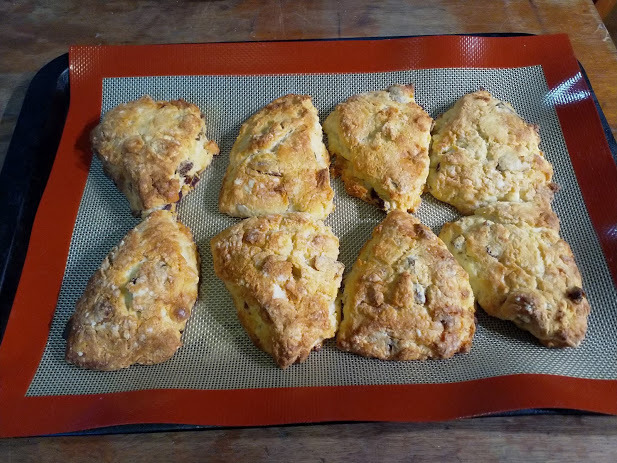
Before, it was spite box cake. (Which was understandably underwhelming.)

Now, behold, It’ll-Do 3AM Scones!

I have never made gluten free scones before. I only vaguely followed the recipe, and I changed up the flavours. Still, turned out pretty great!

The original recipe is here

I replaced the pomegranate with chopped dried apricots. For the greek yoghurt, I dumped in a tub of strawberry Chobani without measuring and hoped it would do the job. (Given my baking powder is super old and there’s only one egg in this recipe, it definitely worked.) The chocolate was ¾ of a 180g block of Milky Bar, but it was sweet enough to not need more. Also, I had just under 100g of a block of butter left, and decided ‘it’ll do!’ because I couldn’t be bothered opening a new block. (It did.) They’re in American-style wedges rather than British/Australian style rounds, because finding my cutters at 3am was, like, nah, when I could just cut the dough into slices with a regular knife.

So, basically, after Emma has been gluten free for fourteen years, I broke my block to do with trying to make scones because it was late, I had a craving, and I decided that because I was fudging half the recipe, if it didn’t work, it didn’t matter. And they’re pretty great. The texture is cakey, but that’s normal for GF without added xanthan gum, and they’re sweet, soft inside, and have a nice crust. I didn’t even bother to egg wash them despite it suggesting to, and look at that colour! The balance of flavours is nice – the chocolate melted in, so there’s no chunks of that, but every now and then you get a surprise pocket of the flavour of it. The strawberry puree from the Chobani is a mild fruity note in the background, and the apricots are tart and add texture. I think the yoghurt has a lot to do with the nice softness inside. I’ve used sour cream in a number of recipes in the past, and it really makes a nice bake.

In the future, I might add another sharp note, because they are very sweet. A citrus glaze, or maybe zest in the mix. It could be more balanced, but it is certainly not going to be a chore to eat through this first batch.

ETA: I did cook mine for five minutes longer than the recipe time (20mins) but my oven is slow, so I expected to have to do that. If your oven is pretty accurate, you probably won’t need to.

The Language of Gluten

(Or, what Do those Words Mean?)

Gluten Free

This is meant to mean absolutely no gluten. It’s been made in a gluten free environment, and tests have proven that there is no detectable gluten in the product. However, a lot of places don’t understand that. You’re generally safe with packaged goods – factories have to pass rigorous tests to be allowed to print it on their packaging – but I’d view that unwrapped pastry in a case with gluten pastries in that cafe with a suspicious eye.

Low Gluten

We’ve done our best, but we can’t guarantee it’s gluten free. We have a kitchen and equipment that is used for both gluten and non gluten products. Also, it may contain a low gluten wheat variant like spelt, which may be fine for the fad dieter, but for the person with a diagnosed allergy or intolerance, is very bad. Ask a lot of questions about the processes involved, and if the people behind the counter seem vague, uninformed or confused about gluten or their handling procedures, avoid.

Gluten Friendly

We’ve produced a product that has no actual gluten ingredients (maybe), but we’re not sure traces of other things haven’t crept in. This is a wishy washy label that’s becoming more common. It’s good for people avoiding grains for diet or fad, but very ambiguous for those looking out for allergens. Because it’s a wishy washy term, uneducated staff may even think it’s gluten free becaue it contains no wheat flour, but might be unsure about ancient or different variants of wheat like spelt or cous cous. May not know about the problems with Oats, Rye and Barley, or with condiments that contain gluten (such as soy sauce or malt vinegar) at all. If they can’t satisfy your questioning, avoid.

May Contain Traces of Gluten

We have a shared facility or kitchen. We wash and/or sterilise it between batches of things, but we can’t 100% guarantee there’s nothing there. We do probably spot test our product and regularly return nil detected results, but we want you to know it’s a possibility. A lot of Coeliacs take a risk and eat ‘May Contain Traces’ food. It’s a gamble, but prepackaged food like crisps are pretty safe because the factory must adhere to food safety guidelines. If they didn’t, then they’d have to recall an entire product rather than just a batch when there was a contamination issue. May contain traces in a restaurant and cafe setting is more of a gamble. Treat it like you’d treat low gluten – ask and decide if it’s worth the risk.

Is there a particular GF bread recipe that you like best or would recommend? *curious* Thanks! :)

The recipe I’ve made most is found in Gluten Free Makeovers and is Beth and Jen’s High Fiber Bread, though I substitute three of the flours because some are hard to come by. Millet and Montina I sub for buckwheat and quinoa, and lupin flour for the teff. (Lupin is a bean flour, but be careful – it can cause a reaction in people with a peanut allergy.) I don’t know if the recipe’s on Beth’s blog or if it’s a book-only recipe. I’ve attempted a fair few of the bread recipes in the book, and they’ve turned out pretty well, even with substitutions. That recipe is the one I go back to, though. I often fill it full of seeds, too – poppy, sesame, linseed and sunflower are favourite additions. I often brush the top with sesame oil, too, because I love the flavour and it gives a great crust.

If you’re interested in getting into baking, I’ll tell you this – with most GF bread doughs, you cannot knead them. You need a good stand mixer with a dough hook. If you try to knead by hand, you’ll just get it everywhere and end up with no bread. Use the machine. Also, I don’t know how most bread baking machines go with GF dough. The one bread machine I tried to use kept erroring out, even though we were using the GF recipe from its own manual. Use the oven.