Someone disagreeable is trying to persuade you to take a trip to Bath.
Your father is absolutely terrible with money. No one has ever told him this.
All of your dresses look like nightgowns.
Someone disagreeable tries to persuade you to join a game of cards.
A woman who hates you is playing the pianoforte.
A picnic has gone horribly wrong.
A member of the armed forces has revealed himself to be morally deficient.
You once took a walk with a cad.
Everyone in the neighborhood, including your mother, has ranked you and your sisters in order of hotness. You know exactly where you fall on the list.
You say something arch yet generous about another woman both younger and richer than you.
You have one friend; he is thirty years old and does business with your father and you are going to marry him someday.
You attempt to befriend someone slightly above or slightly below your social station and are soundly punished for it.
A girl you have only just met tells you a secret, and you despise her for it.
You have five hundred a year. From who? Five hundred what? No one knows. No one cares. You have it. It’s yours. Every year. All five hundred of it.
There are three men in your life: one true love, one tempting but rakish acquaintance, and a third distant possibility — he is courteous and attentive but only slightly interested in you. He is almost certainly the cousin or good friend of your true love, and nothing will ever happen between you two.
A woman who is not your mother treats you like her own daughter. Your actual mother is dead or ridiculous.
You develop a resentment at a public dance.
Someone you know has fallen ill. Not melodramatically ill, just interestingly so.
A man proposes to you, then to another, lesser woman when you politely spurn him. This delights you to no end.
A charming man attempts to flirt with you. This is terrible.
You have become exceedingly ashamed of what your conduct has been.
A shocking marriage of convenience takes place within your social circle two-thirds of the way in.
A woman in an absurd hat is being an absolute bitch to you; there is nothing you can do about it.
You are in a garden, and you are astonished.
(x)
You have five hundred a year. From who? Five hundred what? No one knows. No one cares. You have it. It’s yours. Every year. All five hundred of it.
I lost it with that one. Lost it bad.
I always feel awkward because I actually know what “five hundred a year” means.
Oh, I know it too. But I will admit that I had no idea what it was when I started reading JA books and it’s funny how no one ever, EVER explains it in the books, movies, fanfiction, etc. To a young reader 500 a year could really be anything.
I started cracking up at “a picnic has gone horribly wrong.”
“A woman who hates you is playing the pianoforte.”
I can’t breathe. This list is perfect.
“A charming man attempts to flirt with you. This is terrible.”
I’m dead, bye.
A woman in an absurd hat is being an absolute bitch to you; there is nothing you can do about it.
Be warned: this may also indicate that you are in the American South and you are in a church.
I am almost 30 years old and I STILL don’t know what the 500 a year is or where it’s coming from or why.
Tag: books
it’s all gonna be okay, buck
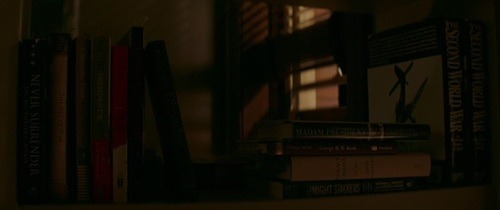
From the Bookshelf of Steve Rogers
On Steve’s Bookshelf (from left to right):
Never Surrender: A Soldier’s Journey to the Crossroads of Faith and Freedom (2008) by Lieutenant General William G. Boykin, a Conservative Christian activist later reprimanded by the Army for the disclosure of classified information and tactics.
The Art of War attributed to Sun Tzu: ancient Chinese military treatise.
A Moveable Feast (1964) by Ernest Hemingway: a memoir of Hemingway’s time in Paris during the 1920s.
All The President’s Men (1974) by Carl Bernstein and Bob Woodward: the investigation of the Watergate Scandal which led to the resignation of President Richard Nixon. Fun Fact: Robert Redford starred in the 1976 film adaptation of the same name.
[Unknown/illegible titles]
Dispatches by Michael Herr (1977): a memoir of the journalist’s experiences during the Vietnam War.
Madam President: Shattering the Last Glass Ceiling (2000) by Eleanor Clift and Tom Brazaitis: a history of women in politics, leading up to Hilary Clinton in the 2008 Presidential Election.
George H.W. Bush by Timothy Naftali (2003): a biography of President George H.W. Bush.
Barack Obama: The Story by David Maraniss (2012): a biography of President Barack Obama.
The Night Stalkers: Top Secret Missions of the US Army’s Special Operations Aviation Regiment (2008) by Michael J. Durant , Steven Hartov, and Lieutenant Colonel Robert L. Johnson: a history of the Army Special Operations Aviation Unit, which delivers Special Forces troops (typically) by night.
The Second World War: An Illustrated History of WWII by Sir John Hammerton, editor (1999-2000): A ten-volume series on the history of WWII.
So long as I confine my activities to social service and the blind, they compliment me extravagantly, calling me ‘arch priestess of the sightless,’ ‘wonder woman,’ and a ‘modern miracle.’ But when it comes to a discussion of poverty, and I maintain that it is the result of wrong economics—that the industrial system under which we live is at the root of much of the physical deafness and blindness in the world—that is a different matter! It is laudable to give aid to the handicapped. Superficial charities make smooth the way of the prosperous; but to advocate that all human beings should have leisure and comfort, the decencies and refinements of life, is a Utopian dream, and one who seriously contemplates its realization indeed must be deaf, dumb, and blind.
Helen Keller (letter to Senator Robert La Follette, 1924)
funny how the most popular narrative about helen keller is a harmless little girl who learns to communicate and then the story ends for some reason gee i wonder why that is
(via callmeoutis)
Gee. Why does the popular narrative end before she became a communist? So strange! And the Martin Luther King Jr. narrative does the same thing! What a coincidence!
(via malachite-in-corvidae)
Also, that the narrative is generally about the abled teacher helping her and how amazing she was to be able to do it. As the wikipedia article frames it: “The story of how Keller’s teacher, Anne Sullivan, broke through the isolation imposed by a near complete lack of language, allowing the girl to blossom as she learned to communicate, has become widely known through the dramatic depictions of the play and film The Miracle Worker.” So even the story about Helen Keller is often not really about her.
(via ami-angelwings)
Helen Keller is a glaring example of it, but history’s dominant narratives are full of women whose stories are depoliticised and infantilised in order to make them more “inspirational”.
A current example: when Malala Yousafzai is the brave little girl who just wanted to learn, she’s the world’s darling, but when she tells Obama that drone strikes are driving terrorism the cameras all turn off.
(via sharpestrose)
I believe that this BS would fall under “inspiration porn”, too.
I got her first book at a thrift store for 95 cents and figured “Hey, it’s short. I can read that.” because I read a few books about her in school, you know? Seemed sensible to read her own words.
Then I find out she was a communist!? 😀 😀 😀 😀 😀 She got more awesome by an order of magnitude.
(via jabberwockypie)
Helen Keller is AMAZING. She was one of the first people who really campaigned for sexual health, because one of the leading causes of blindness in her era was caused by infant exposure to an STI during vaginal birth. The blindness was easily and cheaply preventable by putting a solution in the newborn’s eyes, but this was rarely done because the stigma around sex and STIs was so pronounced. Helen started publicly pushing for every infant to get this treatment when she was still a child, fundraising and educating people and saving the sight of many, many people.
I think everyone who has an interest in Helen and her teacher Annie Sullivan should read Helen and Teacher. It’s an absolute brick of a book, but it’s incredibly interesting and an intricately detailed biography of Helen from birth to death, not just during the childhood years publicised and sanitised for the public’s palette. Read my review on GoodReads here.
UNUSUAL HOARD commission for fatetea, this dragon looks like someone id wanna hang out with
When I say I want to read the book before seeing the movie, I don’t want brownie points or bragging rights. I want to be able to read the book with my imagined world and idea of the characters without the movie’s influence at least once. After you see the movie there’s always some part of it that sticks in your head for a long time and you lose the enjoyment of making it up yourself.
thank you so much for putting it into words
That is is precisely, thank you.
THIS IS WHAT ANARCHY LOOKS LIKE.
Hope for the future.
This kid is incredible.
THIS POST IS BACK ON MY DASH AND I WILL NEVER NOT REBLOG ANARCHIST LIBRARIAN KID.

There are only two rules in Avengers Tower that every Avenger follows:
- Do not fuck with Natasha while she is reading.
- Do not tell Natasha that her feet are cute. She can kill you with them.
Limited color palette #7 for the incomparable rngrn.
 knitting in the dark