Hopefully this works, I’ve never tried to share a google drive link before so I’m not sure if I did it right. Anyway if you weren’t aware since the start of January I have been working on a magazine for my senior project that is meant for autistic people and by autistic people. I have received a lot of contributions from other autistic people on my blog in the form of submissions to sections like the positivity section for example, art for the art section, and articles. Most of the magazine was done via submissions from other autistic people. Except for the school advice section which I wrote based on my own experience, and the autistic celebrity and autistic character sections which I wrote myself after doing research. Last week I turned it in at the end of my final class (and I got an A on the magazine by the way 😊).
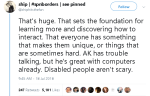
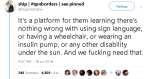
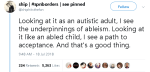
I didn’t mean to code Olivia as autistic, no: Olivia is autistic, full stop. She says as much a little later in the book, when she’s talking about her relationship with her parents (mostly her father) and some assumptions they made about her future before she was old enough to shut that shit down.
This was so important to me reading this book. As someone with Asperger’s, it happens so often that a character is speculated within a book/show/movie to be on the spectrum but the character denies it/other characters deny it/or later the writers/actors deny it. And it hurts. Like when people speculated Cumberbatch’s Sherlock was on the spectrum and Benedict said no, because he’s met people with autism and they can’t hope to be that advanced. Or how Will Graham literally says on the NBC show Hannibal that he is on the spectrum but actors/writers later say he isn’t and other characters say he isn’t because he has empathy, playing into the myth that people on the spectrum lack empathy. It hurts to think you have representation and then have that jerked violently out of your hands with the erroneous claim ‘people on the spectrum can’t do this/be like this.’
having a character explicitly and uncontestedly being on the spectrum was so important to me.
That is honestly why I try not to code people unless they’re at a place where diagnosis is not available to them, and then to be upfront about their neurological state when asked. (Example: Jack Wolcott, from the Wayward Children series, has the same kind of OCD I do. But she’s never been diagnosed. She was too young when she left for the Moors, and when she got back, she had better things to worry about. So she’s technically coded OCD rather than explicitly OCD, but I talk a lot about translating my own experiences onto her.)
Olivia is autistic. Everything about her was written with that in mind, including the fact that she’s a very successful media personality who dresses as Emma Frost for conventions, and these are absolutely 100% things that autistic people can do, because I have met real, live, non-fictional autistic people who do them.
I didn’t mean to code Olivia as autistic, no: Olivia is autistic, full stop. She says as much a little later in the book, when she’s talking about her relationship with her parents (mostly her father) and some assumptions they made about her future before she was old enough to shut that shit down.
Excuse my ignorance – what’s the difference between somebody being “coded” and actually being it? I was under the apparently erroneous impression that they were basically the same thing, only coded being used exclusively for fictional characters showing real life disorders/sexualities/whatever.
Frequently when a character is “coded” one way or another, it’s to get the schema of a group of people without actually having to commit to the realities of fictional diversity.
Example: Sheldon on The Big Bang Theory is coded autistic. He does things that are stereotypical “autistic behaviors,” as interpreted by the mainstream media; he talks in the “ha ha funny” way that is often used for neuroatypical characters.
But.
The creators will not say that Sheldon is autistic, because then the fact that much of the show’s humor (”humor”) is at his expense would be visibly and blatantly cruel. Look at us, mocking an autistic person for being themselves, aren’t we swell people ha ha ha oh wait. So they basically say “no, he could be just like everyone else, he could be ‘normal,’ so when everyone is awful to Sheldon, he’s bringing it on himself,” while still writing the character using a set of schema and narrative shorthands that makes it very, very clear that we’re supposed to laugh at people mocking an autistic man.
(Sheldon is also an asshole. You can be autistic and still be an asshole. But consider how hard it is to have conversations like “knowing what dinner will be at 9am is important for my mental health because I have food insecurity” if you’re not allowed to say the words “mental health” or “food insecurity.”)
I saw something earlier today that pointed out that mocking people for behaviors we code as autistic–special interests, stimming, etc.–is an asshole move whether they have a diagnosis or not, and that is absolutely true. But mocking the “weirdo” is still considered socially acceptable in so many circles, and that means that characters get coded as autistic, or OCD, or queer, or Jewish, and then never actually given that identity, all to make them “other.”
It’s the acceptable face of bigotry. It’s also why you have a lot of really intense same-gender relationships in mainsteam tv shows (Rizzoli & Isles, White Collar, etc.) that never turn romantic or sexual, because they want the numbers queer viewers bring, but they don’t want to lose conservative viewers. Before you think, ‘oh, but they’re just really good friends!’ remember that any relationship on tv betwen opposite-gender people is all about ‘will they/won’t they’ from day one (The X-Files, Castle, Bones, etc.) If you think this is an exaggeration, consider the amount of shit Elementary has gotten from trying to keep Sherlock/Joan platonic. It’s only okay to have queer-coded dynamics if you never intend to pay them off with actual representation. Some shows try to do this right, but are actively stopped by the network (Leverage) and others give representation, but then invoke the Bury Your Gays trope as the endgame (Buffy). Things are slowly improving. Both the Librarians and Brooklyn 99 have given us bi representation in the last year. But there’s a long way to go.


 knitting in the dark