Mary was a beautiful baby, sweet and affectionate, but by the time she’s three she’s turned difficult and strange, with fey moods and a stubborn mouth that screams and bites but never says mama. But her mother’s well-used to hard work with little thanks, and when the village gossips wag their tongues she just shrugs, and pulls her difficult child away from their precious, perfect blossoms, before the bites draw blood. Mary’s mother doesn’t drown her in a bucket of saltwater, and she doesn’t take up the silver knife the wife of the village priest leaves out for her one Sunday brunch.
She gives her daughter yarn, instead, and instead of a rowan stake through her inhuman heart she gives her a child’s first loom, oak and ash. She lets her vicious, uncooperative fairy daughter entertain herself with games of her own devising, in as much peace and comfort as either of them can manage.
Mary grows up strangely, as a strange child would, learning everything in all the wrong order, and biting a great deal more than she should. But she also learns to weave, and takes to it with a grand passion. Soon enough she knows more than her mother–which isn’t all that much–and is striking out into unknown territory, turning out odd new knots and weaves, patterns as complex as spiderwebs and spellrings.
“Aren’t you clever,” her mother says, of her work, and leaves her to her wool and flax and whatnot. Mary’s not biting anymore, and she smiles more than she frowns, and that’s about as much, her mother figures, as anyone should hope for from their child.
Mary still cries sometimes, when the other girls reject her for her strange graces, her odd slow way of talking, her restless reaching fluttering hands that have learned to spin but never to settle. The other girls call her freak, witchblood, hobgoblin.
“I don’t remember girls being quite so stupid when I was that age,” her mother says, brushing Mary’s hair smooth and steady like they’ve both learned to enjoy, smooth as a skein of silk. “Time was, you knew not to insult anyone you might need to flatter later. ‘Specially when you don’t know if they’re going to grow wings or horns or whatnot. Serve ‘em all right if you ever figure out curses.”
“I want to go back,” Mary says. “I want to go home, to where I came from, where there’s people like me. If I’m a fairy’s child I should be in fairyland, and no one would call me a freak.”
“Aye, well, I’d miss you though,” her mother says. “And I expect there’s stupid folk everywhere, even in fairyland. Cruel folk, too. You just have to make the best of things where you are, being my child instead.”
Mary learns to read well enough, in between the weaving, especially when her mother tracks down the traveling booktraders and comes home with slim, precious manuals on dyes and stains and mordants, on pigments and patterns, diagrams too arcane for her own eyes but which make her daughter’s eyes shine.
“We need an herb garden,” her daughter says, hands busy, flipping from page to page, pulling on her hair, twisting in her skirt, itching for a project. “Yarrow, and madder, and woad and weld…”
“Well, start digging,” her mother says. “Won’t do you a harm to get out of the house now’n then.”
Mary doesn’t like dirt but she’s learned determination well enough from her mother. She digs and digs, and plants what she’s given, and the first year doesn’t turn out so well but the second’s better, and by the third a cauldron’s always simmering something over the fire, and Mary’s taking in orders from girls five years older or more, turning out vivid bolts and spools and skeins of red and gold and blue, restless fingers dancing like they’ve summoned down the rainbow. Her mother figures she probably has.
“Just as well you never got the hang of curses,” she says, admiring her bright new skirts. “I like this sort of trick a lot better.”
Mary smiles, rocking back and forth on her heels, fingers already fluttering to find the next project.
She finally grows up tall and fair, if a bit stooped and squinty, and time and age seem to calm her unhappy mouth about as well as it does for human children. Word gets around she never lies or breaks a bargain, and if the first seems odd for a fairy’s child then the second one seems fit enough. The undyed stacks of taken orders grow taller, the dyed lots of filled orders grow brighter, the loom in the corner for Mary’s own creations grows stranger and more complex. Mary’s hands callus just like her mother’s, become as strong and tough and smooth as the oak and ash of her needles and frames, though they never fall still.
“Do you ever wonder what your real daughter would be like?” the priest’s wife asks, once.
Mary’s mother snorts. “She wouldn’t be worth a damn at weaving,” she says. “Lord knows I never was. No, I’ll keep what I’ve been given and thank the givers kindly. It was a fair enough trade for me. Good day, ma’am.”
Mary brings her mother sweet chamomile tea, that night, and a warm shawl in all the colors of a garden, and a hairbrush. In the morning, the priest’s son comes round, with payment for his mother’s pretty new dress and a shy smile just for Mary. He thinks her hair is nice, and her hands are even nicer, vibrant in their strength and skill and endless motion.
no offense but this is literally the most neurotypical thing i have ever seen
Uhhhh… no.
This is what they teach you in therapy to deal with BPD and general depression.
When I got out of the hospital after hurting myself a second time, I got put into intensive outpatient program for people being released from mental hospitals as a way to monitor and help transition them into getting them efficient long-term care.
This is something they stressed, especially for people with general depression. When you want to stay at home and hide in your bed, forcing yourself to do the opposite is what is helpful. For me, who struggles with self harm- “I want to really slice my arm up. The opposite would be to put lotion on my skin (or whatever would be better, like drawing on my skin) the opposite is the better decision.” It doesn’t always work because of course mental health isn’t that easy, but this is part of what’s called mindfulness (they say this all the time in therapy)
Being mindful of these is what puts you on the path to recovery. If you’re mindful, you are able to live in that moment and try your best to remember these better options.
I swear to god, I don’t get why some people on this website straight up reject good recovery help like this because either they a)have never been in therapy so don’t understand in context how to use these coping tactics. Or b)want to insist that all therapists and psych doctors are neurotypical and have zero idea what they are talking about. (Just so ya know, they teach this in DBT, the therapy used to help BPD. The psychologist who came up with DBT actually had BPD, so….a neurotypical women didn’t come up with this.)
I have clinical OCD and for me, exposure therapy–a version of “do the opposite”–has been fundamental. I’ve had huge improvement in the last year, but I’m 100% clear that if I hadn’t done my best to follow this protocol I’d be fucked. I have a lot of empathy for that moment when you’re just too tired to fight and you check the stove or you wash your hands or go back to the office at midnight to make sure the door is locked. But the kind of therapeutic approach outlined above has been crucial for me.
It’s hard to do. I’ve weathered panic attacks trying to follow this protocol. But I’ve gotten remarkable results. I was afraid to touch the surfaces in my house, okay? I was afraid to touch my own feet, afraid to touch my parrot–deliberately exposing myself to “contamination” has helped me heal. I can’t speak for people with other issues, but this has helped my anxiety and OCD.
I feel that tumblr, in an effort to be accepting of mental illness, has become anti-recovery. Having a mental illness does not make you a bad person. There is nothing morally wrong with having a mental illness anymore than more than there’s something morally wrong with having the flu. However, if you’re “ill” physically or mentally, something is wrong in the sense that you are unwell and to alleviate that you should try to get better. While there is not “cure” for mental illness, there are ways to get better.
There was a post on tumblr where someone with ADHD posted about how much you can get done when you focus and was attacked for posting about being “nuerotypical” – when she was posting about the relief she got from being on an medication to treat her illness.
I saw another post going around tumblr that said something along the line of “you control your thoughts, why not choose to have happy thoughts” which again was shot down as “nuerotypical” but while you don’t have control over what thoughts come into your mind, you absolutely can and should choose to have happy thoughts. In DBT we call this “positive self talk”.
I’m in DBT to help treat PTSD stemming from child abuse. The abuse and abandonment I experienced destroyed my self esteem and created a lot of anxiety over upsetting other people. DBT has taught me to recognize when my thoughts are distorting realty ‘no one likes you’ and answer back ‘plenty of people like you, you don’t need everyone to like you, especially if the relationship doesn’t make you happy’, to respond to the thought ‘I’m so worthless’ with ‘you’re really great and have accomplished something’
And it’s not easy to challenge your thoughts, it’s a skill that’s learned and it’s hard to force yourself to think something that doesn’t seem authentic or even seems wrong to think – it’s hard to be encouraging towards yourself when you hate yourself – but you force yourself to be aware of your thoughts and push back when you fall into unhealthy patterns
That isn’t “so neurotypical” that’s recovery.
Not shaming mental illness doesn’t mean shaming RECOVERY.
Pro-Recovery isn’t anti-disability.
Do not shame healthy behaviors as “neurotypical”.
Learning healthy behaviors and taking steps to treat mental illness and disorders including taking medication if that’s what works for you is important. You shouldn’t be ashamed if you have mental illness, but you shouldn’t say ‘well I’m not neurotypical therefor I can’t do anything to get better’ – while there is no cure for mental illness, there is a lot you can do to get better, to function better, to manage your mental illness and be safer, happier, and healthier for it.
I’m sort of on the fence here, because sure, there are things I can do as someone with depression/anxiety/PTSD to get myself out of negative patterns of behaviour and thought. These things are hard, almost always harder than just defaulting to how I feel and think without challenging them, but that doesn’t mean I shouldn’t try.
BUT.
I am also an autistic person who probably also has inattentive type ADHD, and ignoring my body and mind telling me “okay, I need to leave now, I need to shut down for a while, I need to recharge, I need to get out of this environment” and pushing into areas of sensory and social discomfort CONSTANTLY is a great way for me to end up in meltdown, shutdown, and maybe even end up with a “hangover” for days where all I can do is sleep and watch TV. I was constantly told, as an undiagnosed autistic person, that these sensory and social limits didn’t exist, that “everyone else” was just fine, so these messages were fake and that I was just “shy” and “high strung” and needed to push myself. Scared in social situations? Do public speaking! and so on, and so forth. Neurotypical standards of what was resonable to “push through” resulted in periods of being housebound, temporarily nonverbal, and so anxious and depressed I couldn’t do anything. It absolutely tanked my self-worth. It made me disregard these warning signals my autistic brain gave me that could have helped me avoid burnout. Learning how to notice and respect these warning signals has been an incredibly difficult process, because ignoring them was reinforced so often, for the first twenty-five years of my life.
So, lists like this have their place, but for neurodiverse people, they are only useful if they have the self-knowledge about what is useful and what is going to be harmful. This is something I didn’t have until very recently, and something I still struggle with. It’s lists and advice like this that made me continuously force myself into situations that harmed me, and made me ruthlessly repress stimming and selfcare that may have helped me. Those stimming and selfcare behaviours didn’t conform with the list/advice, you see. They were particular to my neurotype, and were things I had to discover/rediscover for myself, because no professional or well-meaning non-professional ever knew they were needed, BECAUSE NONE OF THEM WERE MY NEUROTYPE.
So, yes, challenge negative behaviour and thought patterns.
And yes, it’s the most neurotypical thing I’ve ever seen.
Listen to your body and your mind and take care of your SELF. Because there is no ‘one size fits all’ for mental health.
Also, I have Feelings about ‘forgiveness’ being the advised ‘good’ thing for betrayal. This anchors in heavily with the way people treat victims/survivors of abuse.
You don’t get to decide that someone else who’s been abused in any way should ‘forgive’.
You never have to ‘be the better person’ and forgive those who hurt you.
You never have to listen to those who tell you if you don’t forgive your abuser, you’ll be living with that abuse for the rest of your life.
You never have to look at your abuse and say, “Actually, I feel okay with my past and what you did to me and have love and acceptance in my heart for it all, and forgive what you did.”
It is absolutely fine for you to live your life without forgiving.
But gosh, you think, won’t it make me a toxic, bitter ball of hatred, unable to process trauma and move on? That’s what all those well-meaning people tell me.
No.
Actually, what happens is you work out that your abuser is irrelevant. Gradually, you won’t think about them every minute, or every hour, or every day. Eventually, you’ll go longer and longer, until you barely think of them at all, and your life will be as full as anyone else’s of things that are not the abuse or abuser.
That’s where I’m at. And I never had to forgive my abuser to get there.
no offense but this is literally the most neurotypical thing i have ever seen
Uhhhh… no.
This is what they teach you in therapy to deal with BPD and general depression.
When I got out of the hospital after hurting myself a second time, I got put into intensive outpatient program for people being released from mental hospitals as a way to monitor and help transition them into getting them efficient long-term care.
This is something they stressed, especially for people with general depression. When you want to stay at home and hide in your bed, forcing yourself to do the opposite is what is helpful. For me, who struggles with self harm- “I want to really slice my arm up. The opposite would be to put lotion on my skin (or whatever would be better, like drawing on my skin) the opposite is the better decision.” It doesn’t always work because of course mental health isn’t that easy, but this is part of what’s called mindfulness (they say this all the time in therapy)
Being mindful of these is what puts you on the path to recovery. If you’re mindful, you are able to live in that moment and try your best to remember these better options.
I swear to god, I don’t get why some people on this website straight up reject good recovery help like this because either they a)have never been in therapy so don’t understand in context how to use these coping tactics. Or b)want to insist that all therapists and psych doctors are neurotypical and have zero idea what they are talking about. (Just so ya know, they teach this in DBT, the therapy used to help BPD. The psychologist who came up with DBT actually had BPD, so….a neurotypical women didn’t come up with this.)
I have clinical OCD and for me, exposure therapy–a version of “do the opposite”–has been fundamental. I’ve had huge improvement in the last year, but I’m 100% clear that if I hadn’t done my best to follow this protocol I’d be fucked. I have a lot of empathy for that moment when you’re just too tired to fight and you check the stove or you wash your hands or go back to the office at midnight to make sure the door is locked. But the kind of therapeutic approach outlined above has been crucial for me.
It’s hard to do. I’ve weathered panic attacks trying to follow this protocol. But I’ve gotten remarkable results. I was afraid to touch the surfaces in my house, okay? I was afraid to touch my own feet, afraid to touch my parrot–deliberately exposing myself to “contamination” has helped me heal. I can’t speak for people with other issues, but this has helped my anxiety and OCD.
I feel that tumblr, in an effort to be accepting of mental illness, has become anti-recovery. Having a mental illness does not make you a bad person. There is nothing morally wrong with having a mental illness anymore than more than there’s something morally wrong with having the flu. However, if you’re “ill” physically or mentally, something is wrong in the sense that you are unwell and to alleviate that you should try to get better. While there is not “cure” for mental illness, there are ways to get better.
There was a post on tumblr where someone with ADHD posted about how much you can get done when you focus and was attacked for posting about being “nuerotypical” – when she was posting about the relief she got from being on an medication to treat her illness.
I saw another post going around tumblr that said something along the line of “you control your thoughts, why not choose to have happy thoughts” which again was shot down as “nuerotypical” but while you don’t have control over what thoughts come into your mind, you absolutely can and should choose to have happy thoughts. In DBT we call this “positive self talk”.
I’m in DBT to help treat PTSD stemming from child abuse. The abuse and abandonment I experienced destroyed my self esteem and created a lot of anxiety over upsetting other people. DBT has taught me to recognize when my thoughts are distorting realty ‘no one likes you’ and answer back ‘plenty of people like you, you don’t need everyone to like you, especially if the relationship doesn’t make you happy’, to respond to the thought ‘I’m so worthless’ with ‘you’re really great and have accomplished something’
And it’s not easy to challenge your thoughts, it’s a skill that’s learned and it’s hard to force yourself to think something that doesn’t seem authentic or even seems wrong to think – it’s hard to be encouraging towards yourself when you hate yourself – but you force yourself to be aware of your thoughts and push back when you fall into unhealthy patterns
That isn’t “so neurotypical” that’s recovery.
Not shaming mental illness doesn’t mean shaming RECOVERY.
Pro-Recovery isn’t anti-disability.
Do not shame healthy behaviors as “neurotypical”.
Learning healthy behaviors and taking steps to treat mental illness and disorders including taking medication if that’s what works for you is important. You shouldn’t be ashamed if you have mental illness, but you shouldn’t say ‘well I’m not neurotypical therefor I can’t do anything to get better’ – while there is no cure for mental illness, there is a lot you can do to get better, to function better, to manage your mental illness and be safer, happier, and healthier for it.
I’m sort of on the fence here, because sure, there are things I can do as someone with depression/anxiety/PTSD to get myself out of negative patterns of behaviour and thought. These things are hard, almost always harder than just defaulting to how I feel and think without challenging them, but that doesn’t mean I shouldn’t try.
BUT.
I am also an autistic person who probably also has inattentive type ADHD, and ignoring my body and mind telling me “okay, I need to leave now, I need to shut down for a while, I need to recharge, I need to get out of this environment” and pushing into areas of sensory and social discomfort CONSTANTLY is a great way for me to end up in meltdown, shutdown, and maybe even end up with a “hangover” for days where all I can do is sleep and watch TV. I was constantly told, as an undiagnosed autistic person, that these sensory and social limits didn’t exist, that “everyone else” was just fine, so these messages were fake and that I was just “shy” and “high strung” and needed to push myself. Scared in social situations? Do public speaking! and so on, and so forth. Neurotypical standards of what was resonable to “push through” resulted in periods of being housebound, temporarily nonverbal, and so anxious and depressed I couldn’t do anything. It absolutely tanked my self-worth. It made me disregard these warning signals my autistic brain gave me that could have helped me avoid burnout. Learning how to notice and respect these warning signals has been an incredibly difficult process, because ignoring them was reinforced so often, for the first twenty-five years of my life.
So, lists like this have their place, but for neurodiverse people, they are only useful if they have the self-knowledge about what is useful and what is going to be harmful. This is something I didn’t have until very recently, and something I still struggle with. It’s lists and advice like this that made me continuously force myself into situations that harmed me, and made me ruthlessly repress stimming and selfcare that may have helped me. Those stimming and selfcare behaviours didn’t conform with the list/advice, you see. They were particular to my neurotype, and were things I had to discover/rediscover for myself, because no professional or well-meaning non-professional ever knew they were needed, BECAUSE NONE OF THEM WERE MY NEUROTYPE.
So, yes, challenge negative behaviour and thought patterns.
And yes, it’s the most neurotypical thing I’ve ever seen.
Listen to your body and your mind and take care of your SELF. Because there is no ‘one size fits all’ for mental health.
This isn’t as directly related to the theme of shame as most things I post here, but I keep coming back to the idea that I should post something about it. Toward a Behavior of Reciprocity by autism researcher Morton Ann Gernsbacher is an academic paper, but instead of describing new research it’s mostly a critique of problems with mainstream autism research and therapy.
Reading this paper was surprisingly emotional for me. In a thoughtful, academic way, Gernsbacher describes some of the most painful parts of autism stigma and shows why they aren’t true. I seriously recommend reading this paper to anybody who was bullied or labelled a “problem kid”.
Her main point is that people apply the ideas of “social reciprocity” and “social skills” unfairly. People blame things like the bullying of autistic children on autistic children not having social skills, as if the people bullying us have nothing to do with it. As if being a bully isn’t a violation of social rules too.
Gernsbacher says:
“Other items on the Social Reciprocity Scale [a checklist developed by researchers to measure autistic children’s social skills] illustrate the thesis of this article:
Some professionals have forgotten the true meaning of reciprocity. Consider the item,
“is regarded by other children as odd or weird.” This item appears to measure other
children’s lack of social or emotional reciprocity. Regarding another child as odd or weird implicates the regarder—not the target child—as lacking in empathy or understanding.”
The rest of the paper goes through several other examples of researchers, teachers and parents who “lack reciprocity” toward autistic people, including some descriptions of ABA therapy. Then it explains some research that shows how much reciprocity and understanding from parents, teachers, etc. can help autistic people. That seems like an obvious thing, but it’s cool to see research that proves it.
FYI – the content of this paper is also available as a powerpoint style presentation with voiceover on vimeo HERE, which might be helpful for those who are interested in the content but find dense blocks of academic text difficult to process. There aren’t any subtitles but the key points are summarised in bullet points, which might be enough to be helpful for those with some auditory processing problems, but not for those who are d/Deaf or who have no comprehension of verbal input.
Check out the trailer for DEEJ, a film made by an non-speaking autistic advocate!
“A nonspeaking young man dreams of autistic civil rights. The
documentary film DEEJ with its insider view of autism, challenges us all
to live inclusion.”
Genuinely sitting here with tears in my eyes. I read Reasonable People some years ago now, and it remains one of my favourite autism books, period. Since I found out there might be a film, I’ve been waiting, patiently, hopefully, and this looks like it’s going to be just as amazing as I hoped. So excited for the full movie. So happy.
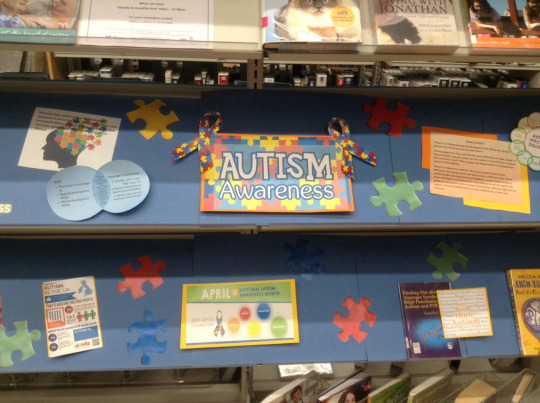
I’m at my local library and they’ve made a display for autism awareness month. This is a well meant effort, but…
As you can see, they’ve gone with the “autism speaks” motif. This is somewhat distressing for me, especially since I usually come here to de-stress. I’m going to write a letter for the library about why this is offensive to me as an autistic person, but I don’t want them to think it’s just me wigging out about it, so if you all would be so kind I’d appreciate it if you could reblog this post and add your own thoughts on autism speaks and the symbols of their organisation. I’m going to print off as many responses as I can and hand them over to the library along with the letter.
Thanks so much for your time, and I hope you all have a good autism awareness month
QUICK ADDITION TO THE POST
If you want to add your comments but feel uncomfortable posting them publicly, please please feel free to message them on anon. You should not be silenced because you are shy or self conscious. I will absolutely add every anonymous comment to the letter
Hey, thought I’d give an update for those of you wondering how this shook out. After the library didn’t contact me for a few days I decided to head down there to see what was going on and:
they’ve changed the display! I have to say, I wasn’t sure what the expect. I thought if they did anything it would just to be to change the colour and hopefully the puzzle pieces, but they actually changed the books and info that they have on there too, Including:
A notice explicitly debunking autism as an illness, and advocating how autism is different for everyone and always requires individual support
Books written by autistic people
Books about helping your kids with the challenges they might face, rather than guides for coping with having an autistic child
Even THIS book
Which I thought had a very suspect title turned out to have this passage inside:
You can even see that they’ve decided to promote the NAS, a society dedicated to helping autistic people live the lives of their choosing.
I’m very happy with the changes that have been made here. And I think it’s a good reminder that just because someone gets something wrong, doesn’t mean that they’re bad people. The important thing is being willing to listen and learn, and the staff at this library have done just that.
This feels to me like a good way to start autistic pride month. And remember, if you want to support people with autism this season – or throughout the rest of the year – be sure that you are speaking with us, not for us or over us.
This is so wonderful!! There’s a lot of good info there and I’m sure it’ll help a lot of people learn more about what autism really is.
I think you and the community have really made a positive difference here ❤
I’m literally crying this makes me so happy! This is amazing!
Im happy-crying too! bless you and that library!
[Image 1: A library display primarily using blue and puzzle piece motives.
Image 2: A library display with a red sign saying: “Autism Awareness Month”. The shelves are mint-coloured. There are no more puzzle pieces.
Image 3: A note reading:
“What is Autism?
Autism is a lifelong developmental disability that affects how people see the world and interact with others.
Autistic people see, hear and feel the world differently than other people. If you are autistic, you are autistic for life; autism is not an illness or a disease and cannot be ‘cured’. Often people feel being autistic is a fundamental aspect of their identity.
Autism is a spectrum disorder. All autistic people share certain difficulties, but being autistic will affect them in different ways. Some autistic people also have learning disabilities, mental health issues or other conditions, meaning people need different levels of support. All people on the autism spectrum learn and develop. With the right sort of support, all can be helped to live a more fulfilling life of their choosing.”
Image 4: A book titled “The reason I jump” by Naoki Higashida.
Image 5: A book titled “I’m not naughty – I’m autistic: Jodi’s journey” by Jean Shaw.
Image 6: A book titled “Sleep well on the autism spectrum” by Kenneth J. Aikten.
Image 7: A book titled: “Girls on the autism spectrum: overcoming the challenges and celebrating the gifts”.
Image 8: A book titled: “My child has autism, now what? 10 steps to get you started”.
Image 9: A page of the above book reading:
“Rules of thumb to live by
I know there is a lot to learn, but here are a few rules of thumb to guide you:
1. If something doesn’t work, try something else.
2. The only expert in autism is a person with autism.
3. Every child with autism is different – what works for one may not work for another.
4. You may not know autism, but you know your child and that is enough.”]
before you ever even consider having a child you should be ready to handle a disabled child, you should be ready to handle twins, you should be ready to handle a gay child or a trans child
because if you’re not ready for your child to be anything other than one straight, cis, able bodied and able minded child, you’re going to end up neglecting and abusing somebody for years to come
and even if your child is all that, you might have a feminine boy or a masculine girl on your hands. so be fucking ready for your child to be a human being and not YOUR PRODUCT or PROPERTY or CREATION
fucking sort your shit out, i am so tired of shitty parental sob stories about how “hard” it is to “raise” (read: beat the divergency out of) an autistic child or whatever. do you know what’s harder? being the divergent child of parents who you’ve already let down by virtue of existing in a way they didn’t ask for. putting up with years of neglect and abuse because you’re just not good enough for them, you weren’t what they were planning for or expecting.
i.
“but you don’t look autistic”
i know, it’s shocking
i’m sure you were expecting scaly green skin
or another pair of eyes hidden beneath my bangs
but take a look
two legs, two arms, on pair of eyes
i look just like you
i look like a human
because that’s what i am
autism does not have a costume
our wardrobe isn’t embroidered with puzzle pieces and the color blue
funnily enough
like everyone else on this earth
people with autism are all different
our experiences are not stagnate across the globe
and just because i can disguise my stims
doesn’t mean i am more or less autistic than someone who cannot
and believe it or not
saying that is not a compliment
ii.
yes
autistic people can have jobs
we can be loved by someone other than our family members
we can drive
and go shopping
not all of us are nonverbal
and while most of us cannot handle the horrors of eye contact
and certain stimuli
once again
we’re all different
try not to act so surprised when we’re able to appear just as neurotypical as you
iii.
“oh, so you’re like Rain Man?”
if this is your way of implying that you can drop a bunch of toothpicks on the ground and then ask me how many there are
kindly fuck off
iv.
“autism is a disease and i’m sure they’ll find a cure for you”
we are not sick
we are not suffering
illnesses are contagious
you can’t catch autism
it isn’t going to spread if you get too close to me
this isn’t rocket science
it isn’t that hard to understand
you either have autism
or you never will
and more importantly
there is nothing about us that needs to be cured
v.
instead of listening to a fear mongering
hate spreading
poor representation
unsupportive
harmful group that markets itself on our existence and feels the need to “fix” autistic people
why not just listen to autistic people instead?
Five Myths / Things You Should Know About People with Autism (cc, 2017)


 knitting in the dark