“His stimming is beautiful. To get him to stop stimming would require intensive coercion that, even if successful, would likely result in irreparable psychological harm.”
* This question was posted on another social media site. What follows is my answer.
1) Treat us as people, not as less. An adult or an older child being talked to in a baby voice is not on, regardless of how their disability presents. Talk to us at age appropriate level. If we’re interested in something, get excited about it with us, rather than telling us we’re boring. Sharing our interest is our way of trying to communicate. We love a thing. We’re opening up ourselves to you. It might not be how you’re used to doing a conversation, but it is meaningful communication, and it means we want to share that excitement with you. That’s a big deal. Recognise it.
2) Our diagnosis is none of your business, unless we feel comfortable talking to you about it. It’s really none of your business if we were diagnosed as a kid, an adult, self-diagnosed, or questioning. It’s none of your business if our autism has changed its presentation as we’ve aged. It’s really none of your business if you think you know what autism looks like, and we don’t match up with your preconceptions. And please, if we’re verbal, dressed appropriately, out in public and unattended, it’s not a compliment to tell us how well we’re doing. We’re just as autistic when we’re ‘passing’ as when we really aren’t. Passing for normal is not an achievement, it’s a monumental effort that most of us feel long term health effects from if we have to do it daily. Allowing natural autistic behaviours is something a lot of us have to relearn in adulthood to manage our anxiety. An adult flapping, pacing, tapping, or playing with a stim toy isn’t being babyish or playing at autism, they’re trying to take care of themselves. Don’t stare or tut or tell us we’re embarrassing you. (Telling us our Tangle is awesome and you want one is totally okay, though.)
3) Our sex life is none of your business, unless we’re in a sexual relationship with you. Just because we’re autistic doesn’t mean we can’t consent. That said, if there’s someone being weird and intimate with us when we’re a minor and they’re in a position of authority, make sure we’re okay. Compliance based therapies heavily used with autistic children (like ABA) make autistic children very vulnerable to sexual abuse, because they teach children to do things that are uncomfortable, painful or unnatural to them to please adults for rewards.
4) Make a conscious choice to be okay with difference, be it physical, intellectual, neurological, whatever. This might be harder than it sounds. Disability can come with mobility needs, sensory needs, dietary needs and routine based needs. It might require communication devices or sign language, or a picture-based communication system, even if to you, the person ‘seems’ verbal. It’s rare for an autistic person to have no difficulties with verbal communication, and if you’ve only ever seen them happy or relaxed, you might not know they need to use their phone to communicate when they’re upset or overwhelmed. Also, non verbal autistics might have a couple of words, scripted speech, or echolalic phrases they can use when conditions are right, even though they primarily use AAC or sign. Verbal ability isn’t a fixed thing. It fluctuates. Be patient if we’re struggling. It’s more frustrating for us than for you.
5) Everyone’s disability is unique. No two autistic people are the same. Likes, dislikes, sensitivities, strengths, difficulties. An autistic person might be sensory seeking, non verbal, highly intelligent, low anxiety, highly organised. They might be highly verbal, high anxiety, low executive function, mild intellectual disability, dyslexic, supertaster. They could have any combination of interests and personality traits, and come combined with a whole array of other disabilities. Don’t think because you know one autistic person, you know every autistic person. We’re individuals.
6) Listen to us, not to Autism Speaks or ‘autism moms’. Our experience is unique to us. It cannot be fully understood by a neurotypical bystander, regardless of how close that relationship is. Read books by autistic people (there are a lot). Donate to the Autistic Self Advocacy Network or Autistic Women & Nonbinary Network. Don’t light it up blue, put puzzle pieces on your car, or spread anti-vax rhetoric (which is fake science and basically hinges on the fact that a lot of people would rather have dead kids than autistic ones). Watch documentaries produced by autistic people about their experiences. Check out neurowonderful’s Youtube series Ask An Autistic.
7) Don’t assume we’re straight. Don’t assume we’re cisgender. Don’t assume we don’t understand the complexities of our multifaceted identities. Gender and sexuality variance is present in autistic people, just as it is in neurotypical people. In fact, there’s actually evidence there is a higher proportion of transgender, nonbinary and genderqueer people in the autistic community than in the genpop. Our experience of sexuality and gender is also viewed through our lens of autistic experience, and there are terms created specifically by autistic people to encapsulate this (like gendervague).
8) Don’t assume we can’t have relationships, friendships, and families outside of our parents and siblings. Don’t assume we can’t be awesome parents. Don’t assume we can’t make informed choices about our bodies and procreation. Autistic people have been here as long as people have been here. I’m from a multigenerational family myself, with both male and female autistic people, stretching back at least five generations, anecdotally (further than that, highly probably, but we don’t have the information).
9) Don’t think we’d be better off dead. This is why adults and children are murdered by parents and caregivers every year without legal repercussions. Our lives have value. The next time you see a news article where a parent cries about killing their child, don’t rationalise that ‘it must be so hard’ to be taking care of us. That’s essentially saying we’re responsible for our own murder, and that it was justifiable homicide. MURDER IS MURDER. If you want to campaign for better respite and support in your area, GREAT, but don’t give parents who murder their children a free pass. Parenting is hard, but people have a choice, and we must stop allowing people who make the choice to kill to get away with murder. Whenever it happens, someone else, somewhere, thinks murder is an appropriate solution to the problem of a disabled person needing care in their life, and another irreplaceable, unique person dies.
10) We have the right to exist in public spaces. Yes, that autistic person having a meltdown might be disrupting your shopping and hurting your ears. I can guarantee their life is harder than yours right then. Have some compassion (not pity) and give them some space. We have the right to be in restaurants, in theatres, in libraries and in schools. If you think a person with a disability being in those spaces is going to have a negative effect on your children, maybe you should think about your parenting, rather than about segregation.
A busker plays music for a blind autistic girl sitting in a wheelchair. She’s being allowed to stim (flapping and rubbing her shirt) and respond to the music her own natural way. The busker places her hand on the guitar to let her see what is creating the music, and she smiles as he sings to her.
They made a connection.
That is autism acceptance.
Take note. Many autistic people will open up to you like a flower if you gently connect with them in ways that work for them instead of forcing them to connect with you in ways that only work for you.
I hope that sweet kid grows up to be a musician or artist! 🙂
Image description: [pale purple and yellow background with dark text] This April, don’t support an organization that harms autistic people. [crossed out logo for Autism Speaks] Support one built by autistic people, for autistic people. [logos for the Autistic Self Advocacy Network and the Autism Women’s Network]
Check out the trailer for DEEJ, a film made by an non-speaking autistic advocate!
“A nonspeaking young man dreams of autistic civil rights. The
documentary film DEEJ with its insider view of autism, challenges us all
to live inclusion.”
Genuinely sitting here with tears in my eyes. I read Reasonable People some years ago now, and it remains one of my favourite autism books, period. Since I found out there might be a film, I’ve been waiting, patiently, hopefully, and this looks like it’s going to be just as amazing as I hoped. So excited for the full movie. So happy.
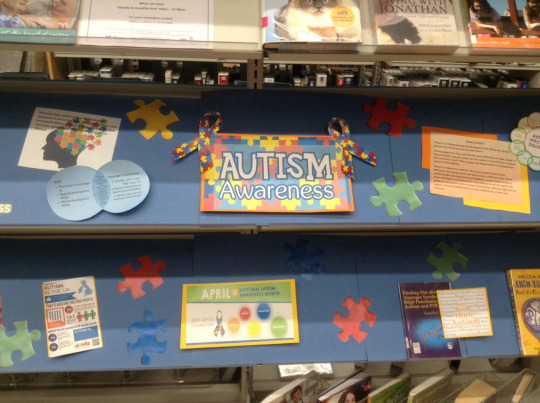
I’m at my local library and they’ve made a display for autism awareness month. This is a well meant effort, but…
As you can see, they’ve gone with the “autism speaks” motif. This is somewhat distressing for me, especially since I usually come here to de-stress. I’m going to write a letter for the library about why this is offensive to me as an autistic person, but I don’t want them to think it’s just me wigging out about it, so if you all would be so kind I’d appreciate it if you could reblog this post and add your own thoughts on autism speaks and the symbols of their organisation. I’m going to print off as many responses as I can and hand them over to the library along with the letter.
Thanks so much for your time, and I hope you all have a good autism awareness month
QUICK ADDITION TO THE POST
If you want to add your comments but feel uncomfortable posting them publicly, please please feel free to message them on anon. You should not be silenced because you are shy or self conscious. I will absolutely add every anonymous comment to the letter
Hey, thought I’d give an update for those of you wondering how this shook out. After the library didn’t contact me for a few days I decided to head down there to see what was going on and:
they’ve changed the display! I have to say, I wasn’t sure what the expect. I thought if they did anything it would just to be to change the colour and hopefully the puzzle pieces, but they actually changed the books and info that they have on there too, Including:
A notice explicitly debunking autism as an illness, and advocating how autism is different for everyone and always requires individual support
Books written by autistic people
Books about helping your kids with the challenges they might face, rather than guides for coping with having an autistic child
Even THIS book
Which I thought had a very suspect title turned out to have this passage inside:
You can even see that they’ve decided to promote the NAS, a society dedicated to helping autistic people live the lives of their choosing.
I’m very happy with the changes that have been made here. And I think it’s a good reminder that just because someone gets something wrong, doesn’t mean that they’re bad people. The important thing is being willing to listen and learn, and the staff at this library have done just that.
This feels to me like a good way to start autistic pride month. And remember, if you want to support people with autism this season – or throughout the rest of the year – be sure that you are speaking with us, not for us or over us.
This is so wonderful!! There’s a lot of good info there and I’m sure it’ll help a lot of people learn more about what autism really is.
I think you and the community have really made a positive difference here ❤
I’m literally crying this makes me so happy! This is amazing!
Im happy-crying too! bless you and that library!
[Image 1: A library display primarily using blue and puzzle piece motives.
Image 2: A library display with a red sign saying: “Autism Awareness Month”. The shelves are mint-coloured. There are no more puzzle pieces.
Image 3: A note reading:
“What is Autism?
Autism is a lifelong developmental disability that affects how people see the world and interact with others.
Autistic people see, hear and feel the world differently than other people. If you are autistic, you are autistic for life; autism is not an illness or a disease and cannot be ‘cured’. Often people feel being autistic is a fundamental aspect of their identity.
Autism is a spectrum disorder. All autistic people share certain difficulties, but being autistic will affect them in different ways. Some autistic people also have learning disabilities, mental health issues or other conditions, meaning people need different levels of support. All people on the autism spectrum learn and develop. With the right sort of support, all can be helped to live a more fulfilling life of their choosing.”
Image 4: A book titled “The reason I jump” by Naoki Higashida.
Image 5: A book titled “I’m not naughty – I’m autistic: Jodi’s journey” by Jean Shaw.
Image 6: A book titled “Sleep well on the autism spectrum” by Kenneth J. Aikten.
Image 7: A book titled: “Girls on the autism spectrum: overcoming the challenges and celebrating the gifts”.
Image 8: A book titled: “My child has autism, now what? 10 steps to get you started”.
Image 9: A page of the above book reading:
“Rules of thumb to live by
I know there is a lot to learn, but here are a few rules of thumb to guide you:
1. If something doesn’t work, try something else.
2. The only expert in autism is a person with autism.
3. Every child with autism is different – what works for one may not work for another.
4. You may not know autism, but you know your child and that is enough.”]
If you believe this person can pay attention without seeing your face, [image of a woman on the phone]
why can’t you believe they can too? [images of children looking down/away]
Eye contact makes comprehension harder for many autistics.
i.
“but you don’t look autistic”
i know, it’s shocking
i’m sure you were expecting scaly green skin
or another pair of eyes hidden beneath my bangs
but take a look
two legs, two arms, on pair of eyes
i look just like you
i look like a human
because that’s what i am
autism does not have a costume
our wardrobe isn’t embroidered with puzzle pieces and the color blue
funnily enough
like everyone else on this earth
people with autism are all different
our experiences are not stagnate across the globe
and just because i can disguise my stims
doesn’t mean i am more or less autistic than someone who cannot
and believe it or not
saying that is not a compliment
ii.
yes
autistic people can have jobs
we can be loved by someone other than our family members
we can drive
and go shopping
not all of us are nonverbal
and while most of us cannot handle the horrors of eye contact
and certain stimuli
once again
we’re all different
try not to act so surprised when we’re able to appear just as neurotypical as you
iii.
“oh, so you’re like Rain Man?”
if this is your way of implying that you can drop a bunch of toothpicks on the ground and then ask me how many there are
kindly fuck off
iv.
“autism is a disease and i’m sure they’ll find a cure for you”
we are not sick
we are not suffering
illnesses are contagious
you can’t catch autism
it isn’t going to spread if you get too close to me
this isn’t rocket science
it isn’t that hard to understand
you either have autism
or you never will
and more importantly
there is nothing about us that needs to be cured
v.
instead of listening to a fear mongering
hate spreading
poor representation
unsupportive
harmful group that markets itself on our existence and feels the need to “fix” autistic people
why not just listen to autistic people instead?
Five Myths / Things You Should Know About People with Autism (cc, 2017)





 knitting in the dark