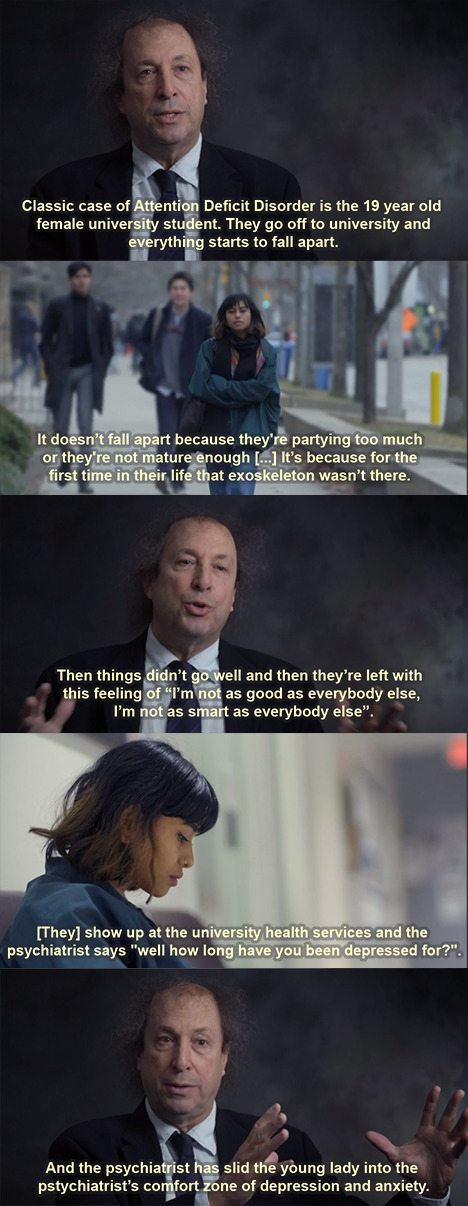
CBC made a good documentary on adult ADHD and part of it really caught me off guard because i swear they repeated verbatim my life story for the past 3 years
full programme here:
http://www.cbc.ca/natureofthings/episodes/adhd-not-just-for-kids
CBC made a good documentary on adult ADHD and part of it really caught me off guard because i swear they repeated verbatim my life story for the past 3 years
full programme here:
http://www.cbc.ca/natureofthings/episodes/adhd-not-just-for-kids
October is ADHD Awareness Month! • [click to enlarge] [source]
I love this picture because it works nearly the same way my brain does and I can bounce around and absorb however I like.
fun fact, this is exactly how this graphic idea came to me in the first place
BBC Horizon 2017: ADHD and Me with Rory Bremner
“For as long as I can remember, I had a really active brain. The problem is, when it gets too active… it jumps around all over the place, gets distracted by a million and one things when it’s supposed to be concentrating. I used to think that was just what it was like to be me. But recently, I’ve come to suspect that it’s what it’s like to have ADHD.”
no offense but this is literally the most neurotypical thing i have ever seen
Uhhhh… no.
This is what they teach you in therapy to deal with BPD and general depression.
When I got out of the hospital after hurting myself a second time, I got put into intensive outpatient program for people being released from mental hospitals as a way to monitor and help transition them into getting them efficient long-term care.
This is something they stressed, especially for people with general depression. When you want to stay at home and hide in your bed, forcing yourself to do the opposite is what is helpful. For me, who struggles with self harm- “I want to really slice my arm up. The opposite would be to put lotion on my skin (or whatever would be better, like drawing on my skin) the opposite is the better decision.” It doesn’t always work because of course mental health isn’t that easy, but this is part of what’s called mindfulness (they say this all the time in therapy)Being mindful of these is what puts you on the path to recovery. If you’re mindful, you are able to live in that moment and try your best to remember these better options.
I swear to god, I don’t get why some people on this website straight up reject good recovery help like this because either they a)have never been in therapy so don’t understand in context how to use these coping tactics. Or b)want to insist that all therapists and psych doctors are neurotypical and have zero idea what they are talking about. (Just so ya know, they teach this in DBT, the therapy used to help BPD. The psychologist who came up with DBT actually had BPD, so….a neurotypical women didn’t come up with this.)
I have clinical OCD and for me, exposure therapy–a version of “do the opposite”–has been fundamental. I’ve had huge improvement in the last year, but I’m 100% clear that if I hadn’t done my best to follow this protocol I’d be fucked. I have a lot of empathy for that moment when you’re just too tired to fight and you check the stove or you wash your hands or go back to the office at midnight to make sure the door is locked. But the kind of therapeutic approach outlined above has been crucial for me.
It’s hard to do. I’ve weathered panic attacks trying to follow this protocol. But I’ve gotten remarkable results. I was afraid to touch the surfaces in my house, okay? I was afraid to touch my own feet, afraid to touch my parrot–deliberately exposing myself to “contamination” has helped me heal. I can’t speak for people with other issues, but this has helped my anxiety and OCD.
I feel that tumblr, in an effort to be accepting of mental illness, has become anti-recovery. Having a mental illness does not make you a bad person. There is nothing morally wrong with having a mental illness anymore than more than there’s something morally wrong with having the flu. However, if you’re “ill” physically or mentally, something is wrong in the sense that you are unwell and to alleviate that you should try to get better. While there is not “cure” for mental illness, there are ways to get better.
There was a post on tumblr where someone with ADHD posted about how much you can get done when you focus and was attacked for posting about being “nuerotypical” – when she was posting about the relief she got from being on an medication to treat her illness.
I saw another post going around tumblr that said something along the line of “you control your thoughts, why not choose to have happy thoughts” which again was shot down as “nuerotypical” but while you don’t have control over what thoughts come into your mind, you absolutely can and should choose to have happy thoughts. In DBT we call this “positive self talk”.
I’m in DBT to help treat PTSD stemming from child abuse. The abuse and abandonment I experienced destroyed my self esteem and created a lot of anxiety over upsetting other people. DBT has taught me to recognize when my thoughts are distorting realty ‘no one likes you’ and answer back ‘plenty of people like you, you don’t need everyone to like you, especially if the relationship doesn’t make you happy’, to respond to the thought ‘I’m so worthless’ with ‘you’re really great and have accomplished something’
And it’s not easy to challenge your thoughts, it’s a skill that’s learned and it’s hard to force yourself to think something that doesn’t seem authentic or even seems wrong to think – it’s hard to be encouraging towards yourself when you hate yourself – but you force yourself to be aware of your thoughts and push back when you fall into unhealthy patterns
That isn’t “so neurotypical” that’s recovery.
Not shaming mental illness doesn’t mean shaming RECOVERY.
Pro-Recovery isn’t anti-disability.
Do not shame healthy behaviors as “neurotypical”.
Learning healthy behaviors and taking steps to treat mental illness and disorders including taking medication if that’s what works for you is important. You shouldn’t be ashamed if you have mental illness, but you shouldn’t say ‘well I’m not neurotypical therefor I can’t do anything to get better’ – while there is no cure for mental illness, there is a lot you can do to get better, to function better, to manage your mental illness and be safer, happier, and healthier for it.
I’m sort of on the fence here, because sure, there are things I can do as someone with depression/anxiety/PTSD to get myself out of negative patterns of behaviour and thought. These things are hard, almost always harder than just defaulting to how I feel and think without challenging them, but that doesn’t mean I shouldn’t try.
BUT.
I am also an autistic person who probably also has inattentive type ADHD, and ignoring my body and mind telling me “okay, I need to leave now, I need to shut down for a while, I need to recharge, I need to get out of this environment” and pushing into areas of sensory and social discomfort CONSTANTLY is a great way for me to end up in meltdown, shutdown, and maybe even end up with a “hangover” for days where all I can do is sleep and watch TV. I was constantly told, as an undiagnosed autistic person, that these sensory and social limits didn’t exist, that “everyone else” was just fine, so these messages were fake and that I was just “shy” and “high strung” and needed to push myself. Scared in social situations? Do public speaking! and so on, and so forth. Neurotypical standards of what was resonable to “push through” resulted in periods of being housebound, temporarily nonverbal, and so anxious and depressed I couldn’t do anything. It absolutely tanked my self-worth. It made me disregard these warning signals my autistic brain gave me that could have helped me avoid burnout. Learning how to notice and respect these warning signals has been an incredibly difficult process, because ignoring them was reinforced so often, for the first twenty-five years of my life.
So, lists like this have their place, but for neurodiverse people, they are only useful if they have the self-knowledge about what is useful and what is going to be harmful. This is something I didn’t have until very recently, and something I still struggle with. It’s lists and advice like this that made me continuously force myself into situations that harmed me, and made me ruthlessly repress stimming and selfcare that may have helped me. Those stimming and selfcare behaviours didn’t conform with the list/advice, you see. They were particular to my neurotype, and were things I had to discover/rediscover for myself, because no professional or well-meaning non-professional ever knew they were needed, BECAUSE NONE OF THEM WERE MY NEUROTYPE.
So, yes, challenge negative behaviour and thought patterns.
And yes, it’s the most neurotypical thing I’ve ever seen.
Listen to your body and your mind and take care of your SELF. Because there is no ‘one size fits all’ for mental health.
Also, I have Feelings about ‘forgiveness’ being the advised ‘good’ thing for betrayal. This anchors in heavily with the way people treat victims/survivors of abuse.
You don’t get to decide that someone else who’s been abused in any way should ‘forgive’.
You never have to ‘be the better person’ and forgive those who hurt you.
You never have to listen to those who tell you if you don’t forgive your abuser, you’ll be living with that abuse for the rest of your life.
You never have to look at your abuse and say, “Actually, I feel okay with my past and what you did to me and have love and acceptance in my heart for it all, and forgive what you did.”
It is absolutely fine for you to live your life without forgiving.
But gosh, you think, won’t it make me a toxic, bitter ball of hatred, unable to process trauma and move on? That’s what all those well-meaning people tell me.
No.
Actually, what happens is you work out that your abuser is irrelevant. Gradually, you won’t think about them every minute, or every hour, or every day. Eventually, you’ll go longer and longer, until you barely think of them at all, and your life will be as full as anyone else’s of things that are not the abuse or abuser.
That’s where I’m at. And I never had to forgive my abuser to get there.
filed under: things I wish I had known earlier but are quite obvious when you think about it
well
There you have it! You can cross off the spaces throughout a day and see if you win! (Let’s face it, this will be an easy one to complete…)
Or you can just read this so you can relate to what’s listed and feel less alone.
Thanks for all the suggestions! Finally, a project I have finished.
goddamn i blacked out the card today
I cross pretty much all of these squares most days, which is why I have a self-dx of adhd along with my prof-dx of autism.
giveaway!
we are: a household of three non-binary autistic folks, two of whom have bpd, one of whom is schizophrenic, all of whom struggle with anxiety/depression stuff with all the trimmings. we know brain weird, and we know how hard winter (and especially the holiday season) can be for people like us—cold dim days, noisy crowds everywhere, flashing lights, extra-busy retail jobs, dealing with relatives who don’t get it. we’ve been there, and we want to help ease the passage into the new year with nice things. that’s why we’re making self-care surprise kits to start 2015 off on a good note!
if you are: neurodivergent and/or mentally ill, especially if you’re those things and also trans and/or non-binary, reblog this post to enter our giveaway! (if you simply want to boost this post for your followers to see, please tag accordingly so we know.) be aware that if you win, you will need to give us a mailing address, so if it’s not okay to send a parcel to where you live/get your mail, we’d be happy to send it to a friend who can receive it for you!
self-care kits will include some or even all of the following:
- a LUSH gift card
- a bath & body works gift card
- a handmade beaded bracelet with an uplifting message
- a soft little plush friend you can keep in your pocket
- an expertly-crafted chain maille stim/fidget toy
- unscented candles (we know sometimes scents can be overwhelming)
- happy drawings that you can look at when you feel down
- LUSH products such as lotion, bath bombs, soaps, etc
- stickers
- cute bandaids
- a link to a little song written especially for the winners
- other surprises!
giveaway ends january 1, 2015, when we will select four winners at random out of those who have reblogged this post.
even when you feel alone, there are people out there who understand what you’re going through. your experiences are valid, your needs are important, you are believed, and you matter. ♥
(obligatory disclaimer: we are not associated with or endorsed by tumblr or any company in any official capacity, this is just giving presents to people we haven’t yet met. if you are under the legal age of majority where you live, please consult a guardian before giving out your personal information.)
Source: An inside look at ADHD.
Me 100% of the time. Luckily Ito help for my ADD when I was a child
fun facts!
- ADD and ADHD are the same disorder, Attention Deficit Disorder was officially renamed Attention Deficit Hyperactivity Disorder in 1994. Many people use ADD to refer to Type One presented here, and ADHD to refer to Type Two, but they are the same core disorder.
- In many cases where ADHD carries into adulthood, it’s a genetic issue [My grandfather, mother, siblings, and I have all been diagnosed with ADHD], though this does not always occur.
hello yes this is me
more fun facts!
- there are a lot of talks about how ADHD is overdiagnosed, and that may be true for boys, but for girls ADHD is severely underdiagnosed.
- older studies mostly looked at hyperactive boys and that’s the perception we have of ADHD. because of this many girls will go undiagnosed until adulthood.
- most girls/women who have ADHD are inattentive type. they tend to be introverted, disorganized and daydreamers.
- girls will internalize these as personal failings and teenage girls have a much higher rate of suicide and self harm because of it
- ADHD is often comorbid with anxiety and depression, both of which are caused by the failings from having ADHD
- depression can present itself differently in people with ADHD. it’s more of a discouragement from constantly failing, but it can be just as debilitating.
- read this article from the atlantic: It’s Different for Girls with ADHD
themoreyouknow.jpg
AAaaaaaahhhhhh seeing this on my dash makes me so happy! I was diagnosed with ADHD when I was only three years old and I’ve struggled with it my entire life. In fact, I’m so disorganized and forgetful that my parents pulled me out of school so that I wouldn’t flunk it. I constantly forgot to hand in assignments, and my inattentiveness was so bad when it came to homework that my mom had to hover over me and make sure I did it every day. It was an extremely stressful ordeal, especially once I got to middle school. I was homeschooled for my high school years, using an independent study program, but I was so far behind on my assignments that that’s when my parents removed me from it by the time I was 15. I still don’t have a high school diploma, a driver’s license, or even a GED.
As a result of all of this, I’m dealing with anxiety and depression, as well, but with the help of medication and therapy, I’m getting things under check. I do okay without ADD-specific medication now, so I’m starting to feel much more confident about getting a driver’s license and just going and getting my GED so I can start looking for jobs.
ADHD is a seriously underrepresented mental disorder on this site, so I’m really happy to see this infograph.
And this is why I have a self-diagnosis of inattentive type ADHD as well as my autism, even though the person who diagnosed my autism wasn’t interested in giving me the double diagnosis when I raised the probability of it. While the autism spectrum does come with its own bunch of executive function problems, I still remember the blinding clarity of reading the chapter on ADD/ADHD in Different Minds by Deirdre V. Lovecky and thinking, oh my God, this is me, this explains why I couldn’t handle school past the age of eight. There are still a lot of thinking/working memory/attention issues I have to wrangle on a daily basis that are due to my ADHD, not my autism.
- Do not talk about an obviously disabled person in front of them as if they can’t hear or understand you.
- Do not talk to a disabled person’s companion instead of them.
- Ask permission before touching people, or their wheelchairs/other equipment. Even if you want to help.
- Ask disabled people about their lives and really listen to their answers. (Within reason. Asking people personal questions about their sex lives, for example, is rude unless you are very close to them and they’ve communicated they’re OK with that).
- Listen to what they say whether they are speaking, writing, typing, using text to speech, using a letterboard, using PECS, gesturing, using sign language, or using any other form of communication. People who cannot speak can still communicate.
- Stand up for people you see getting bullied.
- Understand that disabled people don’t just need friends, they can be friends, too.
- Every public place does not need to have loud, blaring music and TVs with flashing screens.
- If you blog, put bright, flashing images that can trigger seizures under a cut so that people with seizures can avoid looking at them.
- If a job can possibly be done without a person driving, don’t require candidates to drive/have a driver’s license, and don’t interview candidates and then reject them because they don’t drive.
- When talking to someone who has trouble speaking or stutters, and takes a long time to speak, wait for them to answer. Don’t keep repeating the question or pressuring them. Yes, if you’re like me and your mind is going really fast and you forget what people are saying if they take too long, it can be hard to be patient. Do it anyway.
- If you are talking to a deaf person, make it easier for them to lip-read by facing towards them while looking at them, and not covering your mouth with your hands.
- If you are talking to someone with hearing impairment or auditory processing disorder, it is more helpful to slow down or rephrase what you’re saying than to just speak more loudly.
- Some disabled people have difficulty understanding nonliteral language such as metaphors and idioms (e.g., “a stitch in time saves nine”). If you’re talking to someone like this, try explaining what you mean by these figures of speech, or just not using them.
- Recognize that failure to make eye contact does not mean someone is lying to you. It may be uncomfortable for them.
- Recognize that unwillingness to go out to loud, crowded bars does not mean someone isn’t interested in socializing with you.
- If people have difficulty spelling, or using the appropriate jargon/terminology for your social group, do not assume they’re stupid. You may need to paraphrase some “jargon” for them.
- Recognize that a person can need time alone and it doesn’t mean they don’t like you or want to be with you. It’s just something they need so they can function at their best.
- If a person does not recognize you, do not assume they don’t care about you. They may be face-blind.
- If a person does not remember your birthday (or other major names, numbers, or dates) do not assume they don’t care about you. They may simply have a bad memory.
- Understand that a disabled person’s talents, however esoteric, are real, not unimportant “splinter skills.”
- Colorblindness affects more than just knowing what color something is. To a colorblind person, colors that they can’t see will look the same if they have the same degree of lightness/darkness. That means that to a red-green colorblind person, a red rose on a green background will blend in instead of contrast starkly, and the Chicago CTA El map will be difficult to understand. Understand that something that stands out to you and seems obvious may literally not be visible to a colorblind person.
- Accept stimming.
- Don’t tell them “but you look so normal.” But, if they accomplish something you know they were working really hard to do, it’s great to compliment them on it.
- Understand that a person can be working incredibly hard to do something and may still not perform as well as you’d like them to, as well as the average person would, or as well as the situation demands.
- If someone has a major medical problem, disability, or chronic illness, then just eating some special healthy diet or exercising more isn’t going to cure it. It might help, it might hurt, it might do nothing, but they’ve probably heard it before, and it’s none of your business in any case.
- A person with OCD knows that checking or counting or whatever compulsion they perform won’t really prevent disaster from happening, it’s just a compulsion. That doesn’t stop them from feeling the need to do it anyway. A person with anxiety may know at least some of their fears are irrational or unlikely to occur. That doesn’t stop them from feeling anxious. A person with trichotillomania may know it hurts them to pull out their hair or pick at their skin, but they have trouble stopping themselves anyway. A depressed person may know they would feel better if they got out of their house and talked to people, but that doesn’t make them feel any more up to doing those things. A person who hallucinates may know the hallucinations aren’t real, but that doesn’t make them go away or feel less upsetting. You see the pattern? You can’t cure people with mental illnesses by telling them they’re being irrational or hurting themselves. If it were that easy, they’d have cured themselves already.
- Do not tell a person with ADHD or mental illness that they should not be taking medication. This is a personal decision. Furthermore, since medications have wide-ranging effects on people’s bodies and minds and often unpleasant side effects, most people taking medications have thought through the issue, done a cost-benefit analysis, and decided that the ability to function better is worth it. Their decision should be respected.
- A disabled person with intellectual disability who has the academic or IQ abilities of, say, a seven year old does not actually have the mind of a seven year old. They have different life experiences, needs, stages of life, bodies, and so on.
- If a disabled person is having a meltdown, they are not angry, they are terrified. They’re not throwing a tantrum or being aggressive, they have gone into fight or flight. The best thing you can do is remain calm yourself and help them calm down. It may help to keep your distance, keep your voice low and calm, let them retreat to a safe place if they know to do that, or remind them to do so if they don’t. Reasoning with them won’t work well because they’re unlikely to be able to hear and understand you. The worst thing you can do is start yelling yourself, threatening them, be violent to them, cut off their escape route, or get right up in their personal space.
Other ideas? Please reblog and add more. The more the merrier.
 knitting in the dark