leslieknope2k44:

image
image
image
image
image
image
image
image

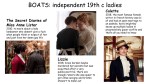
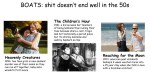
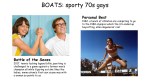
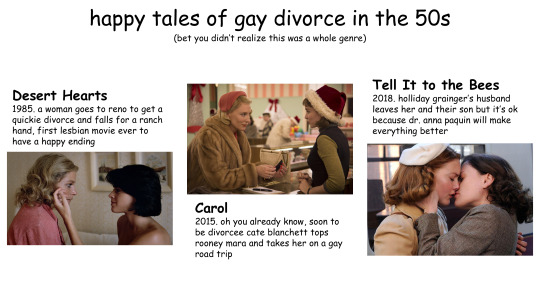
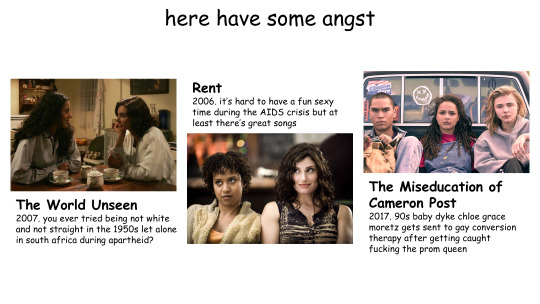
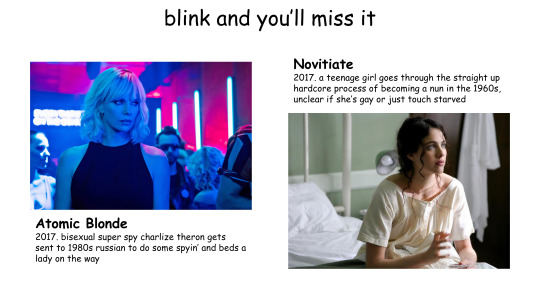
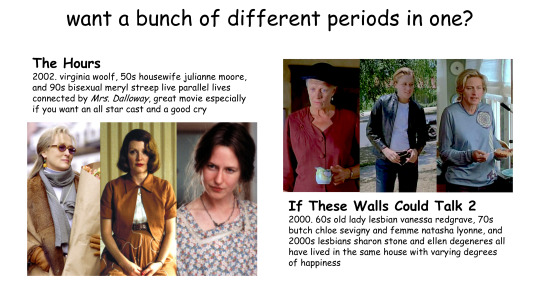
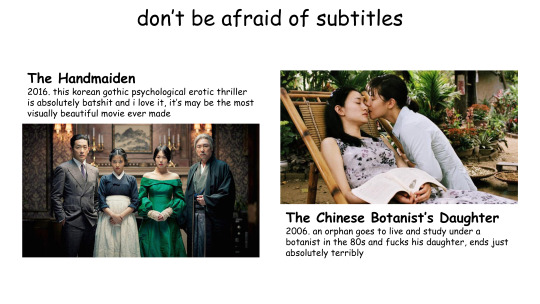
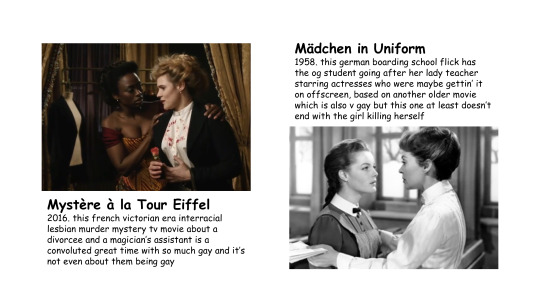
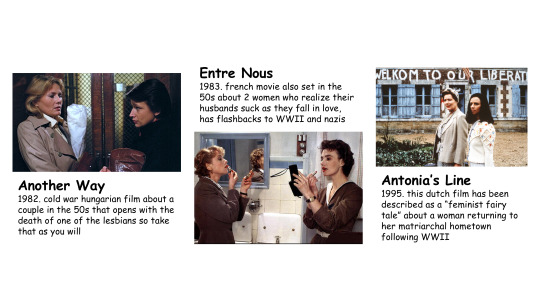
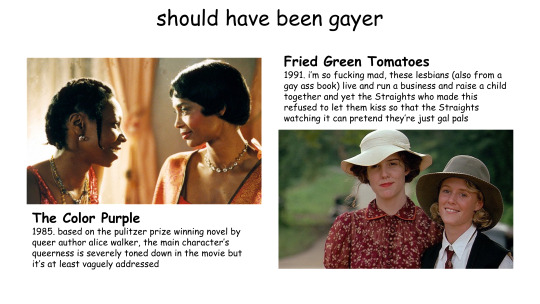
a guide to wlw period pieces

I’d like to add the English language films of Sarah Waters (Tipping The Velvet, Affinity, Fingersmith, The Night Watch) to various time periods ranging from 19th century through to 1940s, and Bend It Like Beckham to should’ve been gayer because the original endgame was Keira Knightley and Parminder Nagra as a happy sporty dyke couple and the studio said no.

jabberwockypie:

Ow ow ow ow ow ow ow ow ow ow ow ow fuck fuck fuck fuck fuck fuck this hurts. This hurts so much and I want to scream, but that would be impolite.

Positive or fluffy or nice distractions welcome!

Bob Ross on Youtube

Due South Full Length Pilot on Youtube
Due South Season One on Youtube

Weightless by Marconi Union (anti-anxiety ambient music – I use this a lot)

Miracle Modus stimming fractal app by and for autistic people

If you can afford them, Emma recommends The Room series of games, Bejeweled Classic, and Machinarium (though I’d have a walkthrough on hand for the last one, to avoid frustration if you can’t find a solution to a room quickly).

I love Alphabear, Candy Crush, 2048, Cut The Rope, Monument Valley, Contre Jour and Blendoku. Drawn and Chocolatier are good, solid series of games, too, but they’re older. Both are available through Big Fish Games. Sorry, most of this list aren’t free, but they’re ones I go back to when I’m stressed and overwhelmed. I also have a Mah Jong app and a bunch of other puzzle style games.

JABTalk is a free android app for communication. It’s programmable for your needs, and might help if you find the stress and pain are making basic speech harder than usual.

How can we help people with disabilities? For example, autistic people who see the world differently.*

iamshadow21:

* This question was posted on another social media site. What follows is my answer.

1) Treat us as people, not as less. An adult or an older child being talked to in a baby voice is not on, regardless of how their disability presents. Talk to us at age appropriate level. If we’re interested in something, get excited about it with us, rather than telling us we’re boring. Sharing our interest is our way of trying to communicate. We love a thing. We’re opening up ourselves to you. It might not be how you’re used to doing a conversation, but it is meaningful communication, and it means we want to share that excitement with you. That’s a big deal. Recognise it.

2) Our diagnosis is none of your business, unless we feel comfortable talking to you about it. It’s really none of your business if we were diagnosed as a kid, an adult, self-diagnosed, or questioning. It’s none of your business if our autism has changed its presentation as we’ve aged. It’s really none of your business if you think you know what autism looks like, and we don’t match up with your preconceptions. And please, if we’re verbal, dressed appropriately, out in public and unattended, it’s not a compliment to tell us how well we’re doing. We’re just as autistic when we’re ‘passing’ as when we really aren’t. Passing for normal is not an achievement, it’s a monumental effort that most of us feel long term health effects from if we have to do it daily. Allowing natural autistic behaviours is something a lot of us have to relearn in adulthood to manage our anxiety. An adult flapping, pacing, tapping, or playing with a stim toy isn’t being babyish or playing at autism, they’re trying to take care of themselves. Don’t stare or tut or tell us we’re embarrassing you. (Telling us our Tangle is awesome and you want one is totally okay, though.)

3) Our sex life is none of your business, unless we’re in a sexual relationship with you. Just because we’re autistic doesn’t mean we can’t consent. That said, if there’s someone being weird and intimate with us when we’re a minor and they’re in a position of authority, make sure we’re okay. Compliance based therapies heavily used with autistic children (like ABA) make autistic children very vulnerable to sexual abuse, because they teach children to do things that are uncomfortable, painful or unnatural to them to please adults for rewards.

4) Make a conscious choice to be okay with difference, be it physical, intellectual, neurological, whatever. This might be harder than it sounds. Disability can come with mobility needs, sensory needs, dietary needs and routine based needs. It might require communication devices or sign language, or a picture-based communication system, even if to you, the person ‘seems’ verbal. It’s rare for an autistic person to have no difficulties with verbal communication, and if you’ve only ever seen them happy or relaxed, you might not know they need to use their phone to communicate when they’re upset or overwhelmed. Also, non verbal autistics might have a couple of words, scripted speech, or echolalic phrases they can use when conditions are right, even though they primarily use AAC or sign. Verbal ability isn’t a fixed thing. It fluctuates. Be patient if we’re struggling. It’s more frustrating for us than for you.

5) Everyone’s disability is unique. No two autistic people are the same. Likes, dislikes, sensitivities, strengths, difficulties. An autistic person might be sensory seeking, non verbal, highly intelligent, low anxiety, highly organised. They might be highly verbal, high anxiety, low executive function, mild intellectual disability, dyslexic, supertaster. They could have any combination of interests and personality traits, and come combined with a whole array of other disabilities. Don’t think because you know one autistic person, you know every autistic person. We’re individuals.

6) Listen to us, not to Autism Speaks or ‘autism moms’. Our experience is unique to us. It cannot be fully understood by a neurotypical bystander, regardless of how close that relationship is. Read books by autistic people (there are a lot). Donate to the Autistic Self Advocacy Network or Autistic Women & Nonbinary Network. Don’t light it up blue, put puzzle pieces on your car, or spread anti-vax rhetoric (which is fake science and basically hinges on the fact that a lot of people would rather have dead kids than autistic ones). Watch documentaries produced by autistic people about their experiences. Check out neurowonderful’s Youtube series Ask An Autistic.

7) Don’t assume we’re straight. Don’t assume we’re cisgender. Don’t assume we don’t understand the complexities of our multifaceted identities. Gender and sexuality variance is present in autistic people, just as it is in neurotypical people. In fact, there’s actually evidence there is a higher proportion of transgender, nonbinary and genderqueer people in the autistic community than in the genpop. Our experience of sexuality and gender is also viewed through our lens of autistic experience, and there are terms created specifically by autistic people to encapsulate this (like gendervague).

8) Don’t assume we can’t have relationships, friendships, and families outside of our parents and siblings. Don’t assume we can’t be awesome parents. Don’t assume we can’t make informed choices about our bodies and procreation. Autistic people have been here as long as people have been here. I’m from a multigenerational family myself, with both male and female autistic people, stretching back at least five generations, anecdotally (further than that, highly probably, but we don’t have the information).

9) Don’t think we’d be better off dead. This is why adults and children are murdered by parents and caregivers every year without legal repercussions. Our lives have value. The next time you see a news article where a parent cries about killing their child, don’t rationalise that ‘it must be so hard’ to be taking care of us. That’s essentially saying we’re responsible for our own murder, and that it was justifiable homicide. MURDER IS MURDER. If you want to campaign for better respite and support in your area, GREAT, but don’t give parents who murder their children a free pass. Parenting is hard, but people have a choice, and we must stop allowing people who make the choice to kill to get away with murder. Whenever it happens, someone else, somewhere, thinks murder is an appropriate solution to the problem of a disabled person needing care in their life, and another irreplaceable, unique person dies.

10) We have the right to exist in public spaces. Yes, that autistic person having a meltdown might be disrupting your shopping and hurting your ears. I can guarantee their life is harder than yours right then. Have some compassion (not pity) and give them some space. We have the right to be in restaurants, in theatres, in libraries and in schools. If you think a person with a disability being in those spaces is going to have a negative effect on your children, maybe you should think about your parenting, rather than about segregation.

Hey it took less than twenty-four hours for me to get this as a reply. (This is only an excerpt. I didn’t include the link to the inspiration porn/curebie video he linked to, or him talking about his cousin’s four year old with Rett Syndrome.)

I totally agree with everything written to this thread (‘Iamshadow’, you are brilliant) but we must never forget the families, carers and supporters who, in many cases, put their lives on hold purely due to love.

What follows is my response.

I wasn’t suggesting forgetting the families and caregivers, I was saying that the voices of disabled people need to be amplified. If you go to a bookshop or a library, there are dozens of books by parents about their experiences with disabled children and family members. There are far fewer by disabled people themselves. This isn’t because the books aren’t being written, it’s because parental accounts get picked up by major publishing houses far more often than personal accounts do, and therefore, get much more exposure and larger print runs, and that’s wrong.

It should be possible for a disabled person to say ‘listen to me’ without nondisabled people around them chiming in to say ‘yes, but listen to us, too!’

Parents choose to put their lives on hold to parent every day. You don’t know, going in, if your child is going to be disabled (unless you choose to adopt an older, disabled child, as in the excellent parental account Reasonable People). Choosing to parent out of love shouldn’t be seen as this monumental thing if the child turns out to be disabled. You chose to parent. Why is love seen as a greater sacrifice when the kid has special needs? It’s ableism. As though loving us is naturally harder, because we’re different, because we take up more space in people’s lives.

How can you help us? Consciously question that. Question why there are books on the shelf about friendship aimed at autistic and other neurodiverse kids called things like It’s So Much Work to Be Your Friend. What kind of weight are you putting on the disabled person when so much of what parents and caregivers focus on is the effort, the ‘extra’ love they require? Believe me, disabled people know. Nondisabled people never let us forget.

How can we help people with disabilities? For example, autistic people who see the world differently.*

* This question was posted on another social media site. What follows is my answer.

1) Treat us as people, not as less. An adult or an older child being talked to in a baby voice is not on, regardless of how their disability presents. Talk to us at age appropriate level. If we’re interested in something, get excited about it with us, rather than telling us we’re boring. Sharing our interest is our way of trying to communicate. We love a thing. We’re opening up ourselves to you. It might not be how you’re used to doing a conversation, but it is meaningful communication, and it means we want to share that excitement with you. That’s a big deal. Recognise it.

2) Our diagnosis is none of your business, unless we feel comfortable talking to you about it. It’s really none of your business if we were diagnosed as a kid, an adult, self-diagnosed, or questioning. It’s none of your business if our autism has changed its presentation as we’ve aged. It’s really none of your business if you think you know what autism looks like, and we don’t match up with your preconceptions. And please, if we’re verbal, dressed appropriately, out in public and unattended, it’s not a compliment to tell us how well we’re doing. We’re just as autistic when we’re ‘passing’ as when we really aren’t. Passing for normal is not an achievement, it’s a monumental effort that most of us feel long term health effects from if we have to do it daily. Allowing natural autistic behaviours is something a lot of us have to relearn in adulthood to manage our anxiety. An adult flapping, pacing, tapping, or playing with a stim toy isn’t being babyish or playing at autism, they’re trying to take care of themselves. Don’t stare or tut or tell us we’re embarrassing you. (Telling us our Tangle is awesome and you want one is totally okay, though.)

3) Our sex life is none of your business, unless we’re in a sexual relationship with you. Just because we’re autistic doesn’t mean we can’t consent. That said, if there’s someone being weird and intimate with us when we’re a minor and they’re in a position of authority, make sure we’re okay. Compliance based therapies heavily used with autistic children (like ABA) make autistic children very vulnerable to sexual abuse, because they teach children to do things that are uncomfortable, painful or unnatural to them to please adults for rewards.

4) Make a conscious choice to be okay with difference, be it physical, intellectual, neurological, whatever. This might be harder than it sounds. Disability can come with mobility needs, sensory needs, dietary needs and routine based needs. It might require communication devices or sign language, or a picture-based communication system, even if to you, the person ‘seems’ verbal. It’s rare for an autistic person to have no difficulties with verbal communication, and if you’ve only ever seen them happy or relaxed, you might not know they need to use their phone to communicate when they’re upset or overwhelmed. Also, non verbal autistics might have a couple of words, scripted speech, or echolalic phrases they can use when conditions are right, even though they primarily use AAC or sign. Verbal ability isn’t a fixed thing. It fluctuates. Be patient if we’re struggling. It’s more frustrating for us than for you.

5) Everyone’s disability is unique. No two autistic people are the same. Likes, dislikes, sensitivities, strengths, difficulties. An autistic person might be sensory seeking, non verbal, highly intelligent, low anxiety, highly organised. They might be highly verbal, high anxiety, low executive function, mild intellectual disability, dyslexic, supertaster. They could have any combination of interests and personality traits, and come combined with a whole array of other disabilities. Don’t think because you know one autistic person, you know every autistic person. We’re individuals.

6) Listen to us, not to Autism Speaks or ‘autism moms’. Our experience is unique to us. It cannot be fully understood by a neurotypical bystander, regardless of how close that relationship is. Read books by autistic people (there are a lot). Donate to the Autistic Self Advocacy Network or Autistic Women & Nonbinary Network. Don’t light it up blue, put puzzle pieces on your car, or spread anti-vax rhetoric (which is fake science and basically hinges on the fact that a lot of people would rather have dead kids than autistic ones). Watch documentaries produced by autistic people about their experiences. Check out neurowonderful’s Youtube series Ask An Autistic.

7) Don’t assume we’re straight. Don’t assume we’re cisgender. Don’t assume we don’t understand the complexities of our multifaceted identities. Gender and sexuality variance is present in autistic people, just as it is in neurotypical people. In fact, there’s actually evidence there is a higher proportion of transgender, nonbinary and genderqueer people in the autistic community than in the genpop. Our experience of sexuality and gender is also viewed through our lens of autistic experience, and there are terms created specifically by autistic people to encapsulate this (like gendervague).

8) Don’t assume we can’t have relationships, friendships, and families outside of our parents and siblings. Don’t assume we can’t be awesome parents. Don’t assume we can’t make informed choices about our bodies and procreation. Autistic people have been here as long as people have been here. I’m from a multigenerational family myself, with both male and female autistic people, stretching back at least five generations, anecdotally (further than that, highly probably, but we don’t have the information).

9) Don’t think we’d be better off dead. This is why adults and children are murdered by parents and caregivers every year without legal repercussions. Our lives have value. The next time you see a news article where a parent cries about killing their child, don’t rationalise that ‘it must be so hard’ to be taking care of us. That’s essentially saying we’re responsible for our own murder, and that it was justifiable homicide. MURDER IS MURDER. If you want to campaign for better respite and support in your area, GREAT, but don’t give parents who murder their children a free pass. Parenting is hard, but people have a choice, and we must stop allowing people who make the choice to kill to get away with murder. Whenever it happens, someone else, somewhere, thinks murder is an appropriate solution to the problem of a disabled person needing care in their life, and another irreplaceable, unique person dies.

10) We have the right to exist in public spaces. Yes, that autistic person having a meltdown might be disrupting your shopping and hurting your ears. I can guarantee their life is harder than yours right then. Have some compassion (not pity) and give them some space. We have the right to be in restaurants, in theatres, in libraries and in schools. If you think a person with a disability being in those spaces is going to have a negative effect on your children, maybe you should think about your parenting, rather than about segregation.

thegirlthatdoesntexist:

image

It’s World Mental Health Day! (October 10th.) So I thought it might be useful to compile mental health resources for the Jewish community into one post. If you know of any that aren’t listed, please feel free to add them.

RELIEF – connects/refers Jewish people to therapists and other
mental health resources (focuses mainly on the frum community)

Elijah’s Journey – suicide prevention for the Jewish community (Facebook page)


The Aleph Institute
– provides spiritual support for Jews in
institutional environments such as prison, health facilities, and
rehab


No Shame On U
– aims to de-stigmatize mental illness by providing
comprehensive education


OHEL
– comprehensive services for those facing mental health issues, with professionals fluent in English, Yiddish, and Hebrew

Yad Rachel – for mothers facing postpartum depression, also helps educate family and health providers

Shema Koli – support for victims of abuse

Frum Support Forums – for mental and physical health

(NY) The Jewish Board – provides services for a number of things, including crisis support, supportive housing, and mental health services.

Torah and the Twelve Steps – spiritual-based rehab for those recovering from substance abuse

(UK) Jewish Helpline – 

0800 652 9249

(Mexico) Jewish Crisis Line – 

1118

(The two following aren’t specifically mental health resources, but I still felt they were important to add.)

A list of Jewish LGBT+ organizations

Keshet – Jewish LGBT+ educational resources

Many cities also have Jewish Family Services, which will often be able to refer you to a therapist or other local resources.

forestlover:

keyholeslumber:

modestinferno:

circumlocute:

Books that people read romantically but shouldn’t because they’re missing the point:

  1. Lolita by Vladimir Nabokov
  2. Romeo and Juliet by William Shakespeare
  3. The Great Gatsby by F. Scott Fitzgerald

That’s your opinion.

there’s nothing romantic about a pedophile rapist, the senseless murder-suicide of teenagers because families can’t get their shit together or the hypocrisy of the roaring 20s

FINALLY SOMEONE SAYS IT

I’d like to add Wuthering Heights, because that is incredibly fucked up if you read it through a romantic lens.