The thing about knitting is it’s much harder to fear the existential futility of all your actions while you’re doing it.
Like ok, sure, sometimes it’s hard to believe you’ve made any positive impact on the world. But it’s pretty easy to believe you’ve made a sock. Look at it. There it is. Put it on, now your foot’s warm.
Checkmate, nihilism.
#yelling into the void#also knitting into the void#now at least the void has socks
Category: Uncategorized
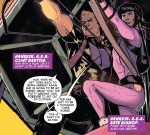
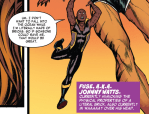
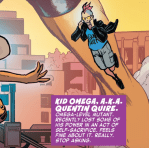

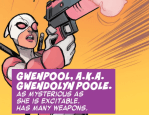

West Coast Avengers #2 (2018)
written by Kelly Thompson
art by Stefano Caselli & Triona Farrell






Good Omens: a gentle reminder
ibelieveinthelittletreetopper:
Your headcanon is your headcanon. The characters in your mind are what they are, and nobody is trying to take them away from you. Think of the Good Omens TV series as a stage play: for six full hours, actors are going to be portraying the roles of Crowley and Aziraphale, Shadwell and Madame Tracy, Newt and Anathema, Adam, Pepper, Wensleydale and Brian and the rest. Will they look like the people in your head? The ones you’ve been drawing and writing about and imagining for (in some cases) almost 30 years?
Probably not. Which is fine.
The people in your head and your drawings are still there, and still real and still true. I’ve seen drawings of hundreds of different Aziraphales over the years, all with different faces and body-shapes, different hair and skin, and would never have thought to tell anyone who drew or loved them that that wasn’t what Aziraphale looked like. (And a couple of years after we wrote it, I was amused to realise that the Aziraphale in my head looked nothing like the Aziraphale in Terry’s head.) I’ve loved every instance of Good Omens Cosplay I’ve seen, and in no case did I ever think anyone was doing it wrong: they were all Aziraphales and Crowleys, and it was always a delight.
Good Omens has been unillustrated for 27 years, which means that each of you gets to make up your own look for the characters, your own backstories, your own ideas about how they will behave.
The TV version is being made with love and with faithfulness to the story. It’s got material and characters in it that Terry and I had discussed over the years, (some of it from what we would have done it there had been a sequel). Writing it has taken up the greater part of my last three years. You might like it – I really hope you will – but you don’t have to. You can start watching it, decide that you prefer the thing in your head, and stop watching it. (I never saw the last Lord of the Rings movie, because I liked the thing in my head too much.)
Remember we are making this with love.
And that your own personal headCrowleys and headAziraphales and headFourHorsemen and headThem and headHastur and headLigur and headSisterMary and all the rest are yours, and safe, and nobody is ever going to take them away from you.
I love Neil Gaiman so much.
This is really nice work…….. via Art LOVER
THAT’S how you make lace??
See, I am a fibre artist, and even to me, bobbin lace just looks like witchcraft.
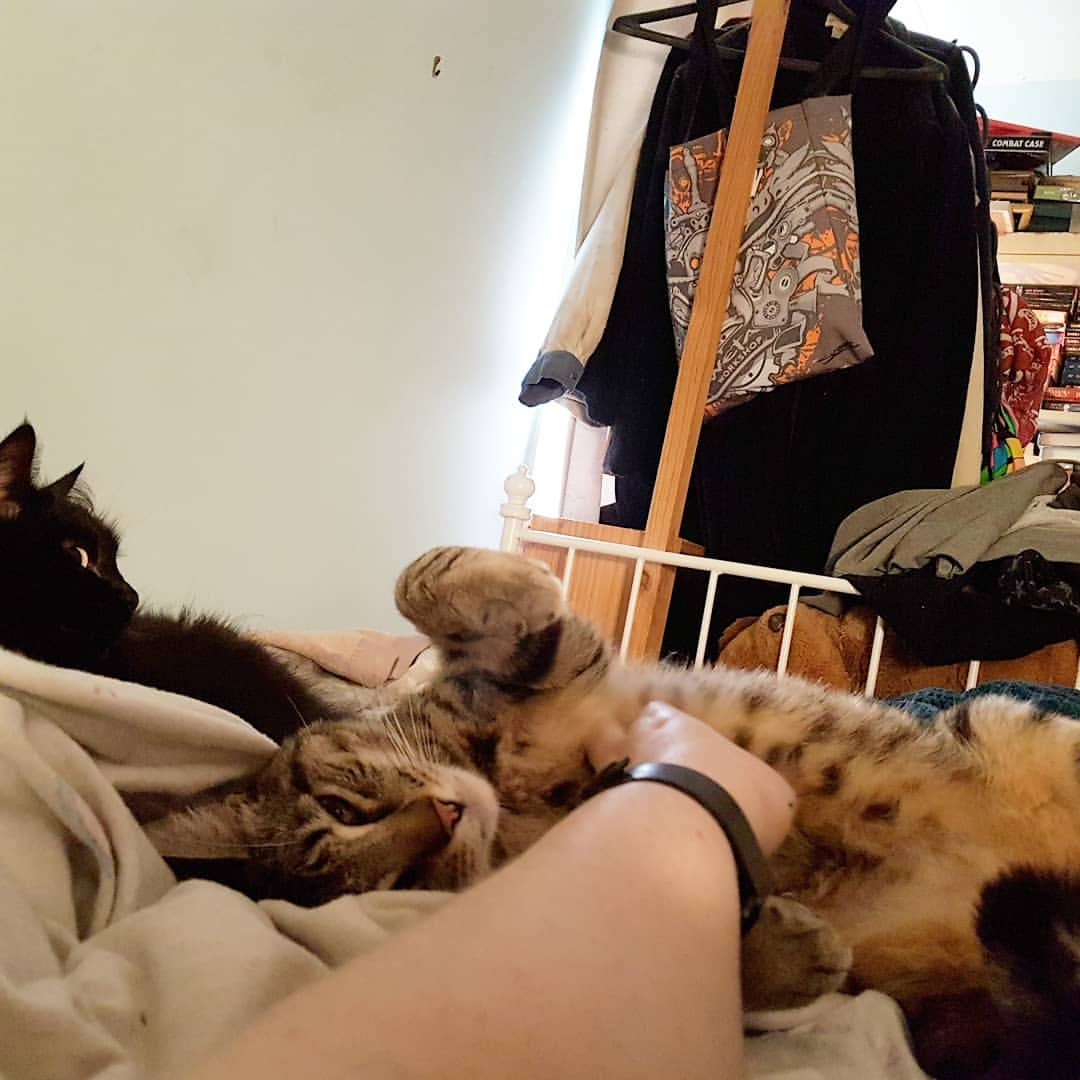
Stuck in bed because trying to fix the pinched nerve in my thigh has set off the herniated disc in my back. Two kitties came to keep me company #catsofinstagram #internationalcatday #winter #nick
https://www.instagram.com/p/BplpC89llhs/?utm_source=ig_tumblr_share&igshid=1j4t1ysa3selo
Winter (tabby) and Nick (his mum, the black medium haired cat) being adorable.
https://www.instagram.com/p/BplpSoYltr3/?utm_source=ig_tumblr_share&igshid=1sj3xerfrma0k
(Source: https://www.instagram.com/)
How can we help people with disabilities? For example, autistic people who see the world differently.*
* This question was posted on another social media site. What follows is my answer.
1) Treat us as people, not as less. An adult or an older child being talked to in a baby voice is not on, regardless of how their disability presents. Talk to us at age appropriate level. If we’re interested in something, get excited about it with us, rather than telling us we’re boring. Sharing our interest is our way of trying to communicate. We love a thing. We’re opening up ourselves to you. It might not be how you’re used to doing a conversation, but it is meaningful communication, and it means we want to share that excitement with you. That’s a big deal. Recognise it.
2) Our diagnosis is none of your business, unless we feel comfortable talking to you about it. It’s really none of your business if we were diagnosed as a kid, an adult, self-diagnosed, or questioning. It’s none of your business if our autism has changed its presentation as we’ve aged. It’s really none of your business if you think you know what autism looks like, and we don’t match up with your preconceptions. And please, if we’re verbal, dressed appropriately, out in public and unattended, it’s not a compliment to tell us how well we’re doing. We’re just as autistic when we’re ‘passing’ as when we really aren’t. Passing for normal is not an achievement, it’s a monumental effort that most of us feel long term health effects from if we have to do it daily. Allowing natural autistic behaviours is something a lot of us have to relearn in adulthood to manage our anxiety. An adult flapping, pacing, tapping, or playing with a stim toy isn’t being babyish or playing at autism, they’re trying to take care of themselves. Don’t stare or tut or tell us we’re embarrassing you. (Telling us our Tangle is awesome and you want one is totally okay, though.)
3) Our sex life is none of your business, unless we’re in a sexual relationship with you. Just because we’re autistic doesn’t mean we can’t consent. That said, if there’s someone being weird and intimate with us when we’re a minor and they’re in a position of authority, make sure we’re okay. Compliance based therapies heavily used with autistic children (like ABA) make autistic children very vulnerable to sexual abuse, because they teach children to do things that are uncomfortable, painful or unnatural to them to please adults for rewards.
4) Make a conscious choice to be okay with difference, be it physical, intellectual, neurological, whatever. This might be harder than it sounds. Disability can come with mobility needs, sensory needs, dietary needs and routine based needs. It might require communication devices or sign language, or a picture-based communication system, even if to you, the person ‘seems’ verbal. It’s rare for an autistic person to have no difficulties with verbal communication, and if you’ve only ever seen them happy or relaxed, you might not know they need to use their phone to communicate when they’re upset or overwhelmed. Also, non verbal autistics might have a couple of words, scripted speech, or echolalic phrases they can use when conditions are right, even though they primarily use AAC or sign. Verbal ability isn’t a fixed thing. It fluctuates. Be patient if we’re struggling. It’s more frustrating for us than for you.
5) Everyone’s disability is unique. No two autistic people are the same. Likes, dislikes, sensitivities, strengths, difficulties. An autistic person might be sensory seeking, non verbal, highly intelligent, low anxiety, highly organised. They might be highly verbal, high anxiety, low executive function, mild intellectual disability, dyslexic, supertaster. They could have any combination of interests and personality traits, and come combined with a whole array of other disabilities. Don’t think because you know one autistic person, you know every autistic person. We’re individuals.
6) Listen to us, not to Autism Speaks or ‘autism moms’. Our experience is unique to us. It cannot be fully understood by a neurotypical bystander, regardless of how close that relationship is. Read books by autistic people (there are a lot). Donate to the Autistic Self Advocacy Network or Autistic Women & Nonbinary Network. Don’t light it up blue, put puzzle pieces on your car, or spread anti-vax rhetoric (which is fake science and basically hinges on the fact that a lot of people would rather have dead kids than autistic ones). Watch documentaries produced by autistic people about their experiences. Check out neurowonderful’s Youtube series Ask An Autistic.
7) Don’t assume we’re straight. Don’t assume we’re cisgender. Don’t assume we don’t understand the complexities of our multifaceted identities. Gender and sexuality variance is present in autistic people, just as it is in neurotypical people. In fact, there’s actually evidence there is a higher proportion of transgender, nonbinary and genderqueer people in the autistic community than in the genpop. Our experience of sexuality and gender is also viewed through our lens of autistic experience, and there are terms created specifically by autistic people to encapsulate this (like gendervague).
8) Don’t assume we can’t have relationships, friendships, and families outside of our parents and siblings. Don’t assume we can’t be awesome parents. Don’t assume we can’t make informed choices about our bodies and procreation. Autistic people have been here as long as people have been here. I’m from a multigenerational family myself, with both male and female autistic people, stretching back at least five generations, anecdotally (further than that, highly probably, but we don’t have the information).
9) Don’t think we’d be better off dead. This is why adults and children are murdered by parents and caregivers every year without legal repercussions. Our lives have value. The next time you see a news article where a parent cries about killing their child, don’t rationalise that ‘it must be so hard’ to be taking care of us. That’s essentially saying we’re responsible for our own murder, and that it was justifiable homicide. MURDER IS MURDER. If you want to campaign for better respite and support in your area, GREAT, but don’t give parents who murder their children a free pass. Parenting is hard, but people have a choice, and we must stop allowing people who make the choice to kill to get away with murder. Whenever it happens, someone else, somewhere, thinks murder is an appropriate solution to the problem of a disabled person needing care in their life, and another irreplaceable, unique person dies.
10) We have the right to exist in public spaces. Yes, that autistic person having a meltdown might be disrupting your shopping and hurting your ears. I can guarantee their life is harder than yours right then. Have some compassion (not pity) and give them some space. We have the right to be in restaurants, in theatres, in libraries and in schools. If you think a person with a disability being in those spaces is going to have a negative effect on your children, maybe you should think about your parenting, rather than about segregation.
greenemeralds-goldenpower said: I only object to the first point’s “ If we’re interested in something, get excited about it with us, rather than telling us we’re boring.” While I think it IS rude to just tell someone they’re boring because you aren’t interested in their stuff, telling someone to fake being interested about the same thing one is still troublesome because now you are invalidating the other person’s feelings and likes. (1)
greenemeralds-goldenpower said: Not everyone is gonna like something we do, so forcing them to act as if they do seems to me as asking them to lie about this. I wouldn’t want them to act as if they absolutely adore it when they don’t. That being, said, the other extreme is also harmful: we have the right to communicate our likes, and if someone finds it boring, we shouldn’t stop talking about it forever. (2)
greenemeralds-goldenpower said: I think there needs to be a balance: not dismissing someone else’s likes but also not forcing them to act excited if they aren’t. Just to listen the other person and accept that one’s likes may not be the same as other people’s. This doesn’t make the interest less important or valid; we’re just diverse folk who like different things. Hope you understand my point. (3)
Okay, I understand what you’re saying, let me explain better what I meant.
You can be excited with someone in an honest and communal way without sharing their interest.
For example: Your friend gets a gift for their birthday. IT IS EXACTLY WHAT THEY WANTED. They might scream a little. They might cry. They are probably going to thank the person who gave it to them, and then they might tell everyone watching why they love it and why it’s important to them.
Do you share the same interest in the item? Probably not. People love different things. But what you can do is open yourself up to the excitement and joy your friend is expressing. You can let yourself get carried along in that wave, and respond to their explanations with warmth and reflect the joy they’re feeling, because you love your friend and love that they love that thing.
But when autistic people try and express their joy and interest, very, very often, neurotypical people around us think it’s their job to shut us down. Roll their eyes, sigh loudly, tell us ‘NO ONE CARES!’. This happens from early childhood. A six year old might want to infodump about their favourite show. THAT’S WHAT KIDS DO. But people will smile and affirm and let a neurotypical kid talk, but firmly tell an autistic six-year-old that no one wants to hear it, and why doesn’t he talk about something everyone likes instead?
It’s a double standard that conditions autistic people to think that no one cares about them, their interests, or their feelings. It makes kids give up on social interactions, because why even try when they’re relentlessly suppressed? The thing is, a lot of these kids get to their teens and adulthood and discover fandoms and discover conventions and discover fan clubs through the internet. Suddenly, a world opens that is full of other people, NT and autistic, who are passionate about what they are. They thought they were alone. And it’s upsetting, to realise they spent so many years being scorned by those closest to them, when they weren’t that weird after all.
Communication, for autistic people, begins with talking about interests. How are we meant to learn the intricacies if every attempt is rebuffed? It’s bullying under the banner of social skills, and it needs to stop. You don’t have to share the interest, just the excitement, and not be such a Mean Girl about an autistic person liking a thing. It lights them up. Let them be happy. Be happy that they’re happy. It’s part of friendship, and if you really care about them, you’ll want that for them.
Oh snap
I had Yooka Laylee on my list to buy when we got the PS4 because it looked like my kind of thing. What with one thing and another, it didn’t get bought in the initial purchase flurry of second hand games.
I actually bought it (for $20, on clearance, from Target), and almost immediately I thought, before even loading it, ‘This looks like Banjo Kazooie.’
IT’S THE SAME FREAKING MAKERS.
The music, the sound effects, the stupid buzzy ‘voices’, the combo of two unlikely cartoon animals…
It’s ‘I Can’t Believe It’s Not Banjo Kazooie’. Except it basically is, just with a chameleon and a bat instead of a bear and a bird.
I LOVE IT. It’s stupid and colourful and THE GOAL IS TO RESCUE BOOKS.
And apparently the developers released an N64 skin for the game the other month, because they’re just as big retro dorks as I am.
 knitting in the dark