Once the children were asleep, Sajjad headed out on an urgent shopping mission. “We are Muslims and we’d never had a Christmas tree in our home. But these children were Christian and we wanted them to feel connected to their culture.”
The couple worked until the early hours putting the tree up and wrapping presents. The first thing the children saw the next morning was the tree.
“I had never seen that kind of extra happiness and excitement on a child’s face.“ The children were meant to stay for two weeks – seven years later two of the three siblings are still living with them.
this is a beautiful article and i just want to include a few other highlights from the above family as well as another profiled:
…she focuses on the positives – in particular how fostering has given her and Sajjad an insight into a world that had been so unfamiliar. “We have learned so much about English culture and religion,” Sajjad says. Riffat would read Bible stories to the children at night and took the girls to church on Sundays. “When I read about Christianity, I don’t think there is much difference,” she says. “It all comes from God.”
The girls, 15 and 12, have also introduced Riffat and Sajjad to the world of after-school ballet, theatre classes and going to pop concerts. “I wouldn’t see many Asian parents at those places,” she says. “But I now tell my extended family you should involve your children in these activities because it is good for their confidence.” Having the girls in her life has also made Riffat reflect on her own childhood. “I had never spent even an hour outside my home without my siblings or parents until my wedding day,” she says.
Just as Riffat and Sajjad have learned about Christianity, the girls have come to look forward to Eid and the traditions of henna. “I’ve taught them how to make potato curry, pakoras and samosas,” Riffat says. “But their spice levels are not quite the same as ours yet.” The girls can also sing Bollywood songs and speak Urdu.
“I now look forward to going home. I have two girls and my wife waiting,” says Sajjad. “It’s been such a blessing for me,” adds Riffat. “It fulfilled the maternal gap.”
[…]
Shareen’s longest foster placement arrived three years ago: a boy from Syria. “He was 14 and had hidden inside a lorry all the way from Syria,” she says. The boy was deeply traumatised. They had to communicate via Google Translate; Shareen later learned Arabic and he picked up English within six months. She read up on Syria and the political situation there to get an insight into the conditions he had left.
“It took ages to gain his trust,” she says. “I got a picture dictionary that showed English and Arabic words and I remember one time when I pronounced an Arabic word wrong and he burst out laughing and told me I was saying it wrong – that was the breakthrough.”
The boy would run home from school and whenever they went shopping in town, he kept asking Shareen when they were going back home. She found out why: “He told me that one day he left his house in Syria and when he had come back, there was no house.” Now he’s 18, speaks English fluently and is applying for apprenticeships. He could move out of Shareen’s home, but has decided to stay. “He is a very different person to the boy who first came here,” she says, “and my relationship with him is that of a mother to her son.”
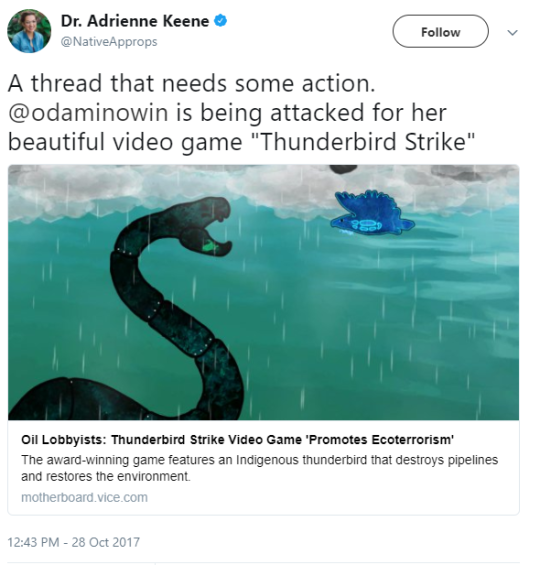
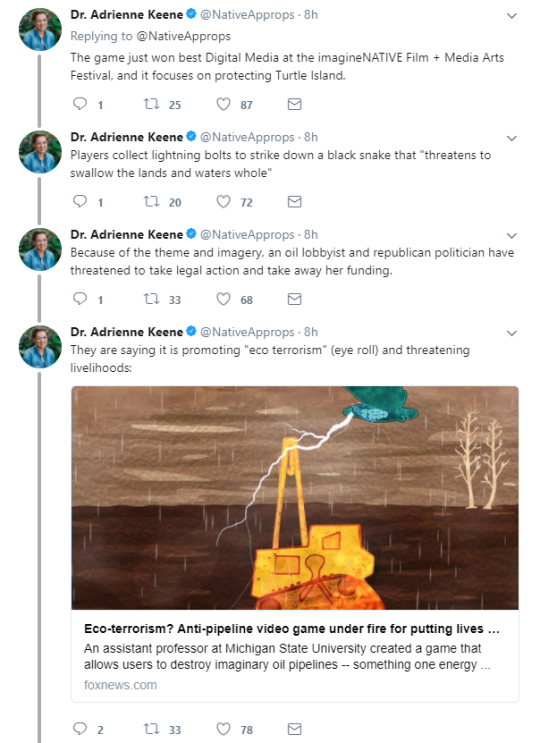
In Thunderbird Strike, a new side-scrolling game that launches at the ImagineNATIVEfestival this week in Toronto, players can control a thunderbird—a symbol in several Indigenous cultures—that destroys as much of the oil industry’s machinery and pipelines as it possibly can. And it’s so satisfying.
The game was created by Elizabeth LaPensée, an Anishinaabe, Métis, and Irish games developer, and assistant professor of media and information at Michigan State University. She told me in an interview that she wanted to create a game where Indigenous players could reclaim some agency around oil pipelines, even if through a video game.
“Especially when we’re talking in the context of pipelines, and the oil industry, there are some wins we can have. But ultimately protectors will be pushed out and the processes are going to move forward. It’s happening with mining and it’s happening with pipelines,” LaPensée told me over the phone.
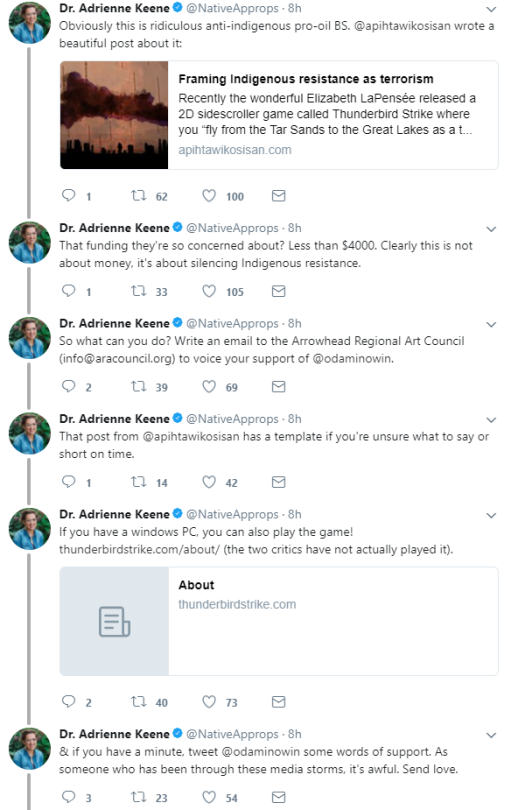
The creator of this game is getting attacked and defamed by oil lobbyists and racists
(and let’s be honest, the venn diagram circle of “oil lobbyists” is just a small circle in the larger circle of “racists”) and could really use support and advocacy:
necromancer: RISE.
necromancer: RISE. RISE UP.
necromancer: RISE BEFORE ME
necromancer: RISE MY CREATION
bread: *does nothing*
necromancer: fuck i forgot the yeast
Broadcaster Duncan Garner has called Taika Waititi “treasonous” for speaking his mind on New Zealand’s environmental woes, concerning suicide rate and lack of affordable housing.
Waititi, this year’s New Zealander of the Year and director of the soon-to-be-released Thor: Ragnarok, told Marae he wasn’t proud to be a Kiwi when so many problems appeared to be ignored.
Stuff columnist Duncan Garner delivered a punchy editorial against the director on The AM Show Thursday morning. He called Waititi “treasonous” for voicing his concerns on the nation’s state of affairs.
“He was New Zealander of the year, this year 2017, so he’s an ambassador for New Zealand now … you cannot be this treasonous about your own country. You cannot say you’re not proud to be a New Zealander if you’re the New Zealander of the year,” Garner said.
Waititi said New Zealand’s waterways were “poisoned”.
“I’m not very proud of coming from a place which everyone overseas thinks is this clean, green country,” he said.
Garner argued that the criticism was wrong because he thought only some waterways were “dodgy”, not all of them. “Wrong,” Garner declared. “It’s not all poison. Some of them, some of them are pretty dodgy I agree.”
In the Marae interview, Waititi had listed a string of problems he saw with New Zealand, one of which was the state of our rivers. Garner agreed with all the other issues but still found issue with Waititi calling them out.
“He’s right on many things. Yes, we’ve got issues with our housing and mental health and depression and suicide numbers,” the journalist said. “I get all that.”
“I’ve got a problem with it, because you have to be accurate as
New Zealander of the Year, and I reckon he’s thrown New Zealand under the bus,” the former political editor concluded.
So… is he not allowed to address issues he has with the country? We all have the right to, so why is he getting all up in arms about him, just because he’s ‘New Zealander of the Year’ when he’s exercising his right to speak up about stuff lots of people, especially the tourism industry here, try to sweep under the rug in terms of environmental issues? Of course it’s completely fine for him to say that he isn’t proud of the country due to the state of it, calling out lies and issues and whatnot. Using his position in society to bring more attention to issues isn’t really throwing us under the bus in my opinion because it just shows things we can try work on to better our image so we don’t spout lies when we say stuff like ‘all our waterways are clean’. How in the world is that ‘treasonous’ to state? Shit, Pissy Baby Duncan even agrees with most of what he said, but hates that it was said… doesn’t that mean if Duncan himself said it he would have to slap that label onto himself? He fucking wouldn’t. Duncan Garner, you’re a fucking idiot.
The Thor: Ragnarok director took to Twitter this evening to ‘apologise’ for comments he made in an interview with Marae regarding New Zealand’s waterways, suicide rates and child poverty, among other things.
“I’m sorry NZ!” he tweeted. “I wasn’t thinking and spoke in haste. I forgot to mention domestic violence, sexism, homophobia, and racism. My bad!”
Waititi later followed that up with several more tweets, including one poking fun at the fact that while he also criticised New Zealand’s high rates of teen suicide, depression, child poverty and abuse, it was his description of our waterways as “poisoned” that seemed to have drawn the most ire from Garner.
Me: NZ has highest teen suicide rates, depression, child poverty/abuse, & our waterways are poisoned.
 knitting in the dark